


Mostrar mensagens com a etiqueta Chris Cooper. Mostrar todas as mensagens
Mostrar mensagens com a etiqueta Chris Cooper. Mostrar todas as mensagens
 “I've been around horses, but I certainly wouldn't call myself a horseman by any means. It's a combination of being very aware of them, and not trusting them.”
Cooper was born in Kansas City, Missouri to Mary Ann, a homemaker, and Charles Cooper, who served as a doctor in the United States Air Force and operated a cattle ranch. He has an older brother, Chuck, and grew up as a "blue-collar cowpoke" in Houston, Texas and Kansas City. Cooper attended Stephens College and the University of Missouri–Columbia, where he dual majored in the school of agriculture and the school of drama. After graduation, Cooper moved to New York City to pursue his career.
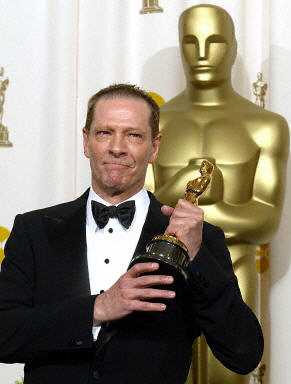
Cooper's early performances include Matewan, the 1987 picture by John Sayles, and the 1989 miniseries Lonesome Dove. Some of his standout performances include Money Train as a psychotic pyromaniac who terrifies toll booth operators, Lone Star in a rare leading role as a Texas sheriff charged with solving a decades old case, and American Beauty as a homophobic Colonel of the United States Marine Corps. While many felt that Cooper should have been nominated for an Academy Award for Best Supporting Actor in that film, he eventually won an Academy Award and a Golden Globe Award in 2003 for playing the role of John Laroche in Adaptation. Cooper also appeared in The Bourne Identity in 2001 as a ruthless CIA special ops director, a role he reprised (in flashbacks) in The Bourne Supremacy.
Cooper was busy in 2005, having appeared in three well-received and acclaimed films: Jarhead (reuniting him with American Beauty director Sam Mendes and October Sky actor Jake Gyllenhaal), Capote and Syriana. His most recent role is in the thriller Breach, playing real-life FBI operative and spy Robert Hanssen; Cooper has said that he believes Breach is the "first studio film where they've considered me the lead" actor.
Cooper will next appear as a government agent in dangerous territory alongside Jamie Foxx, Jennifer Garner and Jason Bateman in the action thriller The Kingdom.
 “I have to go right home. I know how to finish the script now. It ends with Kaufman driving home after his lunch with Amelia, thinking he knows how to finish the script. Shit, that's voice-over. McKee would not approve. How else can I show his thoughts? I don't know. Oh, who cares what McKee says? It feels right. Conclusive. I wonder who's gonna play me. Someone not too fat. I liked that Gerard Depardieu, but can he not do the accent? Anyway, it's done. And that's something. So: "Kaufman drives off from his encounter with Amelia, filled for the first time with hope. ‘I like this. This is good’.”
After the phenomenal success of Being John Malkovich in 1999, screenwriter Charlie Kaufman was commissioned to adapt Susan Orlean's non-fiction novel, "The Orchid Thief," for the screen. However, it didn't take long for him to realise that Orlean's book was basically unfilmable, its sprawling and ponderous story lacking any clear structure or coherence. After some months of struggling vainly to write a screenplay from the novel, Kaufman's script inexplicably became the story of a writer's effort to adapt an inadaptable novel. Kaufman's completed script was presented to his financial backers with some trepidation, but they reportedly loved it so much that they decided to abandon the original project and film his screenplay. Spike Jonze, who had also directed "Being John Malkovich," returned to direct "Adaptation," the quirky, twisting, self-referential film that received almost universal critical acclaim.
Much like Federico Fellini's classic 1963 film, '8½,' from which Kaufman almost certainly drew inspiration, 'Adaptation' tells the story of its own creation. Nicolas Cage plays Charlie Kaufman, the lonely, insecure and socially awkward screenwriter who is hired to adapt "The Orchid Thief," written by Susan Orlean, who is portrayed by Meryl Streep. The novel itself concerns the story of John Laroche (played by Chris Cooper), a smug plant dealer who was arrested in 1994 for poaching rare orchids in the Fakahatchee Strand State Preserve. As Kaufman struggles to write the script, his troubles are compounded by the presence of his twin brother, Donald (also played by Nicolas Cage), who is Charlie's exact opposite: reckless, carefree, over-confident and perhaps even a bit dim.
The script for 'Adaptation' darts back and forth between different moments in time, either chronicling Kaufman's screen writing exploits or Orlean's experiences in writing her novel. At several points in the story, more dramatic flashbacks take place: we see Charles Darwin first penning his theories of evolution and adaptation, a brief history of the grim activity of orchid-hunting, and, in one particularly impressive sequence, we are taken back billions of years to the beginning of life, to trace how Charlie Kaufman came to be here today. Though purportedly based on a true story, the events of the film are highly fictionalised, and the story always treads a fine line with reality, with the audience never certain of whether or not an event is real (in the context of the film) or merely a creation of Charlie's (or even Donald's) imagination.
Though Charlie Kaufman (the true-life writer, not the character) often receives most of the accolades for the film, it is director Spike Jonze who shared the vision to execute "Adaptation" on screen. His approach to film-making is always original and daring, never tentative of trying something unique for the sake of the film, even if it may offend the tastes of an audience that is unaccustomed to anything other than the mundane clichés of the modern movies that are churned out daily by Hollywood studios. If this wasn't completely obvious after the weird, twisted, fascinating 'Being John Malkovich,' then 'Adaptation' put any lingering doubts to rest. The director, who started his career directing music videos, seems to share a singular understanding with Kaufman the writer, and a mutual agreement on what the film is actually trying to say.
In addition to a clever story, 'Adaptation' contains some of the finest acting of the 2000s, presenting an excellent selection of seasoned talents at the top of their games. In arguably the greatest role(s) of his career, Nicolas Cage is phenomenal as both Charlie and Donald Kaufman, twin brothers whose complete polarity is startlingly evident in the execution of their respective film scripts. Charlie, whilst writing his adaptation, is determined to avoid the usual clichés and construct a film without any conventional plot, to write a movie "simply about flowers." Donald, however, blissfully oblivious to his own unoriginality as a writer, churns out a hackneyed psychological thriller, entitled 'The 3,' in which the serial killer, his female hostage and the cop are the very same person. In an ironic twist of fate, Donald's trite treatment is hailed as a masterpiece, adding further to the inadequacy already being felt by his disillusioned brother.
Cage is excellent, and often absolutely hilarious, as both characters, giving each brother a distinct attitude and personality, so that it is possible to tell immediately which is which even though their physical appearance is exactly the same. Meryl Streep is equally excellent as Susan Orlean, the journalist for "The New Yorker" who researches John Laroche and endeavours to catch a glimpse of the famed and very rare Ghost Orchid, if only to understand what it feels like to be passionate about something. Chris Cooper arguably steals the entire show as the charismatic and enigmatic Laroche, whose tragedy-afflicted life is dedicated to mastering numerous obscure fields (such as orchid-collecting, or fish-collecting), each of which is sporadically cast aside and permanently forgotten as soon as he feels it's time to move on, to "adapt" to another hobby. From four Academy Award nominations, only Cooper walked away with a statue. Notably, Charlie Kaufman's screenplay was also nominated for an Oscar.
In a nutshell, 'Adaptation' is all about failure. Charlie Kaufman is absolutely determined to write an original script, without cramming in "sex or guns or car chases or characters learning profound life lessons or growing or coming to like each other or overcoming obstacles to succeed in the end." However, after he eventually asks Donald to complete the script for him, it descends into exactly that. A visit to a screen-writing seminar by Robert McKee (memorably played by Brian Cox) – who is famous for warning strongly against Deus Ex Machina – is used as exactly that. Charlie Kaufman the character fails miserably in writing his script, but, ironically, Charlie Kaufman the writer succeeds ever so magnificently… 9/10
 “They called it the car for every man. Henry Ford himself called it a car for the great multitude. It was functional, and simple, like your sewing machine, or your cast-iron stove. You could learn to drive it in less than a day. And you could get any color you wanted...”
The story of Seabiscuit is actually the tale of four long shots: Charles Howard (Jeff Bridges), a wealthy self-made man and natural salesmen who's suffered both personal and financial loss through the Depression, Tom Smith (Chris Cooper), an aging horse trainer unsure of his place in the world with the ending of the frontier, Red Pollard (Tobey Maguire), a short-tempered jockey with various handicaps against him, and Seabiscuit, an undersized mustang whose been mistreated his whole life.
It's the Depression, and times are hard on everyone. The assembly line philosophy of business is starting to squelch independent spirit and people are looking for anything to help escape the dreary day-to-day of life. During this maelstrom of hopelessness, horse racing quickly gathers favoritism among those wishing to witness a spectacle in otherwise bleak times. It's under these circumstances that the film's four main parties come together. Howard, seeking a new business venture in horse racing, hires Smith as his horse trainer and Pollard as his jockey, and upon Smith's insistence, purchases the ill-tempered Seabiscuit.
It's not long before Seabiscuit becomes the “little horse who could”, gaining favor among the sporting fans on the West Coast. But despite the popularity the mustang and his team gains, they are seen as just a cheap novelty by the East Coast horse racing elite, led by Samuel Riddle, owner of the 1937 Triple Crown Winner War Admiral. This mushrooms into a media circus as Howard tries to gain public favor in order to force Riddle to put his money where his mouth is.
The story should have felt cliched and by-the-numbers, but a funny thing happened: the film makers took a nearly forgotten moment in time and managed to invest it with immediacy and suspense. The near mythic meeting of Seabiscuit and War Admiral on November 1, 1938 at Pimlico is an extension of the movie's overall theme; Seabiscuit, the representative of underdog hopes and pioneering dreams, and War Admiral, the recipient of champion breeding and training, a product of assembly line thinking.
Bridges and Maguire give spirited performances, with their characters forming a father and son bond that both men desperately needed. Cooper can give this kind of performance in his sleep, bringing a quiet, stoic depth to the Smith character. The supporting cast is top drawer as well, especially William H. Macy as “Tick Tock” McGlaughlin, the initially skeptical radio sports commentor who becomes a full blown Seabiscuit supporter.
Director Gary Ross captures the time period marvelously, with broken human beings slowly recapturing their dignity and pride against a landscape of barren ruin. The conflicts are fought not on traditional battlefields, but atop magnificent beasts along a circular track, and Ross wisely utilizes this metaphor to full effect.
Recommendable and enjoyable sports movie. Not exactly an intense and gripping drama, but worth a watch… 8/10

“A story: A man fires a rifle for many years, and he goes to war. And afterward he turns the rifle in at the armory, and he believes he's finished with the rifle. But no matter what else he might do with his hands, love a woman, build a house, change his son's diaper; his hands remember the rifle.”
The first thing that may surprise audiences is that this is not necessarily an anti-war piece. Mendes and screenwriter William Broyles, Jr. have been careful not to make this film narrow in view. Instead, by focusing on the psychological turmoil of one soldier, Anthony Swofford (Jake Gyllenhaal), Jarhead is able to speak specifically about this man's experience and how it relates to those around him.
Mendes drenches the screen with sights and sounds that literally envelope us in the horrors of warfare. These explosions of vision and noise are counterbalanced, however, with scenes of great sadness and warmth. One scene that comes quickly to mind is a boot camp drill where the young soldiers are crawling under barbed wire--the sound design is such that we hear every character screaming or grunting as the gunshots zoom overhead. But then, the scene changes. An event occurs that allows Mendes to silence all of the violence and machismo of war. Amongst the hysteria of the scene, one of the soldiers freaks out and a gunshot is discharged. Mendes lets the camera witness this as if it hadn't expected it to occur. The characters are in shock, and so is the audience. It's just one of many powerful moments where Mendes changes from loud, visceral warfare to quiet, poignant moments.
Not that there's much warfare here. In fact, the lack of warfare becomes a theme for this film. Peter Sarsgaard, in a great performance, reaches his breaking point during the final third of the film, and it's a riveting moment where the lack of warfare has finally made him explode. His performance is very strong throughout, but it is not until the second half of the film when he finally gets the chance to break loose.
Jamie Foxx surprised me here. His character is so well-conceived, and works wonderfully as the counterpoint to the Gyllenhaal character. Foxx plays his scenes confidently, but also with touches of gravitas that, even in Ray, we haven't seen before. The scene that we get a glimpse of at the end of the trailer is wonderful in its fullness, and helps Mendes' film give us a well-rounded opinion of Swofford's opinions on the war. Foxx is by turns hilarious and profound.
And then there was Jake Gyllenhaal. Wow. This is an incredible performance. Watch for a dozen scenes where he literally explodes off the screen, but how he also juggles the quieter moments with great aplomb. What makes Swofford an intriguing character is that he doesn't always get our sympathy; or, for that matter, want our sympathy. He is scarred by war and his family and the life he left behind, and he is just looking for a way to get out of the sand and the sexual dysfunction of war and the lack of gunfire. Gyllenhaal captivates our attention from his very first glimpse, and his voice-over performance laces the film with irony and melancholy. He is a great physical presence in the film as well. I could cite more than a few dynamic scenes that he performs masterfully in, but I'll just mention one. Swofford points a rifle at a fellow soldier after a failed night watch, and then turns the rifle on himself, asking the fellow soldier to discard a round into his mouth. It's an indescribably painful scene to watch, but it's also an example of Gyllenhaal's brave and honest portrayal of this bruised man.
Some people have begun to write about this film as lacking structure or story, and in saying that I'm afraid they may have missed the point. This is a story about ambiguity of self, about dislocation, about ambivalence to war and love, about sexual frustration. In these terms, I think Mendes & Co. have found the perfect way to cinematically allow us to experience the same sort of blank complexity that Swofford must have felt.
As Swof's friend Troy says at one point, "Fuck politics. We're here. All the rest is bullshit". Which is all the movie is about, really. This is what happened. Take it or leave it. 9/10
The first thing that may surprise audiences is that this is not necessarily an anti-war piece. Mendes and screenwriter William Broyles, Jr. have been careful not to make this film narrow in view. Instead, by focusing on the psychological turmoil of one soldier, Anthony Swofford (Jake Gyllenhaal), Jarhead is able to speak specifically about this man's experience and how it relates to those around him.
Mendes drenches the screen with sights and sounds that literally envelope us in the horrors of warfare. These explosions of vision and noise are counterbalanced, however, with scenes of great sadness and warmth. One scene that comes quickly to mind is a boot camp drill where the young soldiers are crawling under barbed wire--the sound design is such that we hear every character screaming or grunting as the gunshots zoom overhead. But then, the scene changes. An event occurs that allows Mendes to silence all of the violence and machismo of war. Amongst the hysteria of the scene, one of the soldiers freaks out and a gunshot is discharged. Mendes lets the camera witness this as if it hadn't expected it to occur. The characters are in shock, and so is the audience. It's just one of many powerful moments where Mendes changes from loud, visceral warfare to quiet, poignant moments.
Not that there's much warfare here. In fact, the lack of warfare becomes a theme for this film. Peter Sarsgaard, in a great performance, reaches his breaking point during the final third of the film, and it's a riveting moment where the lack of warfare has finally made him explode. His performance is very strong throughout, but it is not until the second half of the film when he finally gets the chance to break loose.
Jamie Foxx surprised me here. His character is so well-conceived, and works wonderfully as the counterpoint to the Gyllenhaal character. Foxx plays his scenes confidently, but also with touches of gravitas that, even in Ray, we haven't seen before. The scene that we get a glimpse of at the end of the trailer is wonderful in its fullness, and helps Mendes' film give us a well-rounded opinion of Swofford's opinions on the war. Foxx is by turns hilarious and profound.
And then there was Jake Gyllenhaal. Wow. This is an incredible performance. Watch for a dozen scenes where he literally explodes off the screen, but how he also juggles the quieter moments with great aplomb. What makes Swofford an intriguing character is that he doesn't always get our sympathy; or, for that matter, want our sympathy. He is scarred by war and his family and the life he left behind, and he is just looking for a way to get out of the sand and the sexual dysfunction of war and the lack of gunfire. Gyllenhaal captivates our attention from his very first glimpse, and his voice-over performance laces the film with irony and melancholy. He is a great physical presence in the film as well. I could cite more than a few dynamic scenes that he performs masterfully in, but I'll just mention one. Swofford points a rifle at a fellow soldier after a failed night watch, and then turns the rifle on himself, asking the fellow soldier to discard a round into his mouth. It's an indescribably painful scene to watch, but it's also an example of Gyllenhaal's brave and honest portrayal of this bruised man.
Some people have begun to write about this film as lacking structure or story, and in saying that I'm afraid they may have missed the point. This is a story about ambiguity of self, about dislocation, about ambivalence to war and love, about sexual frustration. In these terms, I think Mendes & Co. have found the perfect way to cinematically allow us to experience the same sort of blank complexity that Swofford must have felt.
As Swof's friend Troy says at one point, "Fuck politics. We're here. All the rest is bullshit". Which is all the movie is about, really. This is what happened. Take it or leave it. 9/10
Mensagens antigas Página inicial
Subscribe to:
Mensagens (Atom)