


Mostrar mensagens com a etiqueta s Odyssey. Mostrar todas as mensagens
Mostrar mensagens com a etiqueta s Odyssey. Mostrar todas as mensagens
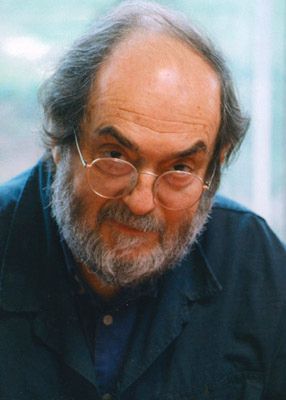 “A film is - or should be - more like music than like fiction. It should be a progression of moods and feelings. The theme, what's behind the emotion, the meaning, all that comes later.”
Stanley Kubrick was born on July 26, 1928 at the Lying-In Hospital in Manhattan, the first of two children born to Jacques Leonard Kubrick and his wife Gertrude. At Stanley's birth, the Kubricks lived in an apartment at 2160 Clinton Avenue in The Bronx. Kubrick's father taught him chess at age twelve; the game remained a life-long obsession. When Stanley was thirteen years old, Jacques Kubrick bought him a Graflex camera, triggering Kubrick's fascination with still photography. He was also interested in jazz, attempting a brief career as a drummer. Kubrick was a poor student with a meager 67 grade average. On graduation from high school in 1945, when soldiers returning from the Second World War crowded colleges, his poor grades eliminated hopes of higher education. Later in life, Kubrick spoke disdainfully of his education and of education in general, maintaining that nothing about school interested him.
In high school, he was chosen official school photographer for a year. Eventually, he sought jobs on his own, and by graduation time had sold a photographic series to Look magazine in NYC. Kubrick supplemented his income playing “chess for quarters” in Washington Square Park and in various Manhattan chess clubs. He registered for night school at the City College to improve his grade-point average. He worked as a freelance photographer for Look, becoming an apprentice photographer in 1946, and later a full-time staff photographer.
During his Look magazine years, on May 29, 1948, Kubrick married Toba Metz and they lived in Greenwich Village, divorcing in 1951. It was then that Kubrick began frequenting film screenings at the Museum of Modern Art and in the cinemas of New York City. He was particularly inspired by the complex, fluid camera movement of Max Ophüls, whose films influenced Kubrick's later visual style.
Many early-period (1945–1950) photographs by Kubrick were published in the book “Drama and Shadows” (2005, Phaidon Press). In 1951, Kubrick's friend, Alex Singer, persuaded him to start making short documentaries for the March of Time, a provider of newsreels to cinemas. Kubrick agreed, and independently financed Day of the Fight (1951). Although the distributor went out of business that year, Kubrick sold Day of the Fight to RKO Pictures for a profit of one hundred dollars. Kubrick quit his job at Look magazine and began working on his second short documentary, Flying Padre (1951), funded by RKO. A third film, The Seafarers (1953), Kubrick's first color film, was a 30-minute promotional short film for the Seafarers' International Union. These three films constitute Kubrick's only surviving work in the documentary genre.
Kubrick's focus on narrative feature films began with Fear and Desire (1953). Fear and Desire is about a team of soldiers behind enemy lines in a fictional war. In the finale, the men see that the faces of their enemy are identical to their own (the same cast play all the characters). Kubrick and wife Toba Metz were the only crew on the film, which was written by Kubrick's friend Howard Sackler, later a successful playwright. Fear and Desire garnered respectable reviews, but failed commercially. In later life, Kubrick was embarrassed by the film, dismissing it as amateur, refusing Fear and Desire's projection in retrospectives and public screenings on establishing himself as a major filmmaker. It is often said that Kubrick bought every print of the film which he could, to keep people from seeing it.
Kubrick's marriage to high school sweetheart Toba ended during the making of Fear and Desire. He met his second wife, Austrian-born dancer and theatrical designer, Ruth Sobotka, in 1952. They lived together in from 1952–1955 until their marriage on January 15, 1955; the couple later moved to Hollywood during the summer of 1955. Sobotka, who made a cameo appearance in Kubrick's next film, Killer's Kiss (1954), also served as art director on The Killing (1956). Like Fear and Desire, Killer's Kiss is a short feature film, with a running time of slightly more than an hour, of limited commercial and critical success. The film is about a young, heavyweight boxer at the end of his career who is involved with organized crime. Both Fear and Desire and Killer's Kiss were privately funded by Kubrick's family and friends.
Alex Singer introduced Kubrick to a producer named James B. Harris, and the two became lifelong friends. Their business partnership, Harris-Kubrick Productions, financed Kubrick's next three films. They bought the rights to the Lionel White novel Clean Break, which Kubrick and co-screenwriter Jim Thompson turned into a story about a race track robbery gone wrong. Starring Sterling Hayden, The Killing was Kubrick's first film with a professional cast and crew. The film made impressive use of non-linear time, unusual in 1950s cinema, and, though financially unsuccessful, was Kubrick's first critically successful film. The widespread admiration for The Killing brought Harris-Kubrick Productions to the attention of Metro-Goldwyn-Mayer. The studio offered them its massive collection of copyrighted stories from which to choose their next project. Eventually, they chose The Burning Secret by Austrian writer Stefan Zweig. Kubrick wrote a screenplay with Calder Willingham, but the deal collapsed before the film got properly underway.
On returning to the United States, Kubrick worked for six months on the Marlon Brando vehicle One-Eyed Jacks (1961). Later, Kubrick claimed Brando forced him from the film, because Brando wanted to direct it himself. Kubrick languished working on unproduced screenplays until Kirk Douglas asked him to assume direction of Spartacus (1960) from Anthony Mann who, two weeks into shooting, was fired by the studio because he lacked. Based upon the true story of a doomed uprising of Roman slaves, Spartacus established Stanley Kubrick as a major director. The production, however, was difficult; creative differences arose between Kubrick and Douglas, the star and producer of the film. Frustrated by lack of creative control, Kubrick later largely disowned its authorship. The Douglas-Kubrick creative control battles destroyed their work relationship from Paths of Glory. Years later, Kirk Douglas referred to Stanley Kubrick as “a talented shit”. Spartacus was a major critical and commercial success, but its embattled production convinced Kubrick to find ways of working with Hollywood financing while remaining independent of its production system. Kubrick referred to Hollywood production as “film by fiat, film by frenzy”, and this reasoning was behind Kubrick's moving to England in 1962.
In 1962, Kubrick moved to England to film Lolita, and resided there for the rest of his life. Unsurprisingly, Lolita was Kubrick's first major controversy. The book by Vladimir Nabokov, dealing with an affair between a middle-aged pedophile and a twelve-year-old girl, already was notorious when Kubrick embarked on the project, however it was also steadily achieving popularity; eventually, the difficult subject matter was mocked in the film's tagline, perhaps to gain attention: “How did they ever make a film of Lolita?” Nabokov wrote a three-hundred page screenplay for Kubrick, which the director abandoned; a second draft by Nabokov, roughly half the length of its first, was revamped by Kubrick into the final screenplay. Despite changing Lolita's age from twelve years to fourteen years, which was a more acceptable age for commercial appeal at the time, several scenes in the final film had to be re-edited to allow the film's release. The resulting film toned down what were considered the novel's more perverse aspects, leaving much to the viewer's imagination, some viewers have even wondered whether Humbert and Lolita actually embarked on a sexual affair, as most of their relationship, sexually, is implied and suggested. Later, Kubrick commented that, had he known the severity of the censorship, he probably would not have made the film. However, Kubrick always spoke highly of James Mason, who portrayed Humbert in the film, identifying him as one of the actors with whom he most enjoyed working. Lolita's release in 1962 was surrounded by immense hype, which was responsible for the box office success at the time; it was also given an "Adults Only" rating, since ratings for film and literature were not applicable at the time of Lolita's release. Critical reception for the film was mixed, many praising it for its daring subject, others surprised by the lack of intimacy between Lolita and Humbert. The film received an Academy Award nomination for Best Writing of an Adapted Screenplay, and Sue Lyon, who played the title role, won a Golden Globe for Best Newcomer Actress.
Kubrick's next film, Dr. Strangelove or: How I Learned to Stop Worrying and Love the Bomb (1964), became a cult film. The screenplay - based upon the novel Red Alert, by ex-RAF flight lieutenant Peter George - was co-written by Kubrick, George, and American satirist Terry Southern. Dr. Strangelove is often considered a masterpiece of black humor. While Red Alert is a serious, cautionary tale of accidental atomic war for Cold War-era readers, Dr. Strangelove accidentally evolved into what Kubrick called a "nightmare comedy." Originally intended as a thriller, Kubrick found the conditions leading to nuclear war so absurd that the story became dark and funny rather than thrilling; Kubrick reconceived it as comedy, recruiting Terry Southern for the required anarchic irony. Peter Sellers, memorable as 'Clare Quilty' in Lolita, was hired to simultaneously play four roles in Dr. Strangelove. Eventually, Sellers played three, due to an injured leg and difficulty in mastering the Texan accent of bomber pilot Major "King" Kong. Later, Kubrick called Sellers "amazing," but lamented that his energy rarely lasted beyond two or three takes. To capture the actor's limited energy, Kubrick set up two cameras to film Sellers's improvisation. Strangelove often is cited as one of Sellers's best films, and proof of his comic genius. Kubrick's decision to film a Cold War thriller as a black comedy was a daring artistic risk that paid off for him and Columbia Pictures. Coincidentally, that same year, Columbia Studios released the dramatic nuclear war thriller Fail-Safe. Its close similarity with Dr Strangelove prompted Kubrick to consider suing the makers of that film, but he decided against it. In belittling the sacrosanct norms of the political culture of mutually assured destruction as the squabbling of intellectual children, Dr. Strangelove foreshadowed the cultural upheavals of the late 1960s and was enormously successful with the nascent American counter-culture. Dr. Strangelove earned four Academy Award nominations (including Best Picture and Best Director) and the New York Film Critics' Best Director award. Kubrick's successful Dr. Strangelove persuaded the studios that he was an auteur who could be trusted to deliver popular films despite his unusual ideas.
Kubrick spent five years developing his next film, 2001: A Space Odyssey (1968), which was photographed in Super Panavision 70. Kubrick co-wrote the screenplay with science fiction writer Sir Arthur C. Clarke, expanding on Clarke's short story "The Sentinel". The screenplay and the novel were written simultaneously. The screenplay is credited to Kubrick and Clarke, while the novel, published in tandem with the film's release, is credited only to Clarke. The novel and the film deviate substantially from each other, with the novel explaining a great deal of what the film leaves deliberately ambiguous. Clarke and Kubrick later spoke highly of one another. Incidentally, Clarke's follow up, 2010: Odyssey Two, follows the events of the movie version of 2001, as opposed to the novel version. This is likely due to the cultural impact of Kubrick's film. The film's special effects, overseen by Kubrick and engineered by special effects pioneer Douglas Trumbull, proved ground-breaking and inspired many of the special effects-driven films which were to follow the success of 2001. Manufacturing companies were consulted as to what the design of both special-purpose and everyday objects would look like in the future. At the time of the movie's release, Arthur C. Clarke predicted that a generation of engineers would design real spacecraft based upon 2001 "even if it isn't the best way to do it". Despite nominations in the directing, writing, and producing categories, the only Academy Award Kubrick ever received was for supervising the special effects of 2001: A Space Odyssey. Artistically, 2001: A Space Odyssey was a radical departure from Kubrick's previous films. It contains only 45 minutes of dialogue, over a running time of over two and a half hours (150 minutes). The dialogue is largely superfluous to the images and music. Nevertheless it outlines the 'story' while presenting mankind as dissociated from itself and its surroundings. After this film, Kubrick would never experiment so radically with special effects or narrative form, but the calculated ambiguity of his films remained a trademark for the rest of his career. Despite being an unorthodox science fiction film, 2001 was an enormous commercial success and became a pop culture phenomenon. However, the film was not an immediate smash. Were it not for a six-week exhibition contract, the film might not have had enough time in cinemas to have benefited from building word-of-mouth popularity. The film's ticket sales were low during the first two weeks of its release, and it was nearly withdrawn from theaters. Actor Jack Nicholson claims that Kubrick told him that 217 people walked out of the exhibitor's screening, including the studio head. Arthur C. Clarke has said that an MGM executive commented on the screening by saying: "Well, that's the end of Stanley Kubrick." Initial critical reaction was also extremely hostile, with critics attacking the film's lack of dialogue, its slow pacing, and seemingly impenetrable storyline. The film's only initial defender was Penelope Gilliat, who called it "some kind of a great film". Following the film's success, however, many critics later revised their opinions. Audiences slowly embraced the film, especially the 1960s counterculture audience, who loved the movie's "Star Gate" sequence, a seemingly psychedelic journey to the infinite reaches of the cosmos. Younger moviegoers often saw the film many times over, resulting in a cult following of repeat viewers. Supposedly, if one were to ingest LSD at the beginning of the movie, the "Star Gate" sequence would start at roughly the same time that the drug was in full effect. This phenomenon prompted the film's distributors to add an LSD-allusive tagline ("The Ultimate Trip") to the movie's advertising poster. Paradoxically, Kubrick won total creative control from Hollywood by succeeding with one of the most thematically "difficult" films ever to win wide commercial release. 2001: A Space Odyssey is likely Kubrick's most famous and influential film. Steven Spielberg called it his generation's big bang, focusing its attention upon the Soviet-American space race. The special effects techniques Kubrick pioneered were later developed by Ridley Scott and George Lucas for films such as Alien and Star Wars. 2001 is particularly notable as one of the few films realistically presenting travel in outer space: the scenes in outer space are silent; weightlessness is constant, with characters strapped in place; when characters wear pressure suits, only their breathing is audible.
After 2001, Kubrick sought a project which he could quickly film with a small budget. He found it in A Clockwork Orange (1971). His film version is a dark, shocking exploration of violence in human society. Based upon the famous novel by Anthony Burgess, the film is the story of a teenage hooligan, Alex, (Malcolm McDowell), who gleefully torments, beats, robs, and rapes without conscience or remorse. Finally imprisoned, Alex undergoes psychiatric aversion treatment to be cured of his instinctively reflexive violence. This conditions him physically unable to act violently, yet also renders him helpless and incapable of moral choice, resulting in a consequently brutal come-uppance at the hands of his victims. Kubrick photographed A Clockwork Orange quickly and almost entirely on location in and around London. Despite the low-tech nature of the film, when compared to 2001: A Space Odyssey, Kubrick was highly innovative, like throwing a camera from a rooftop to achieve the desired viewer disorientation. For the score, Kubrick had electronic music composer Wendy Carlos adapt famous classical works such as Beethoven's Ninth Symphony for the Moog synthesizer. The film was extremely controversial because of its explicitly depicted teenage gang-rape and violence. Released the same year as Sam Peckinpah's Straw Dogs and Don Siegel's Dirty Harry, the three films sparked ferocious debate in the media about the social effects of cinematic violence. The controversy was exacerbated when copycat violence was committed in England, by criminals wearing the same costumes as characters in A Clockwork Orange. When Kubrick and family were threatened with death, resulting from the social controversy, he took the unusual step of removing the film from circulation in Britain. The film was not released again in the United Kingdom until its re-release in 2000, a year after Stanley Kubrick's death. In banning his film in Britain, he showed the unprecedented power he held over his distributor, Warner Brothers. For the remainder of his career he held total control of every aspect of his films, including the marketing and the advertising; such was Warner Brothers' faith in his projects.
Kubrick's next film, released in 1975, was an adaptation of William Makepeace Thackeray's The Luck of Barry Lyndon, also known as Barry Lyndon, a picaresque novel about an 18th century gambler and social climber who slowly insinuates himself to English high society. It would be Kubrick's least-appreciated post-Strangelove film, despite strong acting and Kubrick's innovative cinematography and attention to period detail. Some critics, especially Pauline Kael, one of Kubrick's greatest detractors, found Barry Lyndon a cold, slow-moving, and lifeless film. Its measured pace and length - more than three hours - put off many American critics and audiences. As with most of his films, Barry Lyndon's reputation has grown through the years, particularly among other filmmakers. Director Martin Scorsese cited it as his favorite Kubrick film. Steven Spielberg has praised its "impeccable technique," though, when younger, he famously described it "like going through the Prado without lunch". As in his other films, Kubrick's cinematography and lighting techniques are innovative. Most famously, interior scenes were photographed with a specially-adapted, high-speed still camera lens (originally invented for NASA) allowing many scenes to be lit only with candlelight, creating two-dimensional, diffused light images reminiscent of 18th century painting. Kubrick's blending of music, mise en scene, costume and action set standards for period drama that few other films have matched. The film was nominated for seven Academy Awards and won four, more than any other Kubrick film. Despite this, Barry Lyndon was not a box office success in the US, however, the film found a great audience in Europe, particularly in France.
Kubrick's work pace slowed considerably after Barry Lyndon; he did not make another film until The Shining. Released in 1980, it is an adaptation of Stephen King's popular horror novel. It stars Jack Nicholson and Shelley Duvall in the story of a failed writer who takes a job as an off-season caretaker of the Overlook Hotel, a high-class resort deep in the Colorado mountains. The job demands spending the winter in the isolated hotel. His son, Danny, is gifted with telepathy, called "shining," and has visions of the past and the future. To Danny, the hotel displays increasingly horrible, phantasmagoric images, notably the apparition of two girls murdered years before by their father, the hotel's caretaker. Jack is slowly driven mad by the haunted Overlook Hotel until collapsing into homicidal psychosis, then trying to kill his family with an axe. It was originally thought that the film was shot at The Stanley Hotel in Estes Park, Colorado, however, it was at the Elstree and the Pinewood studios, near London, where the film sets were built. The Overlook Hotel exterior is that of the Timberline Lodge ski resort on Mount Hood, Oregon, U.S.A. Kubrick extensively used the newly-invented Steadicam (a spring-mounted camera support) for smooth movement in enclosed spaces, to convey the haunted hotel's claustrophobic oppression of the family. More than any other of his films, The Shining gave rise to the legend of Kubrick-as-megalomanic-perfectionist. Reportedly, he demanded hundreds of takes of certain scenes, particularly plaguing actress Shelley Duvall. His daughter, Vivian Kubrick, shot a short documentary film of the production. The film opened to mostly negative reviews, but did very well, commercially, with audiences and made Warner Brothers a profit. As with most Kubrick films, subsequent critical reaction reviews the film more favorably. Stephen King was dissatisfied with the movie, calling Kubrick "a man who thinks too much and feels too little". Later, in 1997, King collaborated with Mick Garris to create a television mini-series version of the novel. However, in a later interview on the Bravo channel King admitted that the first time he watched Kubrick's adaptation he found it to be "dreadfully upsetting." Among horror movie fans, The Shining is a classic cult film, often appearing with The Exorcist (1974) and Halloween (1978) at the top of best horror film lists. Some of its images, such as an antique elevator disgorging a tidal wave of blood, are among the most recognizable, widely-known images from any Stanley Kubrick film. The Shining renewed Warner Brothers faith in Kubrick's ability to make artistically satisfying and profitable films after the commercial failure that was Barry Lyndon in the United States.
It was seven years until Kubrick's next film, Full Metal Jacket (1987), an adaptation of Gustav Hasford's Vietnam War novel, The Short-Timers. The film begins at Marine Corps Recruit Depot Parris Island, South Carolina, U.S.A., where Senior Drill Sgt Hartman relentlessly pushes his new men through basic training to transform them from worthless "maggots" to Marine killers. Pvt Pyle, a fat, slow-witted recruit, is unable to cope with the program and slowly cracks under the strain, resulting, on the eve of graduation, in Pvt Pyle's shooting and killing Sgt Hartman before killing himself as he repeats the by-then-familiar Marine mantra: "This is my rifle. There are many like it, but this one is mine…" The scene ends the boot-camp portion of the story. The second half of the film follows Joker, since promoted to sergeant, as he tries to stay sane in Vietnam. As a reporter for the United States Military's newspaper the Stars and Stripes, Joker occupies war's middle ground, using wit and sarcasm to detach himself from the war. Though an American and a member of the United States Marine Corps, he also is a reporter and so is compelled to abide the ethics of the profession. The film then follows an infantry platoon's advance on and through Hue City, decimated by the street fighting of the Tet Offensive. The film climaxes in a battle between Joker's platoon and a sniper hiding in the rubble; she almost kills Joker until his reporter partner shoots and severely injures her. Joker then kills her to put her out of her misery. Filming a Vietnam War film in England was a considerable challenge for Stanley Kubrick and team. Much filming was in the Docklands area of London, with the ruined-city set created by production designer Anton Furst. This helped make the film visually very different from the other, contemporary Vietnam War films Platoon and Hamburger Hill. Instead of being set in the tropical, Southeast-Asian jungle, the second half of the story unfolds in a city, illuminating the urban warfare aspect of a war otherwise perceived as fought exclusively in a jungle. Full Metal Jacket received mixed critical review, but found a reasonably large audience, despite being over-shadowed by Oliver Stone's Platoon.
Stanley Kubrick was a mute presence in Hollywood in the ten-odd years after the release of Full Metal Jacket (1987); many believed that he had retired from film-making. Occasionally, rumours surfaced about possible, new Kubrick projects, including Aryan Papers and A.I. (eventually produced after Kubrick's death, directed by Steven Spielberg). Stanley Kubrick's final film would be Eyes Wide Shut, starring then-married actors Tom Cruise and Nicole Kidman as an upper middle class Manhattan couple on a sexual odyssey. The story of Eyes Wide Shut is based on Arthur Schnitzler's novella Traumnovelle, and follows Dr. William Harford's journey to the sexual underworld of New York City, after his wife, Alice, shatters his faith in her fidelity when she confesses to nearly giving him, and their daughter, up for one night with another man. After trespassing upon the rituals of a sinister, mysterious sexual cult, Dr. Harford thinks twice before seeking sexual revenge against his wife, and learns he and his family might be in danger. The film was in production for more than two years, and two of the main members of the cast, Harvey Keitel and Jennifer Jason Leigh, were replaced in the course of the filming. Although set in New York City, the film was mostly shot in London soundstages, with little location shooting. Because of Kubrick's secrecy about the film, mostly inaccurate rumors abounded about its plot and content.
The film did smashing box-office business, which considerably slowed down in the weeks after the film's release. Eyes Wide Shut, like Lolita and A Clockwork Orange before it, faced censorship before release. In the United States and Canada, digitally manufactured silhouette figures were strategically placed to mask explicit copulation scenes.In 1999, four days after screening a final cut of Eyes Wide Shut for his family, the lead actor and actress, and Warner Brothers executives, the seventy-year-old director Stanley Kubrick died of a heart attack in his sleep. He was buried next to his favorite tree in Childwickbury Manor, Hertfordshire, England, U.K.
 In 1924, theater magnate Marcus Loew had a problem. He'd bought Metro Pictures (founded in 1916) and Goldwyn Pictures (founded in 1917) to provide a steady supply of films for his large theater chain, Loews, Inc. However, these purchases created a need for someone to oversee his new Hollywood operations, since longtime assistant Nicholas Schenck was needed in New York to oversee the theaters.
Loew addressed the situation by buying Mayer Pictures on April 16, 1924. Because of his decade-long success as a producer, Louis B. Mayer was made a vice-president of Loews and head of studio operations in California, with Harry Rapf and the twenty-five year old "boy wonder" Irving Thalberg as heads of production. For decades, MGM's legal name was "Loews, Inc." Originally, the new studio's films were presented in the following manner: Louis B. Mayer presents a Metro-Goldwyn picture, but Mayer soon added his name to the studio. Though Loew's Metro was the dominant partner.
Also inherited from Goldwyn was a runaway production, Ben-Hur, which had been filming in Rome for months without producing much usable film. Mayer took charge of the situation by scrapping most of what had been shot and bringing production back to Culver City. Though Ben-Hur was the most costly film made up to its time, it became MGM's first great public-relations triumph, establishing an image for the company that persisted for years. Also in 1925, MGM passed Universal Studios as the largest studio in Hollywood—a lead it kept for most of the next quarter-century.
Marcus Loew died in 1927, and control of Loews passed to his longtime associate, Nicholas Schenck. Rival mogul William Fox saw an opportunity to expand his empire, and in 1929, with Schenck's assent, bought the Loew family's holdings. However, Mayer and Thalberg were outraged. Despite their high posts in the company, they were not shareholders. Mayer in particular used his political connections to persuade the Justice Department to sue Fox for violating federal antitrust law. During this time, Fox was badly hurt in an automobile accident. By the time he recovered, the stock market crash had virtually wiped out his financial holdings, ending any chance of the Loews merger going through even if the Justice Department had given its blessing. Schenck and Mayer had never gotten along; in fact, Mayer reportedly called his boss "Mr. Skunk" in private. The abortive Fox merger only increased the animosity between them. Schenck blamed Mayer rather than the stock market crash for costing him an instant fortune. The animosity between the two men led to a heated rivalry between the New York and Hollywood sides of the company that lasted over 30 years.
From the outset, MGM tapped into the audience's need for glamour and sophistication. Having inherited few big names from their predecessor companies, Mayer and Thalberg began at once to create and publicize a host of new stars, among them Greta Garbo, John Gilbert and Joan Crawford. The arrival of talking pictures in 1928–29 gave opportunities to other new stars, many of whom would carry MGM through the 1930s: Clark Gable, Jean Harlow, Robert Montgomery and Nelson Eddy among them.
MGM was one of the first studios to experiment with filming in Technicolor. Using the two-color Technicolor process then available, MGM filmed portions of The Uninvited Guest (1924), The Big Parade (1925), and Ben-Hur (1926), among others, in the process. In 1928 MGM released The Viking, the first complete Technicolor feature with sound. MGM's first all-color, "all-talking" sound feature with dialogue was the 1930 musical The Rogue Song. In 1934 MGM introduced the first live-action film made in Technicolor's superior new three-color process, a musical number in the otherwise black and white The Cat and the Fiddle. In animation, MGM purchased the rights in 1930 to distribute a series of cartoons that starred a character named Flip the Frog. The first cartoon in this series (entitled Fiddlesticks) was the first sound cartoon to be produced in two-color Technicolor.
Like its rivals, MGM produced fifty pictures a year. Loew's theaters were mostly located in New York and the northeast, so MGM made films that were sophisticated and polished to cater to an urban audience. As the Depression deepened, MGM could make a claim its rivals could not: it never lost money. It was the only Hollywood studio that continued to pay dividends during the 1930s. MGM stars dominated the box office in the 30's. Norma Shearer (the top star and money maker for the studio), Joan Crawford, and Greta Garbo all reigned as not only the top three figures at the studio but in Hollywood itself. By 1943 all three had left the studio.
Mayer and Irving Thalberg's relationship was lukewarm at best; Thalberg preferred literary works to the crowd-pleasers Mayer wanted. Thalberg, always physically frail, was removed as head of production in 1932. Mayer encouraged other staff producers, among them his son-in-law David O. Selznick, but no one seemed to have the sure touch of Thalberg. As Thalberg fell increasingly ill in 1936, Louis Mayer could now serve as his temporary replacement also. Rumors flew that Thalberg was leaving to set up his own independent company; his early death in 1936, at age thirty-seven, cost MGM dearly. As a result of Thalberg's death, Mayer became head of production as well as studio chief, becoming the first million-dollar executive in American history.
In 1933, MGM began to distribute its second series of cartoons, starring a character named Willie Whopper. MGM's biggest cartoon stars came in the form of the cat-and-mouse duo Tom and Jerry, created by William Hanna and Joseph Barbera in 1940. The Tom and Jerry cartoons won seven Academy Awards between 1943 and 1953.
Increasingly, before and during World War II, Mayer came to rely on his "College of Cardinals" - senior producers who controlled the studio's output. This management-by-committee may explain why MGM seemed to lose its momentum, developing few new stars and relying on the safety of sequels and bland material. After 1940, production was cut from fifty pictures a year to a more manageable twenty-five features per year. It was during this time that MGM released very successful musicals with newly-acquired contract players such as Judy Garland, Fred Astaire, Gene Kelly, and Frank Sinatra, to name just a few. As audiences drifted away after the war, MGM found it difficult to attract audiences. By the late forties, as MGM's profit margins decreased, word came from Schenck in New York: find "a new Thalberg" who could improve quality while paring costs. Mayer thought he had found this savior in Dore Schary, a writer and producer who had had a couple of successful years running RKO.
Gradually cutting loose expensive contract, Schary managed to keep the studio running much as it had through the early 1950s. Under Schary, MGM produced some well-regarded musicals, among them An American in Paris, Singin' in the Rain and The Band Wagon. However, it was a losing fight, as the mass audience preferred to stay home and watch television. In 1954, as a settlement of the government's restraint-of-trade action, U.S. vs. Paramount Pictures, et al., Loews, Inc. gave up control of MGM. It would take another five years before the interlocking arrangements were completely undone, by which time both Loews and MGM were sinking.
As the studio system faded in the late 1950s and 1960s, MGM's prestige faded with it. In 1957 (by coincidence, the year L.B. Mayer died) the studio lost money for the first time in its 34-year history. Cost overruns and the failure of the 1957 big-budget epic Raintree County prompted the studio to release Schary from his contract. Schary's reign at MGM had been marked with few bona-fide hits, but his departure (along with the retirement of Schenck in 1955) left a power vacuum that would prove difficult to fill. By 1960, MGM had released all of its contract players, with many either retiring or moving onto television.
1957 also marked the end of the cartoon era at MGM, as the animation unit was closed due to budget issues. However, there were several major exceptions to this downslide and loss of prestige. In 1956, MGM sold what is now one of its most beloved movies, The Wizard of Oz, to CBS, which scheduled it to be shown in November of that year. In a landmark event, ‘’Oz’’ became the first theatrical film to be shown complete in one evening on prime time television over a major American commercial network. With its second showing on CBS in 1959, The Wizard of Oz became an annual tradition, drawing huge audiences in homes all over the U.S. and earning additional profits for the studio. The studio was all too happy to see Oz become, through television, one of the two or three most famous films MGM has ever made, and one of the few films that nearly everybody in the U.S. has seen at least once.
In 1958, MGM released what is generally considered their last great musical, Arthur Freed's widescreen, color production of Gigi. The film was a box office and critical smash, won nine Academy Awards including Best Picture, and from it came several hit songs. The film was the last MGM musical to win a Best Picture Oscar, an honor that had previously gone to The Broadway Melody (1929), The Great Ziegfeld (1936), and An American in Paris (1951).
In 1959, MGM enjoyed one of its most spectacular successes of later years, with the release of its nearly four hour Technicolor version of Ben-Hur. The film would go on to win 11 Academy Awards, including Best Picture, a record that held until Titanic matched it in 1997 along with "The Lord of the Rings: The Return of the King" in 2003. Ben-Hur was also an immense success both critically and at the box office.
In 1961, MGM resumed releasing new Tom and Jerry shorts, and production moved to Rembrandt Films in Czechoslovakia. In 1963, the production of Tom and Jerry returned to Hollywood under Chuck Jones and his Sib Tower 12 Productions studio. Tom and Jerry folded in 1967. MGM fell into a habit in this period that would eventually sink the studio: an entire year's production schedule relied on the success of one big-budget epic each year. This policy began in 1959, when Ben-Hur was profitable enough to carry the studio through 1960. However, later attempts at big-budget epics failed, among them Cimarron (1960), King of Kings (1961), Four Horsemen of the Apocalypse (1961), and most notoriously, the 1962 remake of Mutiny on the Bounty. One other epic that was a success, however, was the MGM-Cinerama co-production How the West Was Won, with a huge all-star cast. King of Kings, while a commercial and critical flop at the time, has since come to be regarded as a film classic.
As MGM sank (along with the other main-line studios), a series of studio heads came and went, along with a succession of corporate managers, all hoping to bring back the studio's glory days. In 1967, MGM was sold to the Canadian investor Edgar Bronfman. Two years later, an increasingly unprofitable MGM was bought by Nevada millionaire Kirk Kerkorian. What appealed to Kerkorian was MGM's Culver City real estate, and the value of 45 years' worth of glamour associated with the name, which he attached to a Las Vegas hotel and casino. As for film-making, that part of the company was quickly and severely downsized under the supervision of James T. Aubrey, Jr. Aubrey sold off the studio's accumulation of props, furnishings and historical memorabilia, including Dorothy's red slippers from The Wizard of Oz. Through the 1970s studio output slowed considerably - Aubrey preferred four or five medium-budget pictures each year, along with a smattering of low-budget fare. With output cut back so severely, Kerkorian closed MGM's sales and distribution offices in 1973, handing that duty to United Artists. Kerkorian now distanced himself from the operations of the studio, focusing on his casino properties. Another chunk of the back lot was sold in 1974; the last shooting done on the backlot was the introductory material for That's Entertainment! a retrospective documentary that became a surprise hit for the studio. The shoddy look of the famous MGM exteriors and back lots, shown in That's Entertainment! (for instance, the "New York" street), was startling; a studio that had previously had so much glamour and expertise in making big-budget films looked as if it had been reduced to nothing more than the average, low-budget studio. In addition to MGM's fast declining image, the MGM Recording Studios were sold in 1975.
The "Metro-Goldwyn-Mayer" lettering on the studio's logo was changed to reflect their acquisition of UA, now reading "MGM/UA Entertainment Co." - the new name for the company. Following a failed attempt to take over CBS in 1985, the ambitious Georgia-based media entrepreneur Ted Turner bought MGM/UA. But his bankers, concerned about the already heavy debt-load his companies carried, refused to back him, and exactly seventy-four days later, Turner announced he was re-selling most of MGM/UA to Kirk Kerkorian. Turner retained the one MGM asset he really craved, the MGM film library, as well as the United Artists Television package. Kerkorian got United Artists and the rights to the MGM name and trademark. The venerable Culver City lot, home to MGM and its predecessor since 1918, was sold to Lorimar-Telepictures, a television production company. How much of MGM's back catalog Turner actually obtained was a point of conflict for a time; eventually it was determined that Turner owned all of the MGM library, dating back to pre-merger days, as well as the pre-1948 Warner Bros. catalog, the entire RKO library, and a good share of United Artists's own backlist.
In 1990, an obscure Italian promoter, Giancarlo Parretti, announced that he had taken control of France's Pathé Frères, and was about to buy MGM/UA. Despite a cloudy past Parretti got backing from Credit Lyonnais and took control of MGM/UA through a leveraged buyout. The well respected executive, Alan Ladd, Jr., a former President of MGM/UA, was brought on board to Chair Pathe, then ultimately as CEO of MGM in 1991. However the same year Parretti's ownership dissolved in a flurry of lawsuits and a default by Crédit Lyonnais, and Parretti faced securities fraud charges in the United States and Europe. Pathé was purchased by Chargeurs in 1992.
Despite a few commercial successes, Credit Lyonnais was unable to stem the tide of red ink during the mid-1990s; putting the studio up for sale, it found only one willing bidder: Kirk Kerkorian. Now the owner of MGM for the third time, Kerkorian at last conceded that a solid business plan was the studio's only hope. Credit Lyonnais then ordered Kerkorian and the Board of Directors of MGM to fire Alan Ladd, Jr. as CEO of the company and was replaced by former Paramount executive, Frank Mancuso Sr. By committing to more and better pictures, selling a portion of the studio to Australia's Seven Network, and installing a professional management team, Kerkorian was able to convince Wall Street that a revived MGM was worthy of a place on the stock market. However, despite a few successful pictures and a re-built film library, it was clear that MGM could not compete in a business that required hundreds of millions in capital for even the most ordinary picture.
Until 2001, MGM severed ties with UIP (United International Pictures) a joint venture between MGM, Universal Pictures and Paramount Pictures. In January 2001, MGM began distributing films internationally through 20th Century Fox.
Many of MGM's competitors started to make bids to purchase the studio, beginning with Time Warner. It was not unexpected that Time Warner would bid, since the largest shareholder in the company was Ted Turner. His Turner Entertainment group had risen to success in part through its ownership of the pre-1986 MGM library. After a short period of negotiation with MGM, Time Warner was unsuccessful. The leading bidder, though, proved to be Sony Corporation of America. Sony's primary goal was to ensure Blu-Ray support at MGM; cost synergies with Sony Pictures Entertainment were secondary. MGM and Sony agreed on a purchase price of nearly $5 billion, of which about $2 billion was to pay off MGM debt. Since 2005, the Columbia TriStar Motion Picture Group has domestically distributed films by MGM and UA
MGM announced that it would return as a theatrical distribution company. MGM negotiated and struck deals with The Weinstein Company, Lakeshore Entertainment, Bauer Martinez, and many other independent studios, and then announced its plans to release 14 feature films for 2006 and early 2007. MGM also hoped to increase the amount to over 20 by 2007.
Lucky Number Slevin, released April 7, is the first film to be released under the new MGM era. Other recent films under the MGM/Weinstein deal include Clerks II and Bobby. On May 31, MGM announced that it would transfer home video output (MGM Home Entertainment) from Sony Pictures Home Entertainment to 20th Century Fox Home Entertainment. MGM also announced plans to restructure its worldwide television distribution operation. In addition MGM signed a deal with New Line Television in which MGM would handle New Line's U.S. film and series television syndication packages. MGM will also serve as New Line's barter sales rep in the television arena for the next two years.
In April, it was announced that MGM movies will be able to be downloaded through iTunes. MGM is bringing an estimated 100 of its existing movies to Apple’s iTunes service, the California-based computer company revealed. And those movies will include the likes of modern classics such as Rocky, Ronin, Mad Max, and Dances with Wolves, along with more golden classics such as Lilies of the Field and The Great Train Robbery.
MGM continues to produce and fund its own products, most of which will be distributed by MGM domestically and 20th Century Fox internationally, while others will be distributed via Columbia TriStar or Sony. Current films include Casino Royale and Rocky Balboa. The studio owns the distribution rights to a live-action film version of The Hobbit, which is being planned for production with New Line Cinema. MGM has also announced that it will continue to work on sequels for Casino Royale, The Pink Panther and The Thomas Crown Affair.
Mensagens antigas Página inicial
Subscribe to:
Mensagens (Atom)