


Mostrar mensagens com a etiqueta Edward Scissorhands. Mostrar todas as mensagens
Mostrar mensagens com a etiqueta Edward Scissorhands. Mostrar todas as mensagens
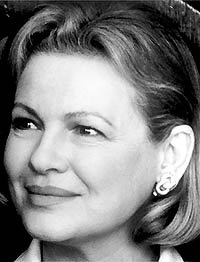 "My first meeting with Woody Allen lasted 30 seconds. He looked at me, said hello, asked someone to take a Polaroid, thanked me very much and I was shown the door. When I came out, the woman due after me was still doing the same thing as when I went in. She was shocked - 'What happened?' But that's how it is. My agent had warned me. Not hers. She was stunned."
Wiest was born in Kansas City, Missouri to a father who was a college dean and former psychiatric social worker for the U.S. Army, and a mother who worked as a nurse. Wiest's original ambition was to be a ballerina, but in late high school she switched her sights to acting in theatre. She made her film debut in 1980, but did not make a name for herself as a film actress until teaming up with Woody Allen during the 1980s.
Wiest's early career was in theatre. She studied theatre at the University of Maryland but left after her third term, in order to tour with a Shakespeare troupe. She worked at the Long Wharf theatre, understudied off-Broadway in Kurt Vonnegut's "Happy Birthday, Wanda June." And then made her Broadway debut in Robert Anderson's "Solitaire/Double Solitaire," taking over in the role of the daughter. She then went to work at Arena Stage in Washington, D.C., and became one of their most prized leading actresses, appearing in many plays including a memorable Emily in "Our Town," Honey in "Who's Afraid of Virginia Woolf," and leading roles in "The Dybbuk," "The Lower Depths," and "Heartbreak House." She also toured the USSR with the Arena Stage Company.
In 1976, Wiest went to the Eugene O'Neill National Playwrights Conference and played leading roles in Amlin Gray's "Pirates" and Christopher Durang's "A History of the American Film." Shortly after that, she left Arena Stage, and performed more in New York City. At Joe Papp's Public Theatre she took over the lead in "Ashes," and played Cassandra in "Agamemnon," directed by Andrei Şerban. She was in two plays by Tina Howe, "Museum" and then "The Art of Dining." In the latter play Wiest was deeply hilarious as the shy and awkward authoress Elizabeth Barrow Colt, and she won every off-Broadway theatre award for her performance: an Obie Award, a Theatre World Award, and the Clarence Derwent Award, given yearly for the most promising performance in New York theatre. In early 1980, she appeared on Broadway in Frankenstein, directed by Tom Moore, portrayed Desdemona in Othello opposite James Earl Jones and Christopher Plummer, and co-starred with John Lithgow in Christopher Durang's romantic screwball comedy Beyond Therapy, directed by John Madden. Also in the 80s she was acclaimed for her performances in Hedda Gabbler, directed by Lloyd Richards at Yale Repertory Theatre, and in Harold Pinter's A Kind of Alaska, Janusz Glowacki's Hunting Cockroaches, and Lanford Wilson's Serenading Louie.
Once her film career took off with her work in Woody Allen's films, Wiest was available to the stage less frequently, though she performed in the 1990s in "In the Summer House," "Square One," Cynthia Ozick's "The Shawl," and Naomi Wallace's "One Flea Spare." In 2003 she acted on Broadway with Al Pacino and Marisa Tomei in Oscar Wilde's "Salome." And in 2005 she starred in Kathleen Tolan's "Memory House," and then at Lincoln Center in the late Wendy Wasserstein's final play "Third," directed by Daniel Sullivan.
Under Allen's direction, Wiest won an Academy Award for Best Supporting Actress, in Hannah and Her Sisters (1986). She followed her Academy Award success with performances in The Lost Boys (1987) and Bright Lights, Big City (1988) before starring with Steve Martin, Mary Steenburgen, Jason Robards, Keanu Reeves and Martha Plimpton in Ron Howard's Parenthood, for which she received her second Oscar nomination.
In 1990, Wiest starred in Edward Scissorhands. She returned to Woody Allen in 1994 for Bullets Over Broadway, a comedy set in 1920s New York City, winning her second Best Supporting Actress Oscar for her portrayal of Helen Sinclair, a boozy, glamorous, and neurotic star of the stage. She appeared in the film Practical Magic (1998) and the television mini-series The 10th Kingdom (2000). From 2000 to 2002, Wiest portrayed Nora Lewin in the long-running NBC crime drama Law & Order.
 "With any part you play, there is a certain amount of yourself in it. There has to be, otherwise it's just not acting. It's lying."
Johnny Depp's first major role was in the 1984 horror film A Nightmare on Elm Street, playing the heroine's boyfriend and one of Freddy's victims. In 1986, he also appeared in a secondary role as a Vietnamese speaking private in Oliver Stone's Platoon. Johnny has since stated that he feels Platoon was the first 'proper' film he was in. Depp then left his teen idol image in 1990, after playing the quirky title role in the Tim Burton film, Edward Scissorhands. The film's success began a long association with Burton, as Depp starred in several of his films, including Ed Wood (1994), Sleepy Hollow (1999), Charlie and the Chocolate Factory (2005) and Corpse Bride (2005). Depp, an avid fan and long-time friend of writer Hunter S. Thompson, played a version of Thompson (named Raoul Duke) in 1998's Fear and Loathing in Las Vegas, based on the writer's pseudobiographical novel of the same name. Depp also accompanied Thompson as his road manager on one of the author's last book tours. In 2006, Depp contributed a touching and personal foreword to Gonzo by Hunter S. Thompson, a posthumous visual biography of the writer's legacy published by ammobooks.com. A close friend of Thompson's, Depp paid for most of Thompson's memorial event, complete with fireworks and the shooting of Thompson's ashes by a cannon, in Aspen, Colorado, where Thompson lived.
Depp's film characters have been described by the press as "iconic loners," and Depp has noted that this period of his career was full of "studio defined failures" and films that were "box office poison," stating that he believes film studios never "understood" the films he appeared in and did not know how to market them properly. Depp has also said that he specifically chose to appear in films that he found personally interesting, rather than those he thought would succeed at the box office.
Depp's status as a major star was solidified with the success of the 2003 Walt Disney Pictures film Pirates of the Caribbean: The Curse of the Black Pearl, for which his lead performance as the suave pirate Captain Jack Sparrow was highly praised. The performance was initially received negatively by the studio bosses who saw the film, but the character became popular with the movie-going public; in 2006, Depp's co-star from the sequel to Pirates of the Caribbean, Bill Nighy, described the role as probably being "one of the most popular performances of recent times."The film's director, Gore Verbinski, has said that Depp's Jack Sparrow character closely resembles Depp's own personality, although Depp himself said that he modelled the character after Rolling Stones guitarist Keith Richards. Depp, who has noted that he was "surprised" and "touched" at the positive reception given to the film, was nominated for an Academy Award for the role. In 2004, he was again nominated for a Best Actor Oscar, this time for playing Scottish author J. M. Barrie in the film Finding Neverland. Depp next starred as Willy Wonka in the 2005 film Charlie and the Chocolate Factory, which was a major success at the box office.
Depp returned to the character of Jack Sparrow for the sequel Pirates of the Caribbean: Dead Man's Chest, which opened on July 7, 2006 and grossed $135.5 million in the first three days of its U.S. release, breaking a box office record in reaching the highest weekend tally ever. The next sequel to Pirates of the Caribbean named At World's End was released May 24, 2007; Depp has mentioned his attachment to his Captain Jack Sparrow character, specifying that Sparrow is "definitely a big part of me," and expressing his desire to portray the character in further sequels. Depp voiced Sparrow in the video game, Pirates of the Caribbean: The Legend of Jack Sparrow.
Depp and Gore Verbinski are executive producers of the album "Rogues Gallery, Pirate Ballads, Sea Songs and Chanteys".
Depp, as a child was obsessed with Dark Shadows. Warner Brothers pitched the idea of making another film to Johnny, and he accepted. In July 2007 a rights deal was closed with the estate of Dan Curtis , the producer/director who created the soap that aired weekdays on ABC, from 1966 to 1971. Depp and Graham King will produce with David Kennedy, who ran Dan Curtis Productions inc. until Curtis died in 2006 of a brain tumor. Infinitum-Nihil's Christi Dembrowski served as the point person on the deal.
It has been confirmed that he will portray Paul Kemp, the main character in a film version of writer Hunter S. Thompson's book, The Rum Diary. Johnny Depp will next play the title role of Sweeney Todd in Tim Burton's film adaptation of the musical Sweeney Todd. Depp's production company has picked up the rights to the story of poisoned former Russian spy Alexander Litvinenko.
 “You see, before he came down here, it never snowed. And afterwards, it did. If he weren't up there now... I don't think it would be snowing. Sometimes you can still catch me dancing in it.”
Tim Burton is a brilliant visual director but with Edward Scissorhands he managed to combine these talents with pure, classic storytelling and serving up a convincingly detailed left-of-center fairytale romance.
The story is fairly basic, being the standard Frankenstein-esque tale of alienation and the empowerment of love. Edward (Johnny Depp) is a lonely man with scissors for hands, crafted by an eccentric inventor (magnificently played by Vincent Price in flashbacks) prior to his death. After Edward witnesses the death of his creator he stays locked away inside his mansion all day, which is located atop the otherwise cheerfully picture-perfect local neighborhood community.
Then one day a nosy neighbor decides to investigate, and ends up bringing Edward to reality. He falls in love with a local girl (Winona Ryder), and is witness first-hand to the joys of life, until accidentally injuring a young boy and becoming the enemy of the overzealous town. Soon everyone is out to get him for no good reason – the climax is beautifully done and, because Burton has allowed his characters to expand so much, it's also very touching.
The movie is decidedly odd but in a good way – the only problem is that it is occasionally quite thin when it comes to actual depth. Burton's never been as good at telling believable stories as he has mythical, exciting fables. The mix of screwball dark comedy, horror, drama, romance and elements and familiar happenings of other genres results in a very different combination. You can literally "feel" the vibe of this picture, its heart pulsing black blood.
The movie was a childhood project of Burton, who drew sketches of Edward as a boy and used to alienate himself from his hostile surroundings by taking refuge in fictional stories involving the scissor-handed hero. As a result Burton's true affinity for the subject is evident – it's clear that he takes this entire project very seriously.
The acting is marvelous – Depp's performance is one of his finest and, arguably, one of the most convincing and fun of all-time. Depp has formed a Scorsese/De Niro-like companionship with Burton over the years, teaming up for various pictures (including Sleepy Hollow and Charlie and the Chocolate Factory). He's always had fun relishing his over-the-top and absurdly dark roles, such as Ichabod Crane in particular. In Scissorhands he gives the equivalent of a Travis Bickle – a man who feels shunned by society, only to open his heart and have it feel crushed again. This is possibly one of the reasons the film is able to affect its audience so well to this very day. The tale does not grow old because the values are timeless.
Edward Scissorhands, despite its occasional flaws, finally gave Burton the chance to unleash his talents as a visual filmmaker along with a pretty solid story mold – the result being a sublimely dark rom-com-drama that never conforms to the typical genre clichés and becomes quite a unique film in its own little world… 9/10
 "Well, I've always been a character actor. I've never been a leading man. It gave me an opportunity not to have to take my clothes off all the time."
Arkin, who had been taking acting lessons since age 10, became a scholarship student at various drama academies, including one run by Stanislavsky student Benjamin Zemach, who had taught Arkin a psychological approach to acting. Arkin attended Franklin High School, in Los Angeles, followed by Los Angeles City College from 1951 to 1953. With two friends, he formed the folk music group The Tarriers, in which Arkin sang and played guitar. The band-members co-composed the group's 1956 hit "The Banana Boat Song" - a reworking, with some new lyrics, of a traditional, same-name Jamaican calypso folk song combined with another titled "Hill and Gully Rider". It reached #4 on the Billboard magazine chart the same year as Harry Belafonte's better-known hit version. From 1958 to 1968, Arkin performed and recorded with the children's folk group, The Baby Sitters.
Arkin is one of only six actors to receive an Academy Award nomination for Best Actor for his first screen appearance (for The Russians Are Coming, the Russians Are Coming) in 1966. Two years later, he was again nominated, for The Heart Is a Lonely Hunter.
Arkin is equally comfortable in comedy and dramatic roles. Among those for which he has garnered the most favorable critical attention are his Oscar-nominated turns above; Wait Until Dark, as the erudite killer stalking Audrey Hepburn; director Mike Nichols' Catch-22; The Seven-Per-Cent Solution (where he played Sigmund Freud); writer Jules Feiffer's Little Murders, which Arkin directed; the The In-Laws, co-starring Peter Falk; Glengarry Glen Ross; and Little Miss Sunshine, for which he received his third Oscar nomination, in the category of Best Supporting Actor. On the 11th February 2007 he received a BAFTA Film Award for Best Actor in a Supporting Role for his portrayal of Grandfather Edwin in Little Miss Sunshine. On February 25, 2007, upon winning the Academy Award for Best Actor in a Supporting Role, Arkin, who plays a foul-mouthed grandfather with a taste for heroin said, "More than anything, I'm deeply moved by the open-hearted appreciation our small film has received, which in these fragmented times speaks so openly of the possibility of innocence, growth and connection". At 72 years old, Arkin became the sixth oldest winner of the Best Supporting Actor Oscar.
On Broadway, Arkin starred in Enter Laughing, for which he won a Tony Award, and Luv. He also directed The Sunshine Boys, among others.
Mensagens antigas Página inicial
Subscribe to:
Mensagens (Atom)