


Mostrar mensagens com a etiqueta Roberto Benigni. Mostrar todas as mensagens
Mostrar mensagens com a etiqueta Roberto Benigni. Mostrar todas as mensagens
 "Thank you. This is a terrible mistake, because I used up all my English!"
Benigni's first movie as director was Tu mi turbi (You Upset Me, 1983). On the set he met the Cesenate actress Nicoletta Braschi, who was to become his wife, and who has starred in most of the films he directed.
With the very popular comic actor Massimo Troisi, in 1984 he played in Non ci resta che piangere ("Nothing left to do but cry"), a fable in which the protagonists are suddenly thrown back in time to the 15th century, just a little before 1492. They start looking for Columbus in order to stop him discovering the Americas (although for very personal love reasons), but are not able to reach him.
Beginning in 1986, Benigni starred in three films by American director Jim Jarmusch. In Down By Law (1986) (which in Italy had its title spelled "Daunbailò", in Italian phonetics) he plays Bob, the innocent abroad, convicted for murder, whose irrepressible good humour and optimism help him escape and find love (also starring Braschi as his beloved.) In Night on Earth, (1991) he plays a cabbie in Rome, causing his passenger, a priest, great discomfort by confessing his revolting sexual experiences. Later, he also starred in the first of Jarmusch's series of short films, Coffee and Cigarettes (2003).
In 1993, he starred in Son of the Pink Panther, directed by veteran Blake Edwards. There, he played Peter Sellers' Inspector Clouseau's illegitimate son, who is assigned to save the Princess of Lugash. The film bombed in the US, but was a hit in Italy, his home country.
A serious role was in Federico Fellini's last movie, La voce della luna (1989). The former years Benigni had started a long-lasting collaboration with screenwriter Vincenzo Cerami, for a series of films which scored great success in Italy: Il piccolo diavolo ("The little devil", with Walter Matthau), Johnny Stecchino ("Johnny Toothpick"), and Il Mostro ("The Monster").
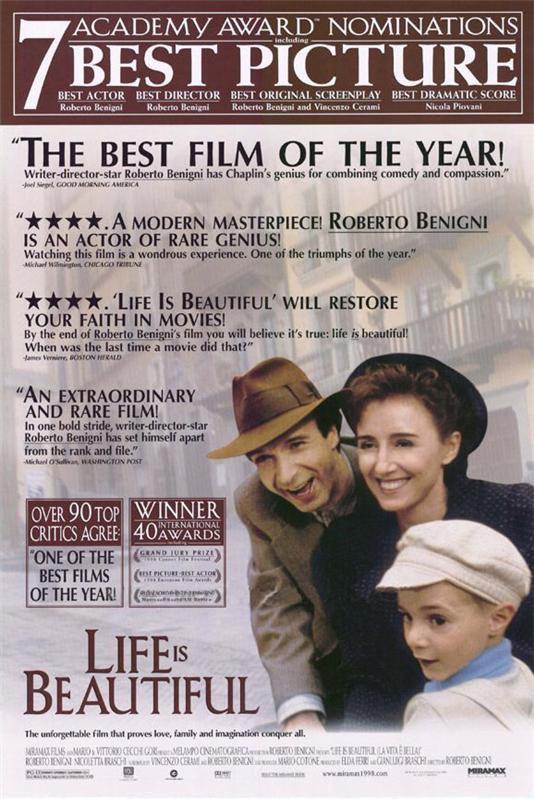
Benigni is probably best known outside Italy for his 1997 tragicomedy Life Is Beautiful (La vita è bella), filmed in Cortona and Arezzo, also written by Cerami. The film is about an Italian Jewish man who tries to protect his son during his internment at a Nazi concentration camp, by telling him that the Holocaust is an elaborate game and he must adhere very carefully to the rules to win. Benigni's father had spent two years in a concentration camp in Bergen-Belsen, and La Vita è bella is based in part on his father's experiences. In 1998, the film was nominated for seven Academy Awards and Benigni personally won the Best Actor (the Best Foreign Language Film is awarded to the film itself, and is often mistaken to be awarded to the director because Academy rules stipulate that he or she will accept the award). The score by Nicola Piovani also won an Oscar. Famously, in the midst of being so giddy with delight, he climbed on the back of the seat for his procession to the stage and applauded the audience after he was told he had won one of his Oscars. The next year's ceremony, where he read the nominees for the Academy Award for Best Actress, the host Billy Crystal playfully appeared behind him with a large net to restrain Benigni if he got excessive with his antics again.
Benigni was also one of the main characters in Asterix and Obelix vs Caesar as Detritus, a corrupted Roman tax collector who wants to kill the Caesar and claim the throne of the Roman Empire.
As a director, his 2002 film Pinocchio, one of the most costly films of Italian cinema, was coldly received by critics, and bombed in North America. That same year, he gave a typically energetic and revealing interview to Canadian filmmaker, Damian Pettigrew for Fellini: I'm a Born Liar (2002), a cinematic portrait of the maestro that was nominated for Best Documentary at The European Film Awards, Europe's equivalent of the Oscars. The film went on to win the prestigious Rockie Award for Best Arts Documentary at the BANFF International Television Festival (2002) and the Coup de Coeur at the International Sunnyside of the Doc Marseille (2002).
Benigni's latest film is La tigre e la neve (The Tiger and the Snow, 2005), about the Iraq War.
On October 15, 2005, he performed an impromptu strip tease on Italy's most watched evening news program, removing his shirt and draping it over the newscaster's shoulders. Prior to removing his shirt, Benigni had already hijacked the opening credits of the news program, jumping behind the newscaster and announcing: "Berlusconi has resigned" (Benigni is an outspoken critic of media tycoon and former Prime Minister Silvio Berlusconi). The previous day, he led a crowd of thousands in Rome on Friday in protest at the center-right government's decision to cut state arts funding by 35 percent.
On February 2, 2007, he was awarded the degree of Doctor Honoris Causa by the Katholieke Universiteit Leuven, Belgium.
Benigni was given offers to bring his Dante show to Broadway, but he has since turned them down.
 “The game starts now. You have to score one thousand points. If you do that, you take home a tank with a big gun. Each day we will announce the scores from that loudspeaker. The one who has the fewest points will have to wear a sign that says "Jackass" on his back. There are three ways to lose points. One, turning into a big crybaby. Two, telling us you want to see your mommy. Three, saying you're hungry and want something to eat.”
Mixing humor and the Holocaust isn't anything new: Ernst Lubitsch's 'To Be Or Not To Be' is just one enduring classic; Mel Brooks' 'The Producers' is another; and 'Life Is Beautiful' has the small-town charm and ambiance of 'Amarcord,' and light-straight satire of 'The Great Dictator.'
Set against the stark reality of World War II Europe, Roberto Benigni's sentimental fable is not a film about the Holocaust, it's a film about life and hope merely against the backdrop of the Holocaust... It's not a denial of the Holocaust, it is a manifestation that humor itself can be courage... It's not about betraying the experience of millions of Jews, it is about the great lengths a father will go to protect his family from the horrors of the Nazis... It's a demonstration of the power of cinema, it's art without claim, hope without fear, dreams without limitations... It's a motion picture about love, not a documentary about the Nazis... It delivers a powerful message that despite everything - life is truly beautiful...
The story begins in 1939 Italy, where a simple, free-spirited Italian Jew Guido Orefice (Benigni) and his poet friend Ferrucio (Sergio Bini Bustic) have dreams of owning their own bookstore. For now, however, Guido must be satisfied to wait tables, while Ferrucio is unable to get a job. Benigni's character is introduced during a long set of fast comedy scenes, particularly when he meets a cute gentile woman, Dora - Nicoletta Braschi: when she 'falls out of the sky,' and he quickly nicknames her 'Principessa', when he rides, in a fascist ball, on a horse painted green, when he turns a gloomy rainy night into a red carpet event, when he is caught by the Nazis as he hurries about securing the safety of his wife and son, when his car speeds, without brakes, through a village and is mistaken for a king...
Guido falls hard for the radiant schoolteacher, daughter of a wealthy family, and pursues her with all the charm and imagination he can discharge: in one sequence, he pretends to be a school inspector and gives an impromptu speech on racial superiority before the assembled students and teachers, ending with a striptease...
That hilarious side of the film takes up the first half. Benigni (who also wrote and directed) borrows a bit of Chaplin's grace and a bit of Groucho Marx charm: all of the action is so neatly contrived that the film essentially ends when it's over, and then begins again with the introduction of Guido and Dora's cute five-year-old son Giosue (Giorgio Cantarini) few years later...
There, in 1945, we catch a glimpse of their enchanting household, but things are soon shattered, and the Nazis take Guido, with his tolerant uncle (Giustino Durano) and little Giosue off to an unidentified concentration camp. Dora races to the train station and demands to be put also on the train...
At the death camp, and in order to protect his son from the nightmare of the place, Guido uses his imagination by creating the illusion that everything that's happening is just a game, an epic game that will be exciting and fun. He convinces Giosue that by hiding from the Gestapo soldiers (whom he refers to simply as the "men who yell a lot") and maintaining silence, he can gain the necessary points to win a tank. Not a toy tank, but a full-size tank, which they'll be free to take home...
As co-writer, Benigni (with Vincenzo Cerami), doesn't just mix drama and comedy, he often hides drama in the comedy. The film does not dwell on the horrors of the camp, nor does it ignore them...With a memorable score by Nicola Piovani, "Life Is Beautiful" is an important film, triumphant, timeless, and sublime... It manages to entertain, educate, and move with its potent combination of humor, poignancy, and dignity... Roberto Benigni has taken pure horror and turned it into a love story between a man and a woman, between a father and his son… As an actor, Benigni manages with his wise and simple performance to make us laugh in tragic situations… He was very realistic, natural, distant from great special effects, far from Hollywood style, only nice and beautiful cinema... 10/10
Mensagens antigas Página inicial
Subscribe to:
Mensagens (Atom)