


Mostrar mensagens com a etiqueta 1997. Mostrar todas as mensagens
Mostrar mensagens com a etiqueta 1997. Mostrar todas as mensagens
“She was Lo, plain Lo, in the morning, standing four feet ten in one sock. She was Lola in slacks. She was Dolly at school. She was Dolores on the dotted line. But in my arms she was always Lolita. Light of my life, fire of my loins. My sin, my soul. Lo... Lee... Ta.”
This is an excellent adaptation of Vladimir Nabokov's brilliant book about the sordid relationship between a grown man and a teenage girl. Although still disconcerting, the subject of pedophilia is far less shocking today than when the book was published almost 50 years ago. Yet, despite the subject matter, the book was wildly popular because it was a literary work of art, beautifully written with some of the most splendid metaphors and descriptive narrative in American literature. This was all the more amazing when one considers that English was Nabokov's second language.
Director Adrian Lynn (Fatal Attraction, 9 ½ weeks, Indecent Proposal) is no stranger to stories with perverse sexual content. His presentation of the story does the book justice although certain interpretations may not have been what Nabokov had in mind. Lynn gives us a presentation that is very sympathetic to Humbert. Nabokov's Humbert was very complex, partly a victim of his fixation on young girls, partly a sexual predator and partly a hopeless romantic. Nabokov's Lolita was extremely innocent, just approaching the threshold of sexual curiosity and urges, more playful than consciously provocative.
While Nabokov hints at a mutual seduction, he leans far more heavily towards Humbert as the cause of the events even though Humbert is clearly helpless in the face of his obsession. Lolita entered into the sexual relationship more as a result of longings burgeoning from her blossoming sexuality than a desire to seduce Humbert in particular, who was not even her first lover.
Lynn's presentation transforms Humbert from the seducer into the seduced, whose weakness for young girls is manipulated by a sexually precocious siren tempting him to dash himself on the shoals of pedophilia. Lynn portrays Lolita as the aggressor, an adolescent temptress who knows she is desired and simultaneously teases and entices him to do her lustful bidding, knowing he is powerless to resist. Lynn's Humbert is more of a hapless romantic than a fiend, ennobling him as a victim of love rather than the confounded sociopath he really is. In Lynn's version, Humbert becomes the fly to Lolita's spider.
However, after the initial seduction when they take to the road, the film is very true to the book in chronicling the decay of the relationship, Humbert's further plunge into feelings of romantic desperation and Lolita's shrewish exploitation of him as she increasingly uses sex as a weapon. The book was very effective at portraying the relationship as a symbiosis of two deficient beings, each selfishly taking from the other what was needed. Lynn does an excellent job of portraying that here. As the relationship degenerates, Lynn is effectual at portraying the ugly side of both characters. The bitterness and rancor that results is compelling. To his credit, he understands that Nabokov's story was more of a character study than a sex story and Lynn avoids the temptation of becoming too lurid, focusing instead on solid character development of two very flawed beings.
I must take a moment to give Lynn the highest praise for his period renderings. This is one of the finest portrayals of 1940's Americana I can remember. The costumes, hairstyles, cars, furniture, locations and sets create a 40's reality that is like being hurtled back in a time machine. The music is not just precise for the period, but it is perfectly integrated with the story. As the two travel, the music changes to reflect the region. Having Lolita dance and sing to period music on the radio is a nice touch because that is exactly what teenage girls of any era are apt to do.
The acting is first rate all around. When the film was made, Dominique Swain was 17, and although she looked young for her age, she could never pass for 12. So for the first part of the film before Charlotte's demise, she is simply too mature. However, for the road trip she is ideal. Though I don't agree with Lynn's early interpretation of Lolita as the teenage temptress, I can't imagine it being done any better than the performance Swain delivers. She is playful and provocative in a childlike manner, part pixie and part vamp. Once they get on the road, Swain hits stride with a performance that is almost a force of nature. She is powerful and intense, effortlessly moving back and forth between sweet innocence and the emotional torrent typified by the `murder me' scene. It is an outstanding performance with depth and breadth that is very unusual for an actor so young.
Jeremy Irons is wonderful as Humbert, giving him as amiable a personality as one could possibly imagine for a character with such vile intentions. Irons injects a good deal of wry humor into the part in addition to giving Humbert an almost quixotic romantic quality. Frank Langella (Dracula) is more obnoxious than mysterious as Quilty, making the audience want to exhort Humbert to pull the trigger as he confronts Quilty with the revolver. Again, I think this is probably Lynn's doing since his vision is clearly that of a Humbert sympathizer.
This is a fine film with great production values, terrific performances and a classic story. I feel that it surpasses Kubrik's adaptation in its ability to capture many of the finer points of Nabokov's book, even though Nabokov collaborated on the Kubrik film… 9/10
This is an excellent adaptation of Vladimir Nabokov's brilliant book about the sordid relationship between a grown man and a teenage girl. Although still disconcerting, the subject of pedophilia is far less shocking today than when the book was published almost 50 years ago. Yet, despite the subject matter, the book was wildly popular because it was a literary work of art, beautifully written with some of the most splendid metaphors and descriptive narrative in American literature. This was all the more amazing when one considers that English was Nabokov's second language.
Director Adrian Lynn (Fatal Attraction, 9 ½ weeks, Indecent Proposal) is no stranger to stories with perverse sexual content. His presentation of the story does the book justice although certain interpretations may not have been what Nabokov had in mind. Lynn gives us a presentation that is very sympathetic to Humbert. Nabokov's Humbert was very complex, partly a victim of his fixation on young girls, partly a sexual predator and partly a hopeless romantic. Nabokov's Lolita was extremely innocent, just approaching the threshold of sexual curiosity and urges, more playful than consciously provocative.
While Nabokov hints at a mutual seduction, he leans far more heavily towards Humbert as the cause of the events even though Humbert is clearly helpless in the face of his obsession. Lolita entered into the sexual relationship more as a result of longings burgeoning from her blossoming sexuality than a desire to seduce Humbert in particular, who was not even her first lover.
Lynn's presentation transforms Humbert from the seducer into the seduced, whose weakness for young girls is manipulated by a sexually precocious siren tempting him to dash himself on the shoals of pedophilia. Lynn portrays Lolita as the aggressor, an adolescent temptress who knows she is desired and simultaneously teases and entices him to do her lustful bidding, knowing he is powerless to resist. Lynn's Humbert is more of a hapless romantic than a fiend, ennobling him as a victim of love rather than the confounded sociopath he really is. In Lynn's version, Humbert becomes the fly to Lolita's spider.
However, after the initial seduction when they take to the road, the film is very true to the book in chronicling the decay of the relationship, Humbert's further plunge into feelings of romantic desperation and Lolita's shrewish exploitation of him as she increasingly uses sex as a weapon. The book was very effective at portraying the relationship as a symbiosis of two deficient beings, each selfishly taking from the other what was needed. Lynn does an excellent job of portraying that here. As the relationship degenerates, Lynn is effectual at portraying the ugly side of both characters. The bitterness and rancor that results is compelling. To his credit, he understands that Nabokov's story was more of a character study than a sex story and Lynn avoids the temptation of becoming too lurid, focusing instead on solid character development of two very flawed beings.
I must take a moment to give Lynn the highest praise for his period renderings. This is one of the finest portrayals of 1940's Americana I can remember. The costumes, hairstyles, cars, furniture, locations and sets create a 40's reality that is like being hurtled back in a time machine. The music is not just precise for the period, but it is perfectly integrated with the story. As the two travel, the music changes to reflect the region. Having Lolita dance and sing to period music on the radio is a nice touch because that is exactly what teenage girls of any era are apt to do.
The acting is first rate all around. When the film was made, Dominique Swain was 17, and although she looked young for her age, she could never pass for 12. So for the first part of the film before Charlotte's demise, she is simply too mature. However, for the road trip she is ideal. Though I don't agree with Lynn's early interpretation of Lolita as the teenage temptress, I can't imagine it being done any better than the performance Swain delivers. She is playful and provocative in a childlike manner, part pixie and part vamp. Once they get on the road, Swain hits stride with a performance that is almost a force of nature. She is powerful and intense, effortlessly moving back and forth between sweet innocence and the emotional torrent typified by the `murder me' scene. It is an outstanding performance with depth and breadth that is very unusual for an actor so young.
Jeremy Irons is wonderful as Humbert, giving him as amiable a personality as one could possibly imagine for a character with such vile intentions. Irons injects a good deal of wry humor into the part in addition to giving Humbert an almost quixotic romantic quality. Frank Langella (Dracula) is more obnoxious than mysterious as Quilty, making the audience want to exhort Humbert to pull the trigger as he confronts Quilty with the revolver. Again, I think this is probably Lynn's doing since his vision is clearly that of a Humbert sympathizer.
This is a fine film with great production values, terrific performances and a classic story. I feel that it surpasses Kubrik's adaptation in its ability to capture many of the finer points of Nabokov's book, even though Nabokov collaborated on the Kubrik film… 9/10
 “The game starts now. You have to score one thousand points. If you do that, you take home a tank with a big gun. Each day we will announce the scores from that loudspeaker. The one who has the fewest points will have to wear a sign that says "Jackass" on his back. There are three ways to lose points. One, turning into a big crybaby. Two, telling us you want to see your mommy. Three, saying you're hungry and want something to eat.”
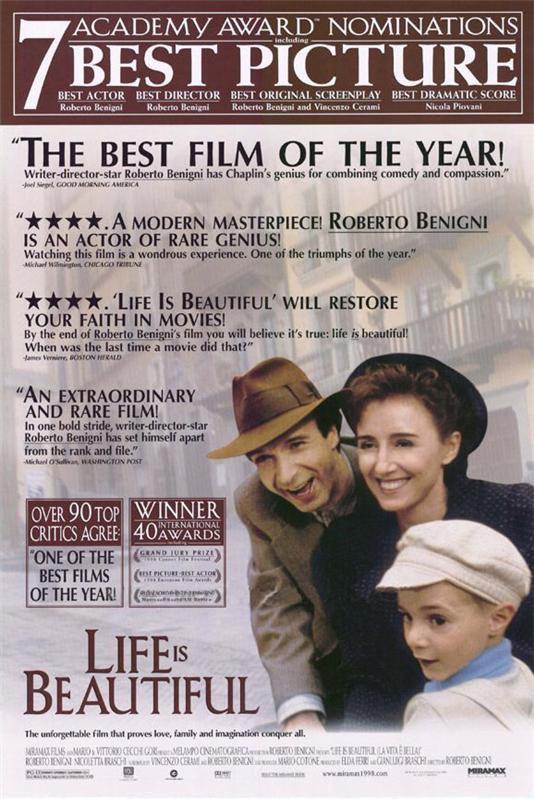
Mixing humor and the Holocaust isn't anything new: Ernst Lubitsch's 'To Be Or Not To Be' is just one enduring classic; Mel Brooks' 'The Producers' is another; and 'Life Is Beautiful' has the small-town charm and ambiance of 'Amarcord,' and light-straight satire of 'The Great Dictator.'
Set against the stark reality of World War II Europe, Roberto Benigni's sentimental fable is not a film about the Holocaust, it's a film about life and hope merely against the backdrop of the Holocaust... It's not a denial of the Holocaust, it is a manifestation that humor itself can be courage... It's not about betraying the experience of millions of Jews, it is about the great lengths a father will go to protect his family from the horrors of the Nazis... It's a demonstration of the power of cinema, it's art without claim, hope without fear, dreams without limitations... It's a motion picture about love, not a documentary about the Nazis... It delivers a powerful message that despite everything - life is truly beautiful...
The story begins in 1939 Italy, where a simple, free-spirited Italian Jew Guido Orefice (Benigni) and his poet friend Ferrucio (Sergio Bini Bustic) have dreams of owning their own bookstore. For now, however, Guido must be satisfied to wait tables, while Ferrucio is unable to get a job. Benigni's character is introduced during a long set of fast comedy scenes, particularly when he meets a cute gentile woman, Dora - Nicoletta Braschi: when she 'falls out of the sky,' and he quickly nicknames her 'Principessa', when he rides, in a fascist ball, on a horse painted green, when he turns a gloomy rainy night into a red carpet event, when he is caught by the Nazis as he hurries about securing the safety of his wife and son, when his car speeds, without brakes, through a village and is mistaken for a king...
Guido falls hard for the radiant schoolteacher, daughter of a wealthy family, and pursues her with all the charm and imagination he can discharge: in one sequence, he pretends to be a school inspector and gives an impromptu speech on racial superiority before the assembled students and teachers, ending with a striptease...
That hilarious side of the film takes up the first half. Benigni (who also wrote and directed) borrows a bit of Chaplin's grace and a bit of Groucho Marx charm: all of the action is so neatly contrived that the film essentially ends when it's over, and then begins again with the introduction of Guido and Dora's cute five-year-old son Giosue (Giorgio Cantarini) few years later...
There, in 1945, we catch a glimpse of their enchanting household, but things are soon shattered, and the Nazis take Guido, with his tolerant uncle (Giustino Durano) and little Giosue off to an unidentified concentration camp. Dora races to the train station and demands to be put also on the train...
At the death camp, and in order to protect his son from the nightmare of the place, Guido uses his imagination by creating the illusion that everything that's happening is just a game, an epic game that will be exciting and fun. He convinces Giosue that by hiding from the Gestapo soldiers (whom he refers to simply as the "men who yell a lot") and maintaining silence, he can gain the necessary points to win a tank. Not a toy tank, but a full-size tank, which they'll be free to take home...
As co-writer, Benigni (with Vincenzo Cerami), doesn't just mix drama and comedy, he often hides drama in the comedy. The film does not dwell on the horrors of the camp, nor does it ignore them...With a memorable score by Nicola Piovani, "Life Is Beautiful" is an important film, triumphant, timeless, and sublime... It manages to entertain, educate, and move with its potent combination of humor, poignancy, and dignity... Roberto Benigni has taken pure horror and turned it into a love story between a man and a woman, between a father and his son… As an actor, Benigni manages with his wise and simple performance to make us laugh in tragic situations… He was very realistic, natural, distant from great special effects, far from Hollywood style, only nice and beautiful cinema... 10/10
 “Sometimes I wish I had never met you. Because then I could go to sleep at night not knowing there was someone like you out there.”
Set in Boston, Massachusetts, it tells the story of Will Hunting (Matt Damon), a troubled prodigy who works as a janitor at the Massachusetts Institute of Technology, despite the fact that his knowledge of and facility with higher mathematics far outstrips that of anyone in the university. Will must learn to overcome his deep fear of abandonment in order to learn how to trust and love the people who care about him. Good Will Hunting is the story of a young man and his struggle with both himself and personal relationships, trying to work through his problems so that he can open up to others, and begin putting his immeasurable intellectual potential to work.
Will, however, has no interest in pursuing a prestigious career in mathematics. He only reluctantly agrees to hold private lessons with the professor, being the only way to get out of jail after a spate of violence lands him there. Part of his parole deal, however, is to meet with a therapist twice a week. After getting a couple of shrinks to give up on him, Will finally lands with psychology teacher Sean Maguire (Robin Williams) who has a similar background as Wills', hailing from the same tough neighborhood in south Boston.
As Sean tries to get through to Will emotionally, the professor tries to train Will's mind in advanced mathematics. All the while, Will, who has had trouble maintaining a loving relationships due to his troubled past, begins to get seriously involved with a girl named Skylar (Minnie Driver). Meanwhile, the professor and the psychiatrist, who've had a rivalry of sorts back in their day, begin to quibble over what's best for Will's future.
Filled with great profound dialogs and intense emotional scenes, it's an immense emotional experience. It obviously has very 'heavy' subject-matter, and thus not an easy light watch, but it is very rewarding and entertains throughout. The most effective parts of "Good Will Hunting" show the conflict between two sets of parallel individuals: Will and Chuckie, and Professors Lambeau and Maguire. The intense and latent rivalry between the two academics describes a potential future for the two twenty-year-olds. Maguire consistently, at least on a superficial basis, searches for the default respect the MIT mathematician receives. Will, although reticent and clearly an outcast, seeks a similar form of respect, although not for his academic qualities, but for his social abilities. Throughout "Good Will Hunting," both pairs of spotlighted characters, after a series of enlightening "adventures," become comfortable with themselves. Despite this banal-sounding narrative flow, the execution is mostly interesting and often unpredictable.
Instead, of giving us a hokey feel good ending, Affleck and Damon offer something much more insightful and honest. Will recognizes that he must deal with lingering emotional problems before he can be satisfied and successful in any profession. The ending is only a recognition of the problem, not a solution. So instead of neatly wrapped up closure, Good Will Hunting ends with something much closer to real life. 9/10
Filled with great profound dialogs and intense emotional scenes, it's an immense emotional experience. It obviously has very 'heavy' subject-matter, and thus not an easy light watch, but it is very rewarding and entertains throughout. The most effective parts of "Good Will Hunting" show the conflict between two sets of parallel individuals: Will and Chuckie, and Professors Lambeau and Maguire. The intense and latent rivalry between the two academics describes a potential future for the two twenty-year-olds. Maguire consistently, at least on a superficial basis, searches for the default respect the MIT mathematician receives. Will, although reticent and clearly an outcast, seeks a similar form of respect, although not for his academic qualities, but for his social abilities. Throughout "Good Will Hunting," both pairs of spotlighted characters, after a series of enlightening "adventures," become comfortable with themselves. Despite this banal-sounding narrative flow, the execution is mostly interesting and often unpredictable.
Instead, of giving us a hokey feel good ending, Affleck and Damon offer something much more insightful and honest. Will recognizes that he must deal with lingering emotional problems before he can be satisfied and successful in any profession. The ending is only a recognition of the problem, not a solution. So instead of neatly wrapped up closure, Good Will Hunting ends with something much closer to real life. 9/10
Mensagens antigas Página inicial
Subscribe to:
Mensagens (Atom)