


Mostrar mensagens com a etiqueta Forrest Gump. Mostrar todas as mensagens
Mostrar mensagens com a etiqueta Forrest Gump. Mostrar todas as mensagens
 Paramount Pictures can trace its beginnings to the creation in May, 1912, of the Famous Players Film Company. Founder Hungarian-born Adolph Zukor, who had been an early investor in nickelodeons, saw that movies appealed mainly to working-class immigrants. With partners Daniel and Charles Frohman he planned to offer feature-length films that would appeal to the middle class by featuring the leading theatrical players of the time. By mid-1913, Famous Players had completed five films, and Zukor was on his way to success.
That same year, another aspiring producer, Jesse L. Lasky, opened his Lasky Feature Play Company with money borrowed from his brother-in-law, Samuel Goldfish (later to be known as Samuel Goldwyn.) As their first employee, the Lasky company hired a stage director with no film experience, Cecil B. DeMille, who would find a suitable location site in Hollywood, near Los Angeles, for his first film, The Squaw Man.
Beginning in 1914, both Lasky and Famous Players released their films through a start-up company, Paramount Pictures. Organized early that year by a Utah theatre owner, W. W. Hodkinson, who had bought and merged several smaller firms, Paramount was the first successful nation-wide distributor. Until this time films were sold on a state-wide or regional basis; not only was this inefficient, but it had proved costly to film producers.
Soon the ambitious Zukor, unused to taking a secondary role, began courting Hodkinson and Lasky. In 1916, Zukor maneuvered a three-way merger of his Famous Players, the Lasky Company, and Paramount. The new company, Famous Players-Lasky, grew quickly, with Lasky and his partners Goldfish and DeMille running the production side, Hiram Abrams in charge of distribution, and Zukor making great plans. With only the exhibitor-owned First National as a rival, Famous Players-Lasky and its "Paramount Pictures" soon dominated the business.
Zukor believed in stars - after all, he had begun by offering "Famous Players in Famous Plays," as his first slogan put it. He signed and developed many of the leading early stars, among them Mary Pickford, Douglas Fairbanks, Gloria Swanson, Rudolph Valentino, and Wallace Reid. With so many important players, Paramount was able to introduce "block booking," which meant that an exhibitor who wanted a particular star's films had to buy a year's worth of other Paramount productions. It was this system that gave Paramount a leading position in the 1920s and 1930s, but which led the government to pursue it on anti-trust grounds for more than twenty years.
The driving force behind Paramount's rise was Zukor. All through the teens and twenties, he built a mighty theatrical chain of nearly 2,000 screens, ran two production studios, and became an early investor in radio, taking a 50% interest in the new Columbia Broadcasting System in 1928. By acquiring the successful Balaban & Katz chain in 1926, he gained the services of both Barney Balaban, who became Paramount's president, and Sam Katz, who ran the Paramount-Publix theatre chain. Zukor also hired independent producer B. P. Schulberg, an unerring eye for new talent, to run the West Coast studio. In 1927, Famous Players-Lasky took on the name Paramount-Famous Lasky Corporation. Three years later, because of the importance of the Publix theater chain, it was later known as Paramount-Publix Corporation.
Also in 1927, Paramount began releasing Inkwell Imps animated cartoons produced by Max & Dave Fleischer's Fleischer Studios in New York City. The Fleischers, veterans in the animation industry, would prove to be among the few animation producers capable of challenging the prominence of Walt Disney.
Eventually Zukor shed most of his early partners; the Frohman brothers, Hodkinson and Goldfish/Goldwyn were out by 1917 while Lasky hung on until 1932, when, blamed for the near-collapse of Paramount in the depression years, he too was tossed out. Zukor's over-expansion and use of overvalued Paramount stock for purchases led the company into receivership in 1933. A bank-mandated reorganization team, led by John Hertz and Otto Kahn kept the company intact, and miraculously, kept Zukor on. In 1935, Paramount Publix went bankrupt. Immediately after this bankruptcy occurred, Zukor was bumped up to an honorary "chairman emeritus" role in 1935, while Barney Balaban became chairman. Upon becoming the "honorary chairman," Zukor reorganized the company as Paramount Pictures, Inc. and was able to successfully bring the studio out of bankruptcy.
As always, Paramount films continued to emphasize stars. By the 1930s, talkies brought in a range of powerful new draws: Marlene Dietrich, Mae West, Gary Cooper, Claudette Colbert, the Marx Brothers, Dorothy Lamour, Carole Lombard, Bing Crosby, and famous Argentine tango singer Carlos Gardel among them. In this period Paramount can truly be described as a movie factory, turning out sixty and seventy pictures a year. Such were the benefits of having a huge theater chain to fill, and of block booking to persuade other chains to go along.
Paramount cartoons produced by Fleischer Studios continued to be successful, with characters such as Betty Boop and Popeye the Sailor becoming widely successful. However, a huge blow to Fleischer Studios occurred in 1934, after the Hays Code was enforced and Betty Boop's popularity declined as she was forced to have a more tame personality and wear a longer skirt too. Fleischer Studios could however, rebound with Popeye, and in 1935, polls showed that Popeye was even more popular than Mickey Mouse. After an unsuccessful expansion into feature films, Fleischer Studios was acquired by Paramount, who renamed the operation Famous Studios and continued cartoon production until 1967.
In 1940, Paramount agreed to a government-instituted consent decree: block booking and "pre-selling" (the practice of collecting up-front money for films not yet in production) would end. Immediately Paramount cut back on production, from sixty-plus pictures to a more modest twenty annually in the war years. Still, with more new stars (like Bob Hope, Alan Ladd, Veronica Lake, Paulette Goddard, and Betty Hutton), and with war-time attendance at astronomical numbers, Paramount and the other integrated studio-theatre combines made more money than ever. At this, the Federal Trade Commission and the Justice Department decided to reopen their case against the five integrated studios. This led to the Supreme Court decision of 1948 that broke up Adolph Zukor's amazing creation and effectively brought an end to the classic Hollywood studio system.
As movie attendance declined after World War II, Paramount and the others struggled to keep the audience. Hovering nearby were the Federal Trade Commission and the Justice Department, still pursuing restraint-of-trade allegations. This case finally came before the Supreme Court as U.S. vs. Paramount Pictures, et al., and in May 1948, the court agreed with the government, finding restraint of competition, and calling for the separation of production and exhibition. Paramount was split in two. Paramount Pictures Corporation remained the production distribution, with the 1,500-screen theater chain handed to the new United Paramount Theaters on December 31, 1949.
With the loss of the theater chain, Paramount Pictures went into a decline, cutting studio-backed production, releasing its contract players, and making production deals with independents. By the mid-1950s, all the great names were gone; only C.B. DeMille, associated with Paramount since 1913, kept making pictures in the grand old style. Like some other studios, Paramount saw little value in its film library.
By the early 1960s Paramount's future was doubtful. The high-risk movie business was wobbly; the theater chain was long gone; investments in DuMont and in early pay-television came to nothing. Even the flagship Paramount building in Times Square was sold to raise cash, as was KTLA (sold to Gene Autry in 1964 for a then-phenomenal $12.5 million). Founding-father Adolph Zukor, born in 1873, was still chairman emeritus; he referred to chairman Barney Balaban (born 1888) as 'the boy'. Such aged leadership was incapable of keeping up with the changing times, and in 1966, a sinking Paramount was sold to the Charles Bluhdorn's industrial conglomerate Gulf and Western Industries. Bluhdorn immediately put his stamp on the studio, installing a virtually unknown producer, Robert Evans, as head of production. Despite some rough times, Evans held the job for eight years, restoring Paramount's reputation for commercial success with The Odd Couple, Love Story, Chinatown, Rosemary's Baby and The Godfather.
Gulf and Western Industries also bought the neighboring Desilu television studio (once the lot of RKO Pictures) from Lucille Ball in 1967. Using Desilu's established shows like Star Trek, Mission: Impossible and Mannix as a foot in the door at the networks, Paramount Television eventually became known as a specialist in half-hour situation comedies.
In 1970, Paramount teamed with Universal Studios to form Cinema International Corporation, a new company that would distribute films by the two studios outside the United States. Metro-Goldwyn-Mayer would become a partner in the mid 1970s. Both Paramount and CIC entered the video market with Paramount Home Video (now Paramount Home Entertainment) and CIC Video, respectively.
Robert Evans quit as head of production in 1974; his successor Richard Sylbert, was too literary and tasteful for Bluhdorn. By 1976, a new, television-trained team was in place: Barry Diller, and his 'killer-Dillers,' associates Michael Eisner, Jeffrey Katzenberg, Dawn Steel and Don Simpson. The specialty now was simpler, 'high concept' pictures like Saturday Night Fever, and Grease. With his television background, Diller kept pitching an idea of his to the board: a fourth commercial network. But the board, and Bluhdorn, wouldn't bite. Neither would Bluhdorn's successor, Martin Davis. Diller took his fourth-network idea with him when he moved to Twentieth Century-Fox in 1984, where the new proprietor, Rupert Murdoch, was a more interested listener.
Paramount Pictures was unconnected to Paramount Records, until it purchased the rights to use Paramount Records' name (but not its catalogue) in the late 1960s. The Paramount name was used for soundtrack albums and some pop re-issues from the Dot Records catalogue. Paramount had acquired the pop-oriented Dot in 1958, but by 1970 Dot had become an all-country label. In 1974, Paramount sold all of its record holdings to ABC Records, which in turn was sold to MCA in 1978.
Paramount's successful run of pictures extended into the 1980s and 1990s, generating hits like Flashdance, the Friday the 13th slasher series; Raiders of the Lost Ark and its sequels; Beverly Hills Cop and a string of films starring comedian Eddie Murphy; Footloose; Fatal Attraction; and the Star Trek series. While the emphasis was decidedly on the commercial, there were occasional less commercial efforts like Atlantic City, Terms of Endearment, and Forrest Gump. During this period responsibility for running the studio passed from Eisner and Katzenberg to Don Simpson to Stanley Jaffe and Sherry Lansing. More so than most, Paramount's slate of films included many remakes and television spinoffs; while sometimes commercially successful, there have been few compelling films of the kind that once made Paramount the industry leader.
In 1981, Cinema International Corporation was reorganized as United International Pictures. This was necessary because MGM had merged with United Artists which had its own international distribution unit, but MGM was not allowed to leave the venture at the time (they finally did in 2001, switching international distribution to 20th Century Fox).
When Charles Bluhdorn died unexpectedly, his successor Martin Davis dumped all of G+W's industrial, mining, and sugar-growing subsidiaries and refocused the company, renaming it Paramount Communications in 1989. With the influx of cash from the sale of G+W's industrial properties in the mid-1980s, Paramount bought a string of television stations and KECO Entertainment's theme park operations, renaming them Paramount Parks.
In 1993, Sumner Redstone's entertainment conglomerate Viacom made a bid for Paramount; this quickly escalated into a bidding war with Barry Diller. But Viacom prevailed, ultimately paying $10 billion for the Paramount holdings.
The most successful period for Paramount in recent times was the administration of Jonathan Dolgen, chairman and Sherry Lansing, president.
Under Dolgen and Lansing the studio had almost a ten year unbroken track record of success including 6 of Paramount's ten highest grossing films ever and the highest grossing film of all time, Titanic (which, along with Braveheart, was co-produced by 20th Century Fox.) The studio won Best Picture Academy Awards for the films Titanic, Braveheart and Forrest Gump, while also releasing such films as Saving Private Ryan and the hugely successful series of Mission Impossible films.
 "Being different personalities brings out some of the personalities that you have, too. So I guess I have become a more well-rounded person."
Osment was born in Los Angeles, California, where his family still resides, to actor Michael Eugene Osment and Theresa Osment née Seifert a teacher. He is the brother of actress Emily Osment of Hannah Montana and Spy Kids fame. He was a student at Flintridge Preparatory School in La Cañada, California, and currently attends New York University's Tisch School of the Arts.
Osment began acting at the age of four, when he tried out for a Pizza Hut commercial in a shopping mall. The commercial launched his career, and he landed his first television role later that year. As a young child his first film role was as Forrest Gump's son, also named Forrest Gump, in the 1994 film of the same name as well as making a small appearance in Mixed Nuts. He had roles in numerous TV series, including Thunder Alley, The Jeff Foxworthy Show and most notably the final season of Murphy Brown, in which he replaced Dylan Christopher as Murphy's son Avery. He also made numerous guest appearances in various TV series including The Larry Sanders Show, Walker, Texas Ranger (as a child dying from AIDS), Touched by an Angel, Chicago Hope, The Pretender, and as a child dying from leukemia in the emotional episode "Angels and Blimps" of the late-1990s show Ally McBeal.
Osment starred in Bogus alongside Whoopi Goldberg and Gérard Depardieu, and appeared in the 1998 made-for-TV movie The Lake with Yasmine Bleeth, as well as I'll Remember April with future The Sixth Sense co-star Trevor Morgan. He first achieved stardom in 1999 when he appeared in the blockbuster The Sixth Sense, co-starring Bruce Willis. For this role, he won the Saturn Award for best young actor. He was also nominated for the Academy Award for Best Supporting Actor but lost to Michael Caine (alongside whom he would later star in Secondhand Lions). One of Osment's lines in The Sixth Sense, "I see dead people" is often repeated or parodied on television programs and in other media. He also made three minor guest appearances on Family Guy in 2000.
The 2000 Academy Awards ceremony honored another future co-star, Best Actor Kevin Spacey, who, along with Helen Hunt, appeared in Osment's next film, Pay It Forward. The following year, he appeared in Steven Spielberg's Artificial Intelligence: A.I., cementing his stature as one of the leading young actors in Hollywood. This role earned him his second Saturn Award. Also in 2001, Osment starred in the Polish film, Edges of the Lord, as Romek. The movie was never released theatrically in the United States. He has since provided voices for The Country Bears and The Jungle Book 2, and returned to live action with the 2003 film, Secondhand Lions.
More recently, Osment was the voice of Sora, the main protagonist of The Walt Disney Company and Square-Enix's Kingdom Hearts video game series, which has been extremely financially successful as well as generally well-received critically. He was also the voice of Takeshi Jinno, the main character of the Immortal Grand Prix anime TV series. Osment's next film will be Home of the Giants, playing a high school journalist opposite Ryan Merriman and Danielle Panabaker.

"No matter how many obstacles that are thrown in our path, there are ways to accept them and to live through them. Understand life's mysteries – as mysteries to be lived."
Robert Zemeckis is an Academy Award and Golden Globe-winning American movie director, producer and writer. Zemeckis first came to public attention in the eighties as the director of "intricate cinematic jungle gyms" like Back to the Future and Who Framed Roger Rabbit, though he has since diversified into more dramatic fare, including Forrest Gump, for which he won an Oscar.
His films are characterized by an interest in state-of-the-art technology, including the early use of match moving in Back to the Future Part II and the pioneering performance capture techniques seen in The Polar Express.
As a result of winning a Student Academy Award at USC for his film, A Field of Honor, Zemeckis came to the attention of Steven Spielberg. Spielberg said, "He barged right past my secretary, and sat me down and showed me this student film....and I thought it was spectacular, with police cars and a riot, all dubbed to Elmer Bernstein's score for The Great Escape." Spielberg became Zemeckis' mentor and executive produced his first two films, both of which Zemeckis co-wrote with Bob Gale.
1978's I Wanna Hold Your Hand and 1980's Used Cars were well-received critically but both were commercially inert. After a third failure, the Spielberg-directed 1941 (for which Zemeckis and Gale had written the screenplay), the pair gained a reputation for writing "scripts that everyone thought were great but somehow didn't translate into movies people wanted to see”.
As a result of this, Zemeckis had trouble finding work in the early eighties, though he and Gale kept busy. Another Zemeckis-Gale project, about a teenager who accidentally travels back in time to the fifties, was turned down by every major studio. The director was jobless until Michael Douglas hired him in 1984 to film Romancing the Stone. A romantic adventure starring Douglas and Kathleen Turner, Romancing was expected to flop but the film became a sleeper hit.
After Romancing, the director suddenly had the clout to direct his time-traveling screenplay, which was titled Back to the Future. Starring Michael J. Fox, the 1985 movie was wildly successful upon its release, and was followed by two sequels. The Back to the Future sequels sandwiched another Zemeckis project, the madcap 1940s toon-mystery Who Framed Roger Rabbit. After the last Back to the Future sequel, Zemeckis did decide to direct more serious fare, starting with what has been his biggest commercial and critical success to date, 1994's Forrest Gump. The film won Zemeckis an Academy Award for Best Director. In 2000, Zemeckis directed "Cast Away", starring Tom Hanks. This move was called, according to the New York Post, "Gives one of the most towering screen performances of all time.”
Robert Zemeckis is an Academy Award and Golden Globe-winning American movie director, producer and writer. Zemeckis first came to public attention in the eighties as the director of "intricate cinematic jungle gyms" like Back to the Future and Who Framed Roger Rabbit, though he has since diversified into more dramatic fare, including Forrest Gump, for which he won an Oscar.
His films are characterized by an interest in state-of-the-art technology, including the early use of match moving in Back to the Future Part II and the pioneering performance capture techniques seen in The Polar Express.
As a result of winning a Student Academy Award at USC for his film, A Field of Honor, Zemeckis came to the attention of Steven Spielberg. Spielberg said, "He barged right past my secretary, and sat me down and showed me this student film....and I thought it was spectacular, with police cars and a riot, all dubbed to Elmer Bernstein's score for The Great Escape." Spielberg became Zemeckis' mentor and executive produced his first two films, both of which Zemeckis co-wrote with Bob Gale.
1978's I Wanna Hold Your Hand and 1980's Used Cars were well-received critically but both were commercially inert. After a third failure, the Spielberg-directed 1941 (for which Zemeckis and Gale had written the screenplay), the pair gained a reputation for writing "scripts that everyone thought were great but somehow didn't translate into movies people wanted to see”.
As a result of this, Zemeckis had trouble finding work in the early eighties, though he and Gale kept busy. Another Zemeckis-Gale project, about a teenager who accidentally travels back in time to the fifties, was turned down by every major studio. The director was jobless until Michael Douglas hired him in 1984 to film Romancing the Stone. A romantic adventure starring Douglas and Kathleen Turner, Romancing was expected to flop but the film became a sleeper hit.
After Romancing, the director suddenly had the clout to direct his time-traveling screenplay, which was titled Back to the Future. Starring Michael J. Fox, the 1985 movie was wildly successful upon its release, and was followed by two sequels. The Back to the Future sequels sandwiched another Zemeckis project, the madcap 1940s toon-mystery Who Framed Roger Rabbit. After the last Back to the Future sequel, Zemeckis did decide to direct more serious fare, starting with what has been his biggest commercial and critical success to date, 1994's Forrest Gump. The film won Zemeckis an Academy Award for Best Director. In 2000, Zemeckis directed "Cast Away", starring Tom Hanks. This move was called, according to the New York Post, "Gives one of the most towering screen performances of all time.”
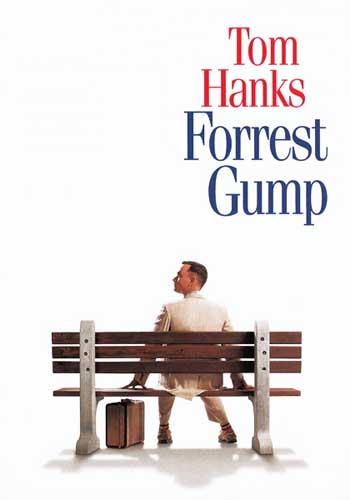 “My momma always said, "Life was like a box of chocolates. You never know what you're gonna get.”
A 1994 drama film based on a 1986 novel by Winston Groom and the name of the title character of both. The film tells the story of a simple man and his epic journey through life, meeting historical figures, influencing popular culture and experiencing first-hand historic events while largely unaware of their significance, due to his lower than average intelligence. The film differs substantially from the book on which it was based.
The title character leads viewers through an accidental travelogue of American social history from the early 1960s through the present in this revisionist fable. Vietnam, desegregation, Watergate and more are presented from the perspective of Hanks' lovably slow-witted character as he finds himself embroiled in situations he can't quite comprehend. The screenplay by Eric Roth has the complexity of modern fiction, not the formulas of modern movies. Its hero, played by Tom Hanks, is a thoroughly decent man with an IQ of 75, who manages, between the 1950s and the 1980s, to become involved in every major event in American history. And he survives them all with only honesty and niceness as his shields.
Yet this is not a heart-warming story about a mentally retarded man. That cubby-hole is much too small and limiting for Forrest Gump. The movie is more of a meditation on our times, as seen through the eyes of a man who lacks cynicism and takes things for exactly what they are. Watch him carefully and you will understand why some people are criticized for being "too clever by half". Forrest is clever by just exactly enough.Forrest Gump teaches you so much about life and the meaning of it. That life isn't as bad as most people make it seem. That an innocent man can impact so many lives with his innocence. The meaning of the movie to me is that everyone needs to have a better outlook on life. That we need to appreciate more of the little things and not let the big things hold us back. That truly although life may throw us trials and tribulations like a box of chocolates but that we have to just bite into it and get through it even if we don't like it. That we all need to hold true to our values and not sink into a place that feels like there's no hope... I just love this movie. And anyone who hasn't seen it or who thinks that don't like it I seriously suggest seeing it or seeing it again. Amazing... 10/10
Mensagens antigas Página inicial
Subscribe to:
Mensagens (Atom)