


Mostrar mensagens com a etiqueta Robert Zemeckis. Mostrar todas as mensagens
Mostrar mensagens com a etiqueta Robert Zemeckis. Mostrar todas as mensagens

"No matter how many obstacles that are thrown in our path, there are ways to accept them and to live through them. Understand life's mysteries – as mysteries to be lived."
Robert Zemeckis is an Academy Award and Golden Globe-winning American movie director, producer and writer. Zemeckis first came to public attention in the eighties as the director of "intricate cinematic jungle gyms" like Back to the Future and Who Framed Roger Rabbit, though he has since diversified into more dramatic fare, including Forrest Gump, for which he won an Oscar.
His films are characterized by an interest in state-of-the-art technology, including the early use of match moving in Back to the Future Part II and the pioneering performance capture techniques seen in The Polar Express.
As a result of winning a Student Academy Award at USC for his film, A Field of Honor, Zemeckis came to the attention of Steven Spielberg. Spielberg said, "He barged right past my secretary, and sat me down and showed me this student film....and I thought it was spectacular, with police cars and a riot, all dubbed to Elmer Bernstein's score for The Great Escape." Spielberg became Zemeckis' mentor and executive produced his first two films, both of which Zemeckis co-wrote with Bob Gale.
1978's I Wanna Hold Your Hand and 1980's Used Cars were well-received critically but both were commercially inert. After a third failure, the Spielberg-directed 1941 (for which Zemeckis and Gale had written the screenplay), the pair gained a reputation for writing "scripts that everyone thought were great but somehow didn't translate into movies people wanted to see”.
As a result of this, Zemeckis had trouble finding work in the early eighties, though he and Gale kept busy. Another Zemeckis-Gale project, about a teenager who accidentally travels back in time to the fifties, was turned down by every major studio. The director was jobless until Michael Douglas hired him in 1984 to film Romancing the Stone. A romantic adventure starring Douglas and Kathleen Turner, Romancing was expected to flop but the film became a sleeper hit.
After Romancing, the director suddenly had the clout to direct his time-traveling screenplay, which was titled Back to the Future. Starring Michael J. Fox, the 1985 movie was wildly successful upon its release, and was followed by two sequels. The Back to the Future sequels sandwiched another Zemeckis project, the madcap 1940s toon-mystery Who Framed Roger Rabbit. After the last Back to the Future sequel, Zemeckis did decide to direct more serious fare, starting with what has been his biggest commercial and critical success to date, 1994's Forrest Gump. The film won Zemeckis an Academy Award for Best Director. In 2000, Zemeckis directed "Cast Away", starring Tom Hanks. This move was called, according to the New York Post, "Gives one of the most towering screen performances of all time.”
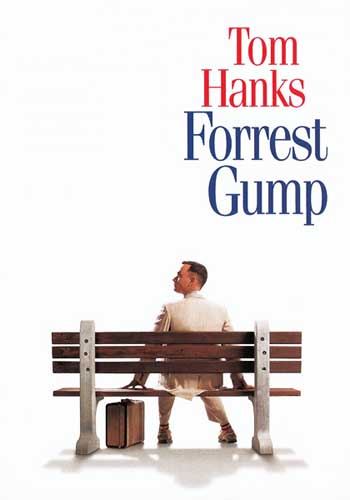 “My momma always said, "Life was like a box of chocolates. You never know what you're gonna get.”
A 1994 drama film based on a 1986 novel by Winston Groom and the name of the title character of both. The film tells the story of a simple man and his epic journey through life, meeting historical figures, influencing popular culture and experiencing first-hand historic events while largely unaware of their significance, due to his lower than average intelligence. The film differs substantially from the book on which it was based.
The title character leads viewers through an accidental travelogue of American social history from the early 1960s through the present in this revisionist fable. Vietnam, desegregation, Watergate and more are presented from the perspective of Hanks' lovably slow-witted character as he finds himself embroiled in situations he can't quite comprehend. The screenplay by Eric Roth has the complexity of modern fiction, not the formulas of modern movies. Its hero, played by Tom Hanks, is a thoroughly decent man with an IQ of 75, who manages, between the 1950s and the 1980s, to become involved in every major event in American history. And he survives them all with only honesty and niceness as his shields.
Yet this is not a heart-warming story about a mentally retarded man. That cubby-hole is much too small and limiting for Forrest Gump. The movie is more of a meditation on our times, as seen through the eyes of a man who lacks cynicism and takes things for exactly what they are. Watch him carefully and you will understand why some people are criticized for being "too clever by half". Forrest is clever by just exactly enough.Forrest Gump teaches you so much about life and the meaning of it. That life isn't as bad as most people make it seem. That an innocent man can impact so many lives with his innocence. The meaning of the movie to me is that everyone needs to have a better outlook on life. That we need to appreciate more of the little things and not let the big things hold us back. That truly although life may throw us trials and tribulations like a box of chocolates but that we have to just bite into it and get through it even if we don't like it. That we all need to hold true to our values and not sink into a place that feels like there's no hope... I just love this movie. And anyone who hasn't seen it or who thinks that don't like it I seriously suggest seeing it or seeing it again. Amazing... 10/10
Mensagens antigas Página inicial
Subscribe to:
Mensagens (Atom)