


Mostrar mensagens com a etiqueta 10. Mostrar todas as mensagens
Mostrar mensagens com a etiqueta 10. Mostrar todas as mensagens
 “Susan Jones, who was wounded in a terrorist attack in Morocco, was discharged from a Casablanca hospital this morning, local time. The American people finally have a happy ending, after five days of frantic phone calls and hand wringing. In other news...”
Alejandro Gonzalez Inarritu's Babel weaves four disparate and seemingly unrelated tales into a distinct, gritty narrative about the importance of communication - and what can happen when it goes awry. The movie is oftentimes difficult to watch, with ultra realistic cinematography and gutsy, honest performances from its entire cast, particularly Oscar-nominated actresses Adriana Barraza (Amelia) and Rinko Kikuchi (Chieko).Told nonlinearly, the movie describes the travails of a troubled married couple with a tour group in Morocco, played by Brad Pitt and Cate Blanchett. Something in their past has driven them apart, and to help deal with the problem they have taken a trip together. Meanwhile, the sons of a shepherd fight over who's the better shot with their new rifle and fire a blast at the couple's tour bus, critically wounding Susan (Blanchett).
Richard (Pitt) calls home in San Diego to notify the nanny of their children, Amelia; Amelia is in a bit of a bind, because she expected the parents’ home so she could attend the wedding of her son in Mexico. With Richard and Susan not returning soon and with no one else available to watch the children, she takes them with her to the wedding.
In Japan, a deaf-mute Japanese girl acts out in reaction to her mother's suicide, which she discovered; the virginal Chieko becomes a huge sexual flirt, even removing her panties in a crowded restaurant to flash older boys. Chieko craves human contact but feels that the world is even more shut off to her now than ever before, and she sullenly shuns even her father's attentions.
It should go without saying that this film really isn't for everyone. It's gut-wrenchingly tough to watch at times, especially when Susan's wound is being treated. You can readily imagine how it'd be if you, an unworldly American, were suddenly in dire need of expert medical attention in a part of the world that wasn't really famed for it. That's enough to strike terror in me already, and I haven't even mentioned how Richard and Susan are awaiting help to arrive in a small, impoverished village with no running water or electricity - and only one person who can speak English to them.
How exactly these stories are commingled becomes evident as the movie progresses, but it's not all elegantly laid out for the viewer to immediately grasp; this is accomplished in part by the nonlinear storytelling. We see a scene near the end of the movie that is a mirror image of one from the beginning, except told from a different character's perspective. That's a tribute to the wonderful camera-work and editing by, respectively, Rodrigo Prieto and the team of Douglas Crise and Stephen Mirrone.
Barraza turns in a powerful, heart-breaking performance; at one point, she's stranded in the middle of the Sonoran desert with her two young charges clad in her dress from the wedding. Dazed by the blistering heat, Amelia cannot gain her bearings in the blazing heat, and she despairs. Then she makes a critical decision with devastating consequences.
Kikuchi is absolutely mesmerizing as the silent Chieko. Without uttering one word, she's able to convey a vast array of emotions, from loneliness to hostility to love to lust to affection. She's alternately serene and violent, in charge of and captured by her impediment. Chieko resents her father, her volleyball teammates, and most of all every so-called normal person who looks at deaf-mutes as monsters, creatures to be scorned and taken advantage of. Like Barraza, Kikuchi's role called for a difficult sacrifice: plenty of nudity.Babel is a spellbinding, multifaceted story with towering, passionate performances by all of the leads. It's full of moxie and stark realism, and despite some minor plot implausibilities, it's a true feather in the cap for Iñarritu… 10/10
 “Always remember your promise to me. Never let nobody or nothing turn you into no cripple.”
It is sad that Ray Charles had passed away shortly after filming for Ray had ended. He did, however, approve the script itself with comfort that the filmmakers really understood his life. The film could have been made years ago, but if it had, it would probably not be as outstanding and breathtaking as this version, simply because nobody besides Jamie Foxx could portray the singer so convincingly. He is the reason that this film works. Whether it is Ray's walking, talking, or even smiling, Foxx covers every detail and sinks into Ray's persona.
The film is not entirely structured as any traditional biographical film. Instead of starting with the events of Ray's childhood, we see him at age 18 as he heads off to Seattle to start his career as a musician. The childhood scenes, especially those related to witnessing his younger brother accidentally drown and the guilt that follows, appear throughout the film as flashbacks. This is an effective method of telling the story, because it is these memories that continue to haunt him as an adult. It would be a major factor in his downhill spiral towards heroin addiction. The childhood scenes also document Ray's blindness from glaucoma and him going off to a school for the blind.
The story in Ray mainly takes place from 1948 to 1965 with one more scene set in 1979. One can easily agree that he was a real musical sensation, and the film nicely shows the record deals made and the friendships with band members along with the problems he had: drug addiction and extramarital affairs. It is an honest look at how Ray Charles had lived. The ups and downs he experienced are effectively presented on screen that one can easily feel Ray's emotions as if we were there with him. What we also see is how it all influences the music he performs.
Jamie Foxx is not the only cast member who deserves credit. I honestly think that every single member of the cast, whether in a major or minor role, has done a great job. Every character, including Ray's mother, his wife Della Bea, the record executives, and the women whom Ray had affairs with, is vivid and full of personality. Kudos especially go to C.J. Sanders, whose role as Ray as a child is both heartbreaking and memorable. This, along with the way the story is told, makes the film shine.The biopic does not cover the last 40 years of Ray's life, but there is no need to. Those last four decades are all years of joy and success. It is the story of the years before that matters since this is when Ray triumphs over his problems. Taylor Hackford and everyone else involved in the making of Ray have done a great job with it. The result is a movie that is a masterpiece and wonderful tribute to the late Ray Charles… 10/10
 “Well, Clarice - have the lambs stopped screaming?”
There are characters who make their entrance in the movie world in such a spectacular way that the actor or actress which played that character risks to be associated with him/her for the rest of his/her career. It's notably the case for Clarice Starling, but especially for Hannibal Lecter. From the moment they appeared for the first time, it became evident that Jodie Foster and Anthony Hopkins would forever be remembered for their iconic roles.
I have to say that it's Hannibal Lecter who impressed me the most. And that's not only the case for me. I allow myself to tell you that anecdote which happened to me. A friend of mine is some kind of horror buff and I decided to test him by showing him "The Silence of the Lambs". He passed the test successfully but I'll always remember his reaction during the famous ambulance scene. When Lecter puts off his mask to reveal his face, my friend instantly gasped. This demonstrates without any doubt the formidable power of Dr. Lecter. His only very presence is frightening. We see him and we are afraid, period.
"The Silence of the Lambs" is the first horror movie in history to be rewarded with the Academy Award for Best Picture. And believe me that it deserves that prize. The Oscars for Foster and Hopkins' acting roles also are. We often associate horror films with ghosts, demons, monsters and other creatures which come from the imaginary and the supernatural. But nothing is more horrifying than what appears real and very plausible. Alfred Hitchcock has already shown that in "Psycho" and director Jonathan Demme raises the bar with this adaptation of Thomas Harris' novel.
The story involves Clarice Starling (played by Foster), a student at the FBI Academy who is also a specialist in serial killers. One of her superiors, Jack Crawford (Scott Glenn), asks Clarice to interview the terrifying psychopath Hannibal "The Cannibal" Lecter (immaculately played by Hopkins) who is also a brilliant psychiatrist, so he could deliver clues which would lead to the capture of Buffalo Bill (Ted Levine), another serial killer actively searched by the FBI.
Lecter accepts to help Clarice, but only to the condition that she feed Lecter's sordid curiosity by confessing herself about her childhood's worst souvenirs. Why is Lecter interesting himself to Clarice's worst days? Does he want to weaken her? Does he want the bad guy to win? Or is he only a sadist and a pervert? I would go with the latter affirmation.
I think that it is useless to specify that, of all the characters, Hannibal Lecter is by far the best and the most fascinating. The other characters describe him in such a frightening and horrible way that we fear him well before we see him for the first time. And when we see him for the first time, we instantly remark his cold and menacing eyes, as well as his disturbing grin. Himself a serial killer, we can consider Lecter as one of the worst (or best, depending on how you read it) villains in the history of cinema, even if we see him killing only once. And precisely, his attack is very stylish. He kills both policemen on the strains of Johann Sebastian Bach's "The Goldberg Variations" and once he accomplished his work, we see him stained with blood, just like a painted how has just finished from making a new painting. That scene establishes a shocking parallel between murder and art.
But Lecter is only one side of this story. In fact, he's only a sub-plot. The true story involves Buffalo Bill's actions. Bill, brilliantly played by Levine, acts in nearly the whole Midwest, but his victims always are rather fat young women. Unlike many movies which hide their killer until the very end, we often see Bill in this film, even if we don't know his true identity, nor the frightening motives of his crimes until the end. The only thing we can discover about Bill is his appearing mental problems which push him to kill.
The horrors of the film aren't limited to the killers themselves. The movie is strewn with blood-chilling naturalistic images, especially the images of corpses who got parts of their skin removed. And how could we forget this unbearable image of the dead policeman with an open abdomen posing like an angel who is about to take off?
There's also a good dose of suspense, especially at the end when Clarice is chasing Bill in his labyrinthine basement. The climax of the pitch-black room while Bill is wearing his night goggles to see in the absolute darkness is breathtaking and holds suspense until the conclusion. At this moment, we're totally absorbed in that cat-and-mouse game at the point that we totally forget Lecter's existence.
"The Silence of the Lambs" is an excellent example of the horrors of the criminal acts and of psychological horror aroused by childhood traumas. Overall, the film is an immense metaphor about the horror of modern world and wants to get sure that the viewer leaves weakened and less in security than before he got inside the theater. The sinister soundtrack of Howard Shore adds to the already sordid atmosphere and the Q. Lazzarus song "Goodbye Horses" adds even more with its broken notes which resonate and give goosebumps. Personnaly, each time that I hear that song, I start thinking about Buffalo Bill who cross-dresses in front of the camera with that song playing in the background.
"The Silence of the Lambs" is a grandiose spooky symphony well-carried by Foster and Hopkins whose roles are already a part of the legend. The numerous references of the movie in the popular culture keep it well alive more than fifteen years after its release. Everybody, at least those who are able to stand horror images, should watch this movie at least once in their life… 10/10
 “You talkin' to me? You talkin' to me? You talkin' to me? Then who the hell else are you talking... you talking to me? Well I'm the only one here. Who the fuck do you think you're talking to? Oh yeah? OK.”
If a picture is worth a thousand words then this movie (moving picture) is worth a million words, which is why it has probably generated at least a million words.
What can one say… The obvious: that "Taxi Driver" is great, it is. That it is a masterpiece, it is. What sets this film apart from so many other films, including great films, is that it is an enigma. Every time I watch this film I see something else, I notice something else, I feel something else, I wonder something else. And I am, clearly, not the only one who reacts to the film this way that is why it lends itself to endless speculation and discussion.
Travis Bickle is the sort of person you wouldn't even see if you encountered him on the street - and if you did take note of him, you would make a point to ignore him. He is a non-entity. In his role as a cabbie, you would be aware of him only in the same way you would notice the color of the upholstery or be aware of a strange smell inside the cab.
On the rare occasion that Travis might make his presence felt, you would tolerate his existence - maybe even graciously acknowledge him with a smile or a noncommittal comment. You would only remember Travis if he said or did something particularly rude or offensive or bizarre; and then only as long as you might remember what you had for lunch or what your horoscope said.
There is no reason to remember, or to feel bad about not remembering, a Travis Bickle because he has no real effect on your life. He does a job, he fills a space; just like millions of other anonymous everyday workers. But the sad thing about Travis is that he has no real effect on anyone. Most people have a life - family, friends, interests, a purpose beyond being part of the machinery. Travis only has a job. You would not notice Travis, but Travis might notice you. And judge you: He might decide that you are part of what makes life worth tolerating, but more likely he might see you as part of what makes the world an unbearable hell.
It is the nature of film that when it casts an eye toward the "little guy," the attempt is to show that the ordinary man has something extraordinary about him that society is missing - even if that is just an everyday niceness. This being a Martin Scorsese film, written by Paul Schrader, filmmakers with a near-suicidal view of mankind, the point of Taxi Driver is just the opposite. If Travis Bickle is a remarkable person in any sense, it is in a negative way. Travis is not a good man; he is petty and mean-spirited and bigoted and self-absorbed and judgmental. He views the world with contempt; he has to, he has to have more hate for the world than he has for himself.
Taxi Driver is the story of a man living the proverbial life of quite desperation. In self-imposed isolation, Travis is mentally unstable, and probably was long before the film starts. Travis, like Norman Bates hides his insanity behind a facade of banality and nurses it with his loneliness. Insignificant men with a significant amount of pent up anger. The main difference - and it is a telling difference - is that we don't see Norman's rage until the end, it takes us by surprise; while we never doubt that Travis has inner demons. What Travis does is a foregone conclusion.
Paul Schrader's dark, oppressive script pointedly refers to Travis as a walking contradiction, often at the cost of the story's credibility. He's not particularly bright and at times almost shockingly slow, but his journal entries are surprisingly articulate. He declares a woman to be "an angel," but is dismayed that she is offended by being taken to a porno film. He claims to have an honorable discharge from the marines, yet he seems to have been born yesterday, not even knowing the meaning of a common phrase like "moonlighting." Schrader's superficial screenplay is long on obscenities and racial slurs, but short on simple logic.
The shortcomings of the script are offset to a great degree by solid performances and Scorsese's stylish direction. As Travis, Robert DeNiro is in virtually every scene and even though the screenplay falters at various times, DeNiro holds the film together with a consistency of tone and insight. Forgoing his usual bombastic method posturing (during most of the film), DeNiro plays Travis with a compassion that makes this otherwise horrid little man pitiable, if not sympathetic. He makes us care for Travis, even though the story offers us no real reason to. Jodie Foster, playing the child prostitute to whom Travis hopes to play savior, still has the youthful freshness and wise innocence that made her a treasure as a child actress.
Scorsese sees in Travis' New York City a teeming cesspool, but with cinematographer Michael Chapman, he makes it the most photogenic cesspool imaginable. He doesn't romanticize New York, but he does romanticize Travis' seething hatred of the city. However, he does wisely counterpoint Travis grubby view of the world with a sense of a real world, where friends and co-workers joke and talk and, well, exist. Unlike Raging Bull, Goodfellas and Casino, Scorsese films where psychotic characters exist in closed worlds where their lunatic behavior seems the norm, Taxi Driver underscores Travis' outsider status by giving us a realistic world that he is isolated from. As such, Taxi Driver has an honesty that his other violent epics lack.
But Scorsese provides us with at least two scenes that ring utterly false. His own gratuitous cameo as a passenger graphically boasting of his plans to murder his wife seems to be Scorsese's way of showing that there are people who are even crazier than Travis. Why? To suggest that Travis is justified in his paranoia? Also the final climatic bloodbath provided only a cheap shock at the time and now seems like a tiresome cliché of special effects gore. Such over the top mayhem doesn't underscore the brutality of the violence, it trivializes the rest of the film. Taxi Driver, like DeNiro's performances, is best in its still moments of quiet desperation.
The irony of the violence is that it eventually makes Travis famous, though it could have just as easily have made him infamous. The bullets that kill the pimp could have killed the politician. In Travis' mind they are pretty much the same. Unfortunately, I don't think some people get that. Travis, in the end, is not a hero, he is a murder. He is not purged of his demons; they are just temporarily placated. The famed "you talking' to me?" scene has reached iconic status, symbolic of tough-guy cool - not unlike Dirty Harry's "Make my day." But both Travis and Harry are dangerous icons; filmgoers delude themselves into accepting their insane displays of violence because the right make-believe characters get killed. They are protected by the fantasy of film; in the real world they would eventually be revealed to be the monsters. To his credit, Scorsese at least suggests that in the end Travis Bickle is still insane, and armed and dangerous.
Even so, the ending is uncomfortably ambiguous: I don't think that Scorsese is as afraid of Travis' insanity as he is in awe of it… 10/10
 “How much courage does it take to walk out on your kid?”
Sometimes, simplicity wins over the rest. In a book, a simple story might be favored. In a meal, something simple may be what you crave. But in a movie, most people do not want simplicity. They want the whole shebang. They want a spectacle. Mostly, they aren't right. Simplicity has made many movies. Kramer Vs. Kramer is one of them.
Life was going great for New York City advertising artist Ted Kramer. He had a great job and a loving wife. No, actually, his wife wasn't so loving, for when Ted returned home late from work that night his wife, Joanna, had a suit case packed and was heading out the door. He tried to stop her, but she just got into the elevator and out of Ted's life. Well, now in addition to his job he's now got to mind the house as well as their 6-year-old son, Billy; Ted assured his boss that his wife's leaving would not affect his job performance in any way. It did however affect his performance as a father. He blew up when Billy spilled punch on his client artwork! Well, some time later Ted and Billy receive a letter from Joanna, and it was obvious from her letter that she wasn't coming back. Ted was distraught. Well, he was late coming home from work on Billy's birthday, which made Billy sore at him.
Ted was late to work one day and his boss yelled at him because he had missed a very important client meeting. When he got home, he yelled at Billy for sneaking ice cream during dinner. Then later he truthfully told Billy that the break-up between he and Joanna may have been his fault, not Billy's; Ted invited a good friend, Phyllis Bernard over that night, and well, Billy got his first look at a naked woman. When Ted took Billy to the park the following day, he fell off the jungle gym and landed face-first onto his toy plane. Ted literally ran him to the hospital where they had to administer stitches. After that, life began taking a downward spiral for Ted. Then one day out of the blue he received a phone call from none other than Joanna! They met in a corner café. At first they have a pleasant conversation but then Joanna informs him that she has returned to collect her son and take him with her. Ted would have none of it and stormed out. Well life got even worse for Ted when his boss, Jim O'Connor, took him out to lunch and abruptly fired him. Not only that but Joanna was choosing to sue for custody of Billy, and without a job, Ted didn't stand a chance in hell for winning. He hired himself a lawyer, John Shaunessy, who charged a pretty penny: $15,000 exact change. And that's if they win.
Ted was also able to find a new job. It was actually a step down from what he used to do with a considerable cut in salary but he accepted with great determination. Finally the court date, January 9, 1980, arrived. Judge Atkins presiding. Joanna took the stand and Shaunessy proceeded to question her about why she left Ted and about her other relationships and how they were failures. The next day, Ted took the stand and Joanna's lawyer really grilled him like a cheeseburger. Ted's good friend Margaret took the stand as well and she really didn't help matters. Well, the judge took some time to think it over and sure enough, one day Shaunessy informs Ted that he lost. Joanna got sole custody of Billy. How typical! Always ruling in favor of the mother. Well, Ted and Billy were just devastated about parting ways. They had a tearful goodbye when suddenly Joanna stopped by. She and Ted have a little talk and well, rather than just give away the ending, let me assure everybody that everything turns out alright for everybody!
Dustin Hoffman was very good. He earned that Academy Award. Meryl Streep was good. She also got an Oscar. Justin Henry was good too, so where was his nomination?. This movie has great drama, light comedy, and is very subtle. It does a good job of holding your attention. If you like Dustin Hoffman or Meryl Streep or movies of this genre, then I recommend Kramer vs. Kramer! A gripping film about the pangs of two divorced parents fighting over their child. I liked Ted's little speech about ruling in favor of mothers all the time. What was it about sex that makes a good parents? Why always rule in favor of the mother because she's a woman?
Kramer vs. Kramer" is a great film from start to finish. Writer-director Robert Benton has made a film that's absolutely unforgettable… 10/10
 “We were on a break!”
Friends was created in 1994 by David Crane and Marta Kauffman as a followup to their cable series Dream On. Friends was aimed at young adults who, during the early 1990s, were identified by their café culture, dating scene and modern independence.
Originally to be named Across the Hall, Six of One, Insomnia Cafe, or Friends Like Us, Friends was produced by Bright/Kauffman/Crane Productions, in association with Warner Bros. Television, for NBC in the U.S., and was first broadcast on that network. The show was a huge success throughout its ten year run and was a staple of the NBC Thursday night line-up. The finale was one of the most-watched series finales in television history, behind only M*A*S*H, Cheers, and Seinfeld.
Two of the series' stars, Matthew Perry and Jennifer Aniston, had already appeared in several unsuccessful sitcom pilots. Another, Lisa Kudrow, was also familiar with working on sitcoms, having played Ursula Buffay on Mad About You. Courteney Cox was already an accomplished TV and film actress when she was cast in 'Friends', having appeared in the likes of Ace Ventura: Pet Detective and with several minor roles on sitcoms such as Seinfeld and Family Ties. The character of Ross was written with David Schwimmer in mind; having auditioned for Crane and Kauffman in the past, Schwimmer was said to have a memorable voice and was most known for his Broadway work. Matt LeBlanc appeared as Vinnie Verducci in Married... with Children in the early 1990s and starred in that sitcom's short-lived spin-off, Top of the Heap, as well as in the unrelated Vinnie & Bobby, but before that had mainly been focusing on advertising and modeling work when he was cast as Joey Tribbiani.
During the show's run, the cast all achieved household name celebrity status, and all pursued careers in the movies, with varied success. Aniston's movie career is predominantly populated with light rom-coms. Cox made several lightweight films, though achieved her greatest success with the Scream series. Kudrow fared best in low budget indie films - a far cry from the role of Phoebe, most notably The Opposite of Sex. The male cast fared less well in the movie world.
During the 1994-2004 run, four of the cast married. Kudrow was first to marry in 1995 to advertising executive Michel Stern. Cox married next in 1999, wedding Scream co-star David Arquette. Aniston married film star Brad Pitt in 2000 and Le Blanc married long-term girlfriend Melissa McKnight in 2003.
Behind the scenes, the show was known for its unusually cohesive and unified cast. The six main actors made deliberate efforts, from early on, to keep the show's ensemble format and not allow one member to dominate. This included requesting that all actors on the show be nominated either for the same category of award ("Supporting Actor" until 2001, then "Lead Actor" from 2002 onwards) or not at all, and entering collective instead of individual salary negotiations. The actors became such close friends that one guest star, Tom Selleck, reported sometimes feeling left out. The cast remained good friends after the show's run, most notably Courteney Cox and Jennifer Aniston, with Aniston being godmother to Courtney's daughter, Coco.
It also scores with it's realistic progression over the last six years. Season One and Season Ten are totally different, and show how much the characters have grown.
In short, Friends is the show of shows. A sitcom where no episode is a disappointment. How many sitcom's can say that? 10/10
 “It's too bad she won't live! But then again, who does?”
This film is probably the most brilliant science-fiction film ever made and it works on many levels. The film is a view of a terrible society. The opening scene of Blade Runner is a brilliant vision of dystopia. Fireballs fly upwards from a bed of lights into a black sky, huge chimneys release pollution and neon lights light up huge advertisements. This oracle of the city of Los Angeles in 2019 appears more like hell than earth. It is a post-apocalyptic concept on excessive capitalism and the blunders of the technological age that reveals itself clearly in the representation of buildings as virulent growths. The street level is crowded, dirty, and congested and gives us a brilliant example of the often-questioned `cyberpunk' milieu. Punks, midgets and other weird and wonderful people wander the streets, a lot of them being Asian giving the impression of the technological Tokyo gone mad.
Blade Runner is a very philosophical film. Roy Batty, played by Rutger Hauer, leads a team of androids (or in the film's terms, replicants) who arrive in Los Angeles from the Off-World colonies in order to face the head of their manufacturer, the huge Tyrell Corporation. Replicants are limited to a four year life span and this group of them want to find a way to extend their intentionally restricted life-spans. Replicants are not allowed on earth under penalty of death. They are hunted by Rick Deckard, played by Harrison Ford, who belongs to a special police unit known as Blade Runners that hunt down replicants. The many questions it asks are, `What does it mean to be human?' `What separates humans from technology?' and ultimately, `What is the meaning of life?'. The film asks these questions but doesn't answer them (because these are unanswerable questions) and leaves the viewer to decide for himself.
In my opinion, the director's cut is the superior film. The `original' film (the director's cut is the true original, it was the film that was meant to be until they decided to add a voice-over and happy ending) is a lot less poignant and it forces the viewers to make decisions but it is still an excellent commentary on society.
Blade Runner is a sophisticated and complex film, memorable both in style and substance. It has so many aspects that can be discussed that I haven't gone through here such as the religious imagery, the iconography, the representation of race and the technology. The cinematography is so brilliant, each shot is good enough to be made into a poster, the acting is top notch, the inspired story is brilliant and a huge talking point and the Vangelis score works very well. It is an important film in the development of cinema, too, because it is the first identifiable `cyberpunk' movie and it has developed a massive cult following.
If you are not someone who naturally enjoys contemplating such themes, the film's brilliance may be lost on you. The climax involves a soliloquy that brings many of the themes together in a simple yet wonderfully poetic way. Anyone who "gets" the film should be moved by this; others will sadly miss the point and may prefer watching some mindless action flick instead.A masterpiece that deserves recognition and long remembrance in film history... 10/10
 “I remember one morning getting up at dawn, there was such a sense of possibility. You know, that feeling? And I remember thinking to myself: So, this is the beginning of happiness. This is where it starts. And of course there will always be more. It never occurred to me it wasn't the beginning. It was happiness. It was the moment. Right then.”
"The Hours" more than lives up to its critical praise. If nothing else it is a must see for the originality of the technique. The film (and the book by Michael Cunningham) is structured around the process of linking up three stories set at different points in time. Each story concerns a woman trying to define herself, to identify what she needs, and to find a way to get it.
The 1920's story concerns Virginia Woolf's (Nicole Kidman) efforts to write her first successful novel, "Mrs. Dallaway"; which is the story of one day in the life of a woman named Clarissa Dallaway. The story set in the early 1950's concerns Laura Brown (Julianne Moore), a woman who is reading "Mrs. Dallaway". Finally the contemporary story concerns Clarissa Vaughn (Meryl Streep) who is essentially living Mrs. Dallaway's life in modern NYC. All three performances are extraordinary in their own unique ways and there are wonderful performances from all members of the supporting cast. It is as if each member of the ensemble brought out the best in each other.
Each story begins with the husband/lover of each woman leading the camera to the woman. All three women are found in bed and this begins a match cut process that will repeat itself throughout the film as the director and editor work to connect and unify the three separate stories. Woolf writes: "Mrs. Dallaway said she would buy the flowers herself" just as Laura Brown reads that sentence and Clarissa speaks that sentence.
Kidman's Woolf is an amazing character. She is a psychological mess, making life difficult for those around her and full of torment and despair. Yet she has a subtle charm that helps you to understand why people found her fascinating.
This is an ambitious character study film with many characters. By necessity, both films rely more on behavioral language than dialogue in revealing the personality of its characters. Note Laura Brown's neatness obsession as she readies her house and herself prior to leaving for the hotel.
Woolf began the book "Mrs. Dallaway" with the intention of basing it on a society woman she knew who unexpectedly committed suicide. Brown describes the book to her neighbor as: "Oh, it's about this woman who's incredibly - well, she's a hostess and she's incredibly confident and she's going to give a party. And, maybe because she's confident, everyone thinks she's fine... but she isn't".
At its core this is a movie about art but it is a broad definition of art, writing a book - baking a cake - giving a party. Each woman/artist is driven and frustrated by a need for unattainable perfection. There is a touch of irony to each situation. For example, Laura Brown is where she is because her husband has pulled her into the great American dream without realizing that it was the worse thing he could do to her. Although all three women love their children/child/niece, those relationships do not give them what they need.
There is a visitor and a kiss in each story central to the self-definition process each woman is going through. Virginia kisses her sister Vanessa (Miranda Richardson), desperately trying to force a better connection with her. Vanessa understands this, she is not shocked by the kiss but by the implication that her sister needs this so desperately.
Sophie Wyburd who plays Virginia's young niece was obviously cast for her haunting voice and her ability to display such a focused intensity. Each woman has a child picking up on their needs, which the adults around them do not seem to be aware of.
Watch the scene where Laura's husband is urging her to come to bed. Moore's voice does not betray the revulsion or the internal struggle which only viewers can see on her face. In fact at this point each woman's partner is urging her to go to bed but each must first a make choice. Then watch for the great match cut, Virginia announces that she has decided that the poet will die in her novel and they cut to little Richard lying in his bed. Moore's expression finally tells us that she has decided to leave her family. Streep's kiss signifies her recognition of the preciousness of what she still has in her life and her choice to embrace it and move forward.
Ultimately this film is about the increasing difficulty we have as we get older in making choices. This is because as we discover who we are, we also experience loss and accumulate grief over the course of our lives, making us ever more aware of the cost of our choices. Clarissa looks back on a short moment that she thought was the beginning of happiness and realizes that it was her only moment of actual happiness… 10/10
 “You can think I'm wrong, but that's no reason to quit thinking.”
House, originally titled House, M.D., is a critically-acclaimed American medical drama television series created by David Shore and executive produced by Shore and film director Bryan Singer. The Emmy and Peabody Award-winning medical drama debuted on the FOX Network on 16 November 2004. The series is currently the most watched program on FOX.
House stars British actor Hugh Laurie as the American title character, a role for which he received the 2006 and 2007 Golden Globe Awards and 2007 Screen Actors Guild award for Best Actor in a Drama. In February 2007, House was renewed for a fourth season, which premiered on September 25, 2007 in the United States and Canada.Gregory House is a maverick medical genius, who heads a team of young diagnosticians at the fictional Princeton-Plainsboro Teaching Hospital (based directly on the Yale-New Haven Hospital in New Haven, Connecticut, the teaching hospital affiliated with Yale University) in New Jersey. Most episodes start with a cold open somewhere outside the hospital, showing the events leading to the onset of symptoms for that week's main patient. The episode follows the team in their attempts to diagnose the illness.
The team arrives at diagnoses using the Socratic method and differential diagnosis, with House guiding the deliberations. House often discounts the information and opinions from his underlings, pointing out that their contributions have missed various relevant factors. The patient is usually misdiagnosed two or three times over the course of each episode, often with sarcoidosis, lupus, cancer, or an infection, and treated with medications appropriate to those diagnoses that cause further complications. Often the ailment cannot be easily deduced because the patient has lied about symptoms and circumstances. House frequently mutters, "Everybody lies," or proclaims during the team's deliberations: "The patient is lying," or "The symptoms never lie." Even when not stated explicitly, this assumption guides House's decisions and diagnoses.House's begrudging fulfillment of his mandatory walk-in clinic duty is a recurring subplot on the show. During clinic duty, House confounds patients with an eccentric bedside manner and unorthodox treatments, but impresses them with rapid and accurate diagnoses after seemingly not paying attention. He often plays video games on either his PSP or his GBA SP while patients or one of his colleagues talk to him, and in one episode House diagnoses five patients in the waiting room in under a minute on his way out of the clinic. Realizations made during some of the simple problems House faces in the clinic often help him solve the main case of the episode - ironic, because he claims to hate working in the clinic.
Episodes frequently feature the unusual practice of entering a patient's house with or without the owner's permission in order to search for clues that might suggest a certain pathology. The creator, David Shore, originally intended for the show to be a CSI-type show where the "germs were the suspects," but has since shifted much of the focus to the characters rather than concentrating solely on the environment.A running joke in the series is that Lupus is suggested as a cause of the patient's symptoms in many episodes, although invariably this is quickly dismissed. In one episode, House produces some of his secret Vicodin stash from inside a hollowed-out Lupus textbook; by way of explanation, he says, "It's never lupus." Lupus is one of the medical conditions known as The Great Imitator, because it can present with a wide variety of symptoms.
Another large portion of the plot centers around House's abuse of Vicodin and other drugs to manage pain stemming from an infarction in his quadriceps muscle some years prior which causes him to walk with a cane (ironically, House was unable to diagnose his own infarction before it damaged his leg). The pain and drug abuse act to increase many of his more objectionable character traits while not impairing his medical acumen, which leads him to often self-medicate. Overall, House is thus presented as a classic flawed hero.
House is in many respects a medical Sherlock Holmes. This resemblance is evident in various large elements of the series' plot. House, like Holmes, often relies (particularly in his clinic cases) on apparent minutiae to make accurate snap judgments about his subject's lives. He also displays a keen interest in individual psychology as a piece of his larger analytic method. House is addicted to Vicodin, but he can get along without it when the case is interesting; similarly, Holmes used cocaine out of boredom when he did not have a good case. Both play a musical instrument: House plays the piano and the guitar, Holmes plays the violin. These thematic parallels are confirmed, and hammered home, by various otherwise-trivial plot details. For example, Holmes lived at 221B Baker Street, and House's street address, as shown in "Hunting" Season 2 Episode 7, is also 221B. Moreover, the name "House" itself can be read as a pun on "Holmes" ("homes") and the name of House's friend James Wilson is a direct reference to Holmes' side-kick John Watson. Another confirmation is in House's encounter with a crazed gunman credited as "Moriarty" - the same name as Sherlock's nemesis… 10/10
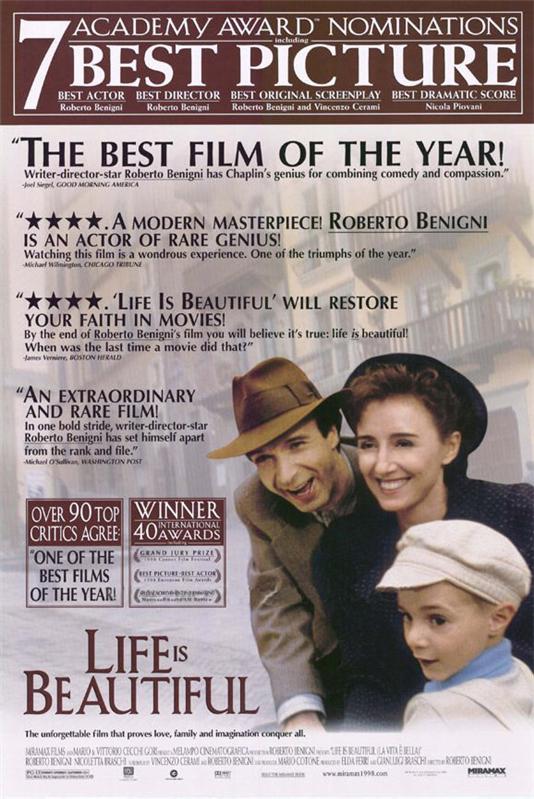 “The game starts now. You have to score one thousand points. If you do that, you take home a tank with a big gun. Each day we will announce the scores from that loudspeaker. The one who has the fewest points will have to wear a sign that says "Jackass" on his back. There are three ways to lose points. One, turning into a big crybaby. Two, telling us you want to see your mommy. Three, saying you're hungry and want something to eat.”
Mixing humor and the Holocaust isn't anything new: Ernst Lubitsch's 'To Be Or Not To Be' is just one enduring classic; Mel Brooks' 'The Producers' is another; and 'Life Is Beautiful' has the small-town charm and ambiance of 'Amarcord,' and light-straight satire of 'The Great Dictator.'
Set against the stark reality of World War II Europe, Roberto Benigni's sentimental fable is not a film about the Holocaust, it's a film about life and hope merely against the backdrop of the Holocaust... It's not a denial of the Holocaust, it is a manifestation that humor itself can be courage... It's not about betraying the experience of millions of Jews, it is about the great lengths a father will go to protect his family from the horrors of the Nazis... It's a demonstration of the power of cinema, it's art without claim, hope without fear, dreams without limitations... It's a motion picture about love, not a documentary about the Nazis... It delivers a powerful message that despite everything - life is truly beautiful...
The story begins in 1939 Italy, where a simple, free-spirited Italian Jew Guido Orefice (Benigni) and his poet friend Ferrucio (Sergio Bini Bustic) have dreams of owning their own bookstore. For now, however, Guido must be satisfied to wait tables, while Ferrucio is unable to get a job. Benigni's character is introduced during a long set of fast comedy scenes, particularly when he meets a cute gentile woman, Dora - Nicoletta Braschi: when she 'falls out of the sky,' and he quickly nicknames her 'Principessa', when he rides, in a fascist ball, on a horse painted green, when he turns a gloomy rainy night into a red carpet event, when he is caught by the Nazis as he hurries about securing the safety of his wife and son, when his car speeds, without brakes, through a village and is mistaken for a king...
Guido falls hard for the radiant schoolteacher, daughter of a wealthy family, and pursues her with all the charm and imagination he can discharge: in one sequence, he pretends to be a school inspector and gives an impromptu speech on racial superiority before the assembled students and teachers, ending with a striptease...
That hilarious side of the film takes up the first half. Benigni (who also wrote and directed) borrows a bit of Chaplin's grace and a bit of Groucho Marx charm: all of the action is so neatly contrived that the film essentially ends when it's over, and then begins again with the introduction of Guido and Dora's cute five-year-old son Giosue (Giorgio Cantarini) few years later...
There, in 1945, we catch a glimpse of their enchanting household, but things are soon shattered, and the Nazis take Guido, with his tolerant uncle (Giustino Durano) and little Giosue off to an unidentified concentration camp. Dora races to the train station and demands to be put also on the train...
At the death camp, and in order to protect his son from the nightmare of the place, Guido uses his imagination by creating the illusion that everything that's happening is just a game, an epic game that will be exciting and fun. He convinces Giosue that by hiding from the Gestapo soldiers (whom he refers to simply as the "men who yell a lot") and maintaining silence, he can gain the necessary points to win a tank. Not a toy tank, but a full-size tank, which they'll be free to take home...
As co-writer, Benigni (with Vincenzo Cerami), doesn't just mix drama and comedy, he often hides drama in the comedy. The film does not dwell on the horrors of the camp, nor does it ignore them...With a memorable score by Nicola Piovani, "Life Is Beautiful" is an important film, triumphant, timeless, and sublime... It manages to entertain, educate, and move with its potent combination of humor, poignancy, and dignity... Roberto Benigni has taken pure horror and turned it into a love story between a man and a woman, between a father and his son… As an actor, Benigni manages with his wise and simple performance to make us laugh in tragic situations… He was very realistic, natural, distant from great special effects, far from Hollywood style, only nice and beautiful cinema... 10/10
 “It's the sense of touch. In any real city, you walk, you know? You brush past people, people bump into you. In L.A., nobody touches you. We're always behind this metal and glass. I think we miss that touch so much, that we crash into each other, just so we can feel something.”
"Crash" is a complex movie with a simple premise: set in Los Angeles it follows 8 main characters (and many, many more supporting) from all walks of life and races whose lives intersect at some point during one 24 hour period. These people are all different yet all alienated, to the point of breaking, so much so that when they come together, things explode.
The complexity of the film comes from the encounters between characters and their tangled lives and worlds. Haggis' screenplay is so intricate and delicately written I couldn't begin to try to summarize the actual plot line (which destines this article to be kind of vague), but everyone meets everyone else at some point in the film (and there are a whole lot of characters). Sufficed to say these meetings are variably intense, casual, fleeting, dangerous, but they all effect the participants in profound and provocative ways, causing lives to find enlightenment or swerve violently, and watching it all unfold is mesmerizing because Paul Haggis (Oscar Nominated writer of Million Dollar Baby) made the film meaty with messy characters and topics and stories to chew and hurtle along with.
The all-encompassing theme of the film is racism, and it is dealt with bluntly, honestly, and without reservation. Every single character participates in the perpetuation of the ugly cycle but also suffers because of it. Where racism makes for an interesting enough subject for an already provoking and fairly experimental film, it's only the catalyst for a deeper, resounding story of redemption and the universality of our lonely situation which the movie becomes during its second hour. It switches from a somewhat depressing contemplative amalgamation of moments about racism in everyday life and how destructive it is, to a throbbing, intense web of choices and consequences - life and death, vivifying or soul killing - and the chance at redemption.
Following their actions in the first hour of the film, everyone meets a fork in the road or is given a second chance of some sort. Some take it, some don't, but regardless, by the end of the movie everyone has changed. This is what gives the movie wings during its second hour, makes it interesting, keeps you guessing and on knife's-edge. It also gives the characters depth and souls and shows that despite perceived and upheld differences, when it comes down to it we aren't different (which we see in a shattering scene between Ryan Philippe and Larenz Tate after Tate notices that he and Philippe have the same St. Christopher statue), in fact we desperately need each other. It's one of the few films I've seen where everyone is at fault somehow and yet there are no villains. It makes it hopeful, particularly with something as ugly as racism: everyone's fallible, but everyone has the capacity for good and nobility. That said, each of these character's inner struggles makes for all the conflict and resolution you need.
A talented ensemble drives the film, sharing almost equal amounts of screen time, but the folks who really stood out and had my full attention each time were Terrence Howard (plays a TV director), Matt Dillon (as a patrol cop), Sandra Bullock (a rich housewife), Don Cheadle (a detective), and Michael Peña (a locksmith). These five gave deeply, deeply felt performances portraying a wide range of emotions and personal situations, giving souls - alone, yearning, and searching in a world that doesn't seem to care-- to shells of imperfect people. But the actors triumph in little moments of human contact: a glance, an embrace, a pause, a smile, a wince, things that breath the film to life and with simple visuals give it profundity. This is beautifully illustrated in a small scene between the downward spiraling Jean (Sandra Bullock) and her maid after she's begun to realize all her problems may not be about the two black guys who car jacked her, but her own life.It's impressive, with his debut Haggis made a film that magically maintains a storytelling balancing act about people's lives that almost seamlessly flows, takes an honest look at racism with an understanding of mankind, a belief in redemption, and even hope. As I walked out of the theater into the rainy night it resonated with me and colored my thoughts as I made my way through the crowds of unknown fellow people filling the cinema. That's about all I can ask for in a film… 10/10
 “Chapter One. He was as tough and romantic as the city he loved. Beneath his black-rimmed glasses was the coiled sexual power of a jungle cat. I love this. New York was his town, and it always would be...”
“Manhattan” does not fit the normal template for a successful film. In 1979, black-and-white photography had been out of favour in the cinema for over a decade. The film has little in the way of action, with more attention paid to dialogue and character development. Although there is humour, and the plot concerns the emotional entanglements of a group of friends, it is not a romantic comedy in the normal sense of the term. All the above points might seem to be weaknesses, and in some films they would have been. In Woody Allen's hands, however, what might have been weaknesses become strengths.
The central character in the film is Isaac Davis, a writer, played by Woody Allen himself. Isaac is divorced from his bisexual wife Jill, who is now involved in a lesbian relationship, and is dating Tracy, a seventeen-year-old schoolgirl. Isaac, however, is also finding himself drawn to Mary, the mistress of his best friend Yale. Yale is married and conducting a secret affair with Mary, who is becoming dissatisfied with the relationship because Yale seems reluctant to leave his wife Emily.
The above outline of the plot might give the impression that it is all very much standard Woody Allen stuff; the emotional difficulties of a bunch of self-centred, neurotic middle-class New Yorkers. Such an impression would be, at most, a half-truth. Although Woody has dealt with similar material in a number of other films (most recently in "Melinda and Melinda"), "Manhattan" represents one of his greatest accomplishments, rising above even his own normal high standards. The main reasons for this are the quality of the acting and the quality of the script. All six of the main roles are played very well. Emily and Jill may be minor characters in terms of on-screen time, but both are important in terms of their contributions to the plot. Anne Byrne's Emily is attractive, but we can sense a certain coolness and reserve about her and understand how her husband might have been drawn to another, more vivacious, woman. Jill (Meryl Streep in one of her earliest film roles) hides her bitterness and vindictiveness beneath a veneer of honesty and truthfulness. She publishes a book which she claims is an honest account of her marriage and divorce but which in reality is merely a device for revenging herself on her ex-husband.
The other four main characters form a sort of eternal quadrilateral instead of the more usual triangle. Isaac is a nervous, insecure intellectual who uses a sort of self-deprecating humour as a cover for his insecurities. This is the sort of part that we have come to associate with Woody Allen, but he has seldom played it as well as he does here. There is perhaps less concentration on humour than in some Allen films, but even so Isaac still manages to deliver some classic lines. ("I think people should mate for life, like pigeons or Catholics"). Diane Keaton's Mary is outgoing and lively but also conceited, self-centred and something of a pseudo-intellectual. She and Yale, another self-centred character, probably deserve each other. For me, however, the best and most perfectly-judged contribution came from Mariel Hemingway as Tracy, played here not as a precociously seductive Lolita or as a spoilt brat but as a charming but vulnerable girl next door. Perhaps more important, however, than any individual performance is the way in which the characters relate to one another; it is a film where the whole is greater than the sum of the parts. A musical analogy might be with a quartet, where a small group play together in harmony, rather than with a concerto which is dominated by one bravura performance.
Like many other lovers of this film, I was particularly impressed by the striking black-and-white photography of New York locations, particularly in the opening scenes. As one might expect from a director who is himself a talented musician, Woody normally pays a lot of attention to his musical scores; here the music of George Gershwin, particularly his "Rhapsody in Blue", seems very appropriate to the mood of the film. These factors contribute greatly to the success of this film, but for me it is perhaps most memorable as Woody's most penetrating analysis of human relationships. It is a film that I find more in every time I see it… 10/10
 “Help me Charlie, I wanna sing for no reason.”
Charlie is a successful and affluent bachelor in his mid-thirties who has a career writing advertisement jingles. Charlie resides in a large ocean front home in Malibu, California, and is portrayed as a chauvinist womanizer. The plot begins when his uptight brother Alan becomes divorced from his wife, loses his house to her and has to move in with his brother. His 10-year-old son (now 14) Jake often stays for weekends and at other times.
Rose is Charlie's zany neighbor and female stalker. We learn Rose had a one-night-stand with Charlie shortly before the show started and keeps entering his house through the patio in the most inopportune moments, expressing her ambition of obtaining Charlie, and often serving as a good albeit crazy friend and advisor. Although obviously troubled herself, Rose has stated a few times that she has a Master's degree in psychology. In various episodes it is insinuated that Rose is very slowly orchestrating a psychological plan to win Charlie back. Early in the series she's heard to say (to herself) "Phase one, complete".
In one episode, Rose's father, Harvey, asks Charlie of his intentions with his daughter after an apparent second one-night-stand between the two. Harvey then meets Charlie's and Alan's mother and has an affair with her, stalking her and popping in just like his daughter does. We then learn from Harvey's mother that "that's what happens when you marry a first cousin," explaining Rose's family's dementia soon after Rose revealing the one-night-stand was not real; they only woke up together.
Another important recurring character is Berta, the sarcastic cleaning lady with an acid tongue.
Alan and Charlie's mother, Evelyn (Holland Taylor) is a hip, wealthy, early-sixties, many-times-divorced, slightly slutty, controlling mother of the brothers. Charlie and Alan attribute their life's problems to the dark manipulative force their mother manages to exert upon them even now, adding to the caustic humor of the show in the situations when depicting their vain attempts to escape her.
Another recurring theme is the conflict of personalities between the two diametrically opposed siblings, the relaxed, good-life, woman-catching, commitment-phobic Charlie and the uptight self-conscious nerdy Alan. Alan can sometimes appear to be jealous of Charlie's lifestyle, and can sometimes try to stop Charlie's decisions. This also provides opportunities for comedy in the show, with Alan saying comments such as 'it's like talking to a horny chimp', or 'it's like trying to talk Shakespeare to a Hershey bar'... 10/10
 “After that it got pretty late, and we both had to go, but it was great seeing Annie again. I... I realized what a terrific person she was, and... and how much fun it was just knowing her; and I... I, I thought of that old joke, y'know, the, this... this guy goes to a psychiatrist and says, "Doc, uh, my brother's crazy; he thinks he's a chicken." And, uh, the doctor says, "Well, why don't you turn him in?" The guy says, "I would, but I need the eggs." Well, I guess that's pretty much now how I feel about relationships; y'know, they're totally irrational, and crazy, and absurd, and... but, uh, I guess we keep goin' through it because, uh, most of us... need the eggs.”
The film that bested Star Wars for the 1977 Best Picture Oscar, Annie Hall is a remarkable achievement in filmmaking that transcends its simple, romantic premise to create a stunning portrait of not only 70's pop culture, but of human nature cumulative. Directed and co-written by Woody Allen, who has since directed other gems such as Hannah and Her Sisters and The Purple Rose of Cairo, Annie Hall also stars Allen as Alvy Singer, a neurotic, death-obsessed comedian who seems unlucky in love and life. That is until he meets Annie, brilliantly played by Diane Keaton, who is beautiful, fashion-savvy, carefree (she likes using expressions like `la di da'), and a terrible driver.
Annie and Alvy's relationship is an unlikely one. She's a Midwestern girl, straight out of white-bread Wisconsin; he's a life-long New York Jew who grew up (literally) under the Coney Island roller coaster. He's been seeing a therapist for the past 15 years; she only `needs' one once she meets him. She's an extroverted aspiring singer; he's an introverted, world-despising imp. Yet Allen and Keaton are so perfect in their roles, they improbably make this couple one of the most memorable ever.
The plot revolves around Alvy's chronicles of loves lost and a retrospective on his relationship with Annie, with whom he has since parted ways. At the end of the film, we see Alvy try his hand at stage-writing - he writes a play about his relationship with Annie, but gives it a happy ending. Yes, Annie and Alvy don't have a fairy tale ending to their relationship, but Alvy certainly wishes they had, even though he learns to live with the acknowledgment it has failed.
The best part of Annie Hall is its incredible screenplay – one of the best ever to be written. Not a word is wasted nor a line unquotable. Except here, while Allen's early films had thrived on streams of one-liners, Allen doesn't go for cheap laughs - each line is simultaneously hilarious and poignant. Everything is part of a greater whole. We laugh because it's funny, but there's a greater dynamic at work in Annie Hall. This is a story not exclusively about a relationship between two people, but also a musing on 70's politics, drugs, East Coast/West Coast rivalry, narcissism, religion, celebrity, and several other topics with which Allen deals with extraordinary ease.
Yet Annie Hall would not be among my favorite films of all-time if it were just Woody Allen ranting and raving about what he likes and dislikes. There are other Allen films that serve that purpose. What separates Annie Hall is its grace, the believable chemistry between Keaton and Allen, the unique direction (ranging from split-screens to cartoon imagery to on-screen subtitles of what the actors are thinking), but mostly because it's the rare film to find a perfect balance between sheer entertainment, humor, and poignancy.When the dust had settled, Diane Keaton deservedly won an Academy Award for her performance, Allen took home Oscars for direction and writing, and the film beat out Star Wars for Best Picture, which most people consider a complete sham. Evidently, those people didn't see Annie Hall … 10/10
 “No, I don't think so; no. Mr. Kane was a man who got everything he wanted and then lost it. Maybe Rosebud was something he couldn't get, or something he lost. Anyway, it wouldn't have explained anything... I don't think any word can explain a man's life. No, I guess Rosebud is just a... piece in a jigsaw puzzle... a missing piece.”
What do you say about a movie more analysed than is enjoyed, more envied and despised than any other piece of cinema: well documented for its perceived portrayal of William Randolph Hearst, and his efforts to have it destroyed....It has survived and now stands at number one on the AFI's top 100 list, for a movie that didn't even win the Oscar for its year of release.
What can you say about the cinematography and direction and acting, that hasn't already been said? The lighting, the camera angles, the new visual techniques and trick photography used for the first time in an American movie to great effect. Special mention has to go to the acting of a 25 year old Orson Welles, an aspect the least highlighted.The grand-daddy of the American Soap Opera, it tells the life of Charles Foster Kane, from his humble beginnings, his mother's giving him up to a wealthy guardian, and his building of a newspaper/radio empire. It sees Kane go from an idealistic journalist to a powerful mogul able to manipulate history through his media empire.
Despite all his money and power, Kane is not immune to the hand of destiny, and oh how she slaps Kane the old American way. A married Kane is caught through pure "innocence" with a "singer" and a scandal erupts, costing Kane the state governorship; you can guess the instigator of the scandal-mongering: the incumbent governor.
In the first part of the movie, we see a Kane adored by the public and employees but we don't see the reason why his relationship with his wife deteriorated, shown in a powerful film sequence of spouses drifting apart through the years. In the second part we see his relationship with the "singer" whom he took as his second wife, and how he uses her to try and manipulate public opinion of himself, just as he had used the media empire previously. The only problem is that his second wife isn't as competent as the media empire was in gaining respect or adoration; she is just terrible as an opera singer. But Kane wants to prove to the public that the "singer" who he was caught with, was more than "whore" and that he had the power to shape public opinion; she even told Kane that she didn't want to be a singer. It is the cruellest thing any man could have done to another human being; manipulated for his own ends. William Randolph Hearst was said to have been less angry about his own portrayal than that of his mistress, Marion Davies.
The movie broke new grounds for cinema also, in its story-telling: we see first the death of a recluse Kane in his old age, and then there are flashbacks from newsreels and investigations and interviews of reporters piecing together the life of Charles Foster Kane and his dying word "Rosebud".
The reporters never found out what his dying word meant, but the audience is shown what it "is". No single word can describe a man's life after all, so what does it mean??? Lost childhood innocence and happiness??
Despite its greatness, Citizen Kane seems to have taken some victims along the way. At age 25, Orson Welles starred, wrote and directed his masterpiece, but because of various reasons, political, envy, hatred, he was never able to match it. The other victim seems to have been Dorothy Comingore as Susan Alexander, mirroring the career of Marilyn Monroe who came after her.
A great movie that stood the test of time. See it for what it is: a fantastic piece of story-telling firstly, only then can you see its greatness. All in all, "Citizen Kane" is a classic of epic proportions. One of the very greatest American films out there... 10/10
“Napalm, son. Nothing in the world smells like that. I love the smell of napalm in the morning. You know, one time we had a hill bombed, for 12 hours. When it was all over, I walked up. We didn't find one of 'em, not one stinkin' dink body. The smell, you know that gasoline smell, the whole hill. Smelled like... victory…”
Francis Ford Coppola's Apocalypse Now is a pure example of method filmmaking. It is the true craftmanship of an essential filmmaker. The art direction, editing and sound effects are partially a small fragment which makes this film classical and memorable. What drives the integrity and semblance of the film is the storyline, acting and inner message. The inner message evidently enough is that war is hell, or in other words, hell is war. Not many directors have the ambition or the true courage to establish such a well-defined piece of art. European filmmakers wouldn't have the slightest problem of directing the film or throw in their personal feelings about the war. What is most interesting is that an American filmmaker spoke his style and the style of the film's collaborators through the continuance of the film.
The plot is fairly simple and brief, adapted by Joseph Conrad's Heart Of Darkness. Martin Sheen plays the role of Captain Willard, a war-torn character who does not see any hope in life or humanity anymore. He has a mission and it is to capture a presumed Colonel Kurtz (Marlon Brando) who has fabricated an army of existensial soldiers on the outskirts of the Cambodian jungle. Throughout the film we encounter astonishing sequences. The most unforgettable is the dawn helicopter attacks. Robert Duvall's character Colonel Kilgore is a steady and firm example of the basic American army brain: to search and destroy and then destroy some more if it includes yourself. The children walk about the playground, oblivious to any danger. The helicopters come into view from the dawning sea; millions of sprinkle reflect from the water, we hear the helicopter's engines roar from the horizon and soon enough we are stuck in a messy attack. Throughout the sequence we hear Wagner's 'Ride Of The Valkyries'. It is method filmmaking. The starting sequence is as fascinating as the rest of the movie; a beautiful scene of palm trees blowing in the ragged wind and seconds away from being inflamed with a carpet bombing. Let's not forget the scene where the soldiers of the boat in which Sheen travels in, stop an innocent upcoming boat, suspecting them to be VietCongs and carrying artilleries. Then they spark off a heavy scene of shooting in which all of the passengers of the boat are pulverised to pieces with their crops and food savaged in the atrocity.
This film has its famous moment, some better to be kept quiet about until they come through the screen. It doesn't require any intellectual understanding, although the film is intellectually remarkable. The American soldiers in the Vietnam War jumped into the land of a fresh governmental country, aiming to protect themselves and in the end only received death and chaos for their troops and for the majority of the country they were fighting against. It was a war gone mad, like all other wars, without purpose or dignity. It was a pure act of humanity: to destroy and restore their own greedy needs. This is a film in which there is no saviour, where it is hardly possible to find hope in the gloomiest corners and where all surroundings are plagued with the infatuations of greed, anger, foolishness and egoism. As Coppola once said about the film: 'This film isn't about Vietnam. This film IS Vietnam'. He was right to the date. During the current situations of the world, where they are trying to protect their own skin, the world should try to analyse this film as much as possible and wonder about what it is trying to represent. It is a film which does not ask for applause or damnation. It asks for realism… 10/10
 “My name is Gladiator.”
Germania, 150 AD, the setting of Gladiator's opening scene. Far from the blazing sun and dazzlingly beauty of ancient Rome, Ridley Scott shoots the opening sequence in a subdued light. The Roman legions are nonetheless impeccably turned out as they face the comparatively disorganised rabble that inhabits this miserable environment. Caesar's soldiers seem somewhat misplaced here. However, Russell Crowe is at home in this environment of knee-deep mud and merciless snow. He commands the screen with all the virtues of his motto: ‘Strength and Honour'.
The plot, with its hero-to-zero-to-hero nature, runs through Gladiator's every vein. As General Maximus, Russell Crowe is welcomed by Marcus Aurelius Caesar (Richard Harris) to take the Roman throne as Emperor of a new Republic. All does not run smoothly however as mislead heir to the throne Commodus (Phoenix) takes over Rome with ill-gotten domination, having dispatched his own Father. Maximus is cast out to find his family murdered and his Spanish farm burnt to the ground. Taken in as a slave by Proximo (Reed), Maximus becomes a Gladiator and starts his journey to the Coliseum and revenge against Commodus.
Scott's cast is powerful and he is not left wanting as powerful performances are delivered by all. Due to his untimely mid-production death, Oliver Reed is created in some scenes by the grace of computer graphics, which are as convincing as they come; sometimes making it difficult to differentiate between Reed himself and his computerised counterpart.
It is, however, the supporting actors who create many of Gladiator's best dialogue-based scenes. In an accomplished demonstration of her acting ability as Lucilla, Connie Nielsen saves the occasional scene as Joaquim Phoenix shows us that he can ‘do evil', but is less convincing when it comes to the more emotional qualities of his role.
As a vehicle for the plot, Scott's beautifully created and highly symbolic (there is an image of fire in nearly every shot of the film) dialogue scenes are of a certain merit with digitally created backgrounds that encompass the meticulous nature of the Roman Empire. However, dialogue alone does not an epic movie make, and it is in the film's spectacular action sequences that Gladiator come into its own. Shot on location in Malta, Scott's first arena was built by an army of locals and commanded some 5000 extras (a large majority of whom were of a cardboard variety). All of this pales in comparison as we arrive in a digitally created Rome which makes some scenes in Ben Hur some somewhat small scale. The Coliseum is immense, both inside and out, and the computerised provides the electric atmosphere in which Crowe and his feline companions (four sizeable, and real, Bengal tigers) perform.
The battle sequences are perfectly choreographed and shot as iconic masks and typically Roman chariots are abundant in their power and imagery. As swords clash and heads roll, Ridley Scott is triumphant in the application of special effects technology and his directorial prowess.It is also emotionally intriguing, something some Scott films lack. Its soul-searching music (kudos to Hans Zimmer) and its ambitious, gorgeous view of the after-life are beautiful. Its truly gritty-edge give it a dirty, gruesome magnificence. It is the tale of earthly combatants, most notable in the final, gut-wrenching duel; where the warriors drop their swords and duke it out with what nature gave them… 10/10

“A week ago I bought a rifle, I went to the store - I bought a rifle! I was gonna, you know, if they told me I had a tumor, I was gonna kill myself. The only thing that might-ve stopped me - MIGHT'VE - is that my parents would be devastated. I would have to shoot them also, first. And then I have an aunt and uncle - you know - it would've been a blood bath.”
In "Hannah and her Sisters," Woody Allen has created a funny, poignant, and sweet film about three very different sisters. The focus is Hannah (Mia Farrow), a successful actress currently married to Elliot (Michael Caine) and divorced from Mickey (Woody Allen). She's more of a mother figure to her sisters, Holly and Lee (Dianne Wiest and Barbara Hershey) than their own mother (Farrow's real-life mother, Maureen O'Sullivan) an alcoholic performer who likes to flirt with younger men, to the fury of her husband. Hannah handles her mother, puts up with Holly constantly borrowing money and then picking fights with her in that mother/daughter fashion, but she doesn't know that her sister Lee is having an affair with Elliot. And so it goes, as Thanksgivings pass and the women attempt to straighten out their lives.
The film is not so much a comedy as it is a drama. The comedy that's in it fits, and is good: the humorous parts of the films are provided by Wiest and Allen, and some of the lines and situations are hilarious: Holly and Mickey's disastrous date ("I had a great time. It was just like the Nurenberg trials"), Mickey's contemplation of suicide, and Mickey's fear of a brain tumor. Allen is brilliant as a man who believes he's living in a godless world but wants to believe. Though Jewish, he decides to become Catholic, bringing home religious info with his mayonnaise and Wonder Bread; when that doesn't work out, he talks to the Hari Krishna in the park. Wiest is as adorable as she is fantastic as a manic-depressive who goes from acting (including auditioning for a musical when she can't sing), catering (until her partner, played by Carrie Fisher, steals the man she thinks is her boyfriend), and finally writing.
The rest of the cast is magnificent and tackle some of the more serious moments of the movie: Michael Caine as Hannah's husband, looking for love in all the wrong places; Max von Sydow, Lee's tortured artist boyfriend; and Lloyd Nolan and Maureen O'Sullivan as the sisters' parents, in an imperfect marriage filled with love, booze, and jealousy. Hershey is lovely as a confused woman who adores her sister but looks to Caine for a way out of her relationship with a controlling boyfriend.
Like most of Woody Allen's films, it is very well-made. His movies always have a simplistic, deadpan use of the camera that works quite well, a lot of the time keeping the camera stationary in the hallway as the characters leave and go from room to room, passing the camera by as it sits, almost as if it were the point of view of the house itself watching its residents go through life. In Hannah and Her Sisters, there are a few great moments where the camera is used to great and unpredicted comical effect. He also uses music very well in this film. The constant, old-fashioned, eclectic soundtrack plays in nearly every scene and when one scene jumps to another, the changing music will contradict the last piece of music from the previous scene.
It has it all; it's hysterically funny at times (the hypochodriac), it's incredibly painful (afternoons) at others and the blending of the characters paths (“Lucky I ran into you”) is just beautiful… 10/10

“No victim can ever say we didn't try.”
I am not sure whether TV accurately shows us real life professions or not. One thing I do know, is that when I find a good TV series, I stick with it. I have done precisely that with CSI…
The crime is committed and the scene is set. Then it is time for it to be investigated. This is Crime Scene Investigation (C.S.I.), which is all about a team of Las Vegas Criminalists working the graveyard shift at the Las Vegas Crime Lab. The team is led by veteran Gil Grissom with Catherine Willows, Nick Stokes, Warrick Brown, and Sara Sidle. They are all on the look out for the clues, which could make the difference in their next big case.
I have only seen five series and a half of it, but I appreciate it . This show is the creation of big-time Hollywood man, Jerry Bruckheimer. But there are other people that deserve praise when it comes to bringing this show to our small screen. All of the directors and producers make this show flow beautifully. Add in the fascinating and interesting stories that have been written make for one terrific show. I especially enjoy how the show has so much packed into each episode. Having two or more cases in every show gives it the perfect feel and pace. I also like how some episodes have all the evidence collected by the certain members of the CSI group, but that it is still not enough to convict anyone (or group) of a crime, whether it be a murder, assault or theft.
Then look at what a great cast has been assembled for this show. I like the people who are all a part of CSI. The main man is Gil Grissom, the boss of CSI. He is portrayed well by William L. Peterson. I like how his character shows how he uses all his past experience to help solve a case. The people under Grissom include Catherine Willows (Marg Helenbeger), Nick Stokes (George Eads), Warrick Brown (Gary Dourdan), and Sara Sidle (Jorja Fox). All these characters are different, challenge each other, in addition to being careful not to get to close to their victims or suspects. I find the way all these people get their job done to be of the utmost professionalism.
If this group were real crime-busting team, I am sure I would like them on my case, whether I was or related to a victim. This show is so good to watch, whether you are in a stressful job or in a family situation, as it is relaxing and educational. If you enjoy TV series that will keep you thinking and guessing until the very end, than you will probably like CSI… 10/10
 “But they showed no corrections of any kind. Not one. He had simply written down music already finished in his head. Page after page of it as if he were just taking dictation. And music, finished as no music is ever finished. Displace one note and there would be diminishment. Displace one phrase and the structure would fall.”
What many people do not seem to understand is that the film is entirely Salieri's--it is not in any way about Mozart himself, nor is it a biography about the composer. It is about Salieri's madness and obsession with Mozart, and yet because the character of Mozart is played so unforgettably by Tom Hulce in such an unconventional performance, the viewer takes most notice of him and will think him the central figure. The film chooses to highlight the comparison of mediocrity versus genius; Mozart is obviously the better of the two composers, and Salieri can see his own mediocrity and recognize his inferiority to Mozart so well that he is driven insane. Watch the film again; while it is true much biographical information about Mozart's life is given while telling us relatively little on Salieri's, you will see that the purpose of this is only to highlight Mozart's genius, his natural and uncanny abilities that come so easily to him. We see how his life affects Salieri's directly and we see Salieri old in his wheelchair, long after Mozart has died, still being affected by it.
The movie of Salieri's life, through which Mozart played an integral part, is told in flashback mode, beginning in around the year 1822. An old and perhaps emotionally disturbed Antonio Salieri attempts suicide, and in doing so, apologizes for killing Mozart some 31 years earlier. He survives and is admitted to an insane asylum, where he tells a young priest his tale of jealousy and mediocrity.
The priest is fascinated and alternately troubled by the lengthy and emotional story. Salieri tells of growing up in Italy with a father who did not care for music; and how he rejoiced for the chance to go to Vienna after his father's untimely death. He tells of how he first had met the young Mozart, and how immature and dirty minded Mozart was. He also tells of how "The Creature" had an intimate relationship with the girl that Salieri had cared for. Most importantly, however, he confided in the priest that he had learned to hate God for giving him a deep love of music, only to deny him the talent to create truly memorable music. He thought God had given him Mozart to mock him. Salieri's heart filled with such rage, such hatred and such jealousy, that he had vowed to himself to make God an enemy and to kill the young Mozart.
One might say "Then why is it called 'Amadeus?'" as that is Mozart's middle name, and naming the film after him would certainly cause one to believe that the central figure would have the title. But why, then, "Amadeus?" Why not "Mozart" or "Wolfgang," the only names he is referred to as in the movie? Look at the connotative meaning of the name "Amadeus:" In Latin it means "Loved by God." It's so perfect, so fitting that this should be the title; Peter Schaffer could not have asked for better! Not only does Salieri throughout the entirety of the movie express his disdain for Mozart, but he keeps coming back to God: "Why does God not give me talent? Why Mozart? Why does God love him, but not me?" Indeed, Mozart is loved by God, if God's love is shown through gifts and abilities. "Amadeus" does not stand for Mozart himself, but for a major theme expressed throughout the film.
Oh, the themes, motifs, symbolism and hidden meanings! But what of the movie itself? The brilliant acting, the beautiful dresses and jackets, the unforgettable scenes? F. Murray Abraham is perfectly cast in this perfectly acted role; he grimaces and holds back hatred so perfectly, and nothing about his performance makes you think he is acting. Tom Hulce as Mozart is wonderful-most will remember his annoying laugh that bursts forth at the most inappropriate of times. The most memorable scene occurs at the end, when Mozart is on his deathbed, dictating his requiem to Salieri as Salieri struggles still to understand the brilliant notes flowing through Mozart's mind. The importance lies not in the fact that Mozart is dying (though his departure from the movie, for me, was quite traumatic) but in seeing how Salieri must have more of Mozart's work; he hates this man and yet he recognizes the brilliance of his music, a brilliance he will never posses. Some of the most enjoyable scenes depict productions of Mozart's operas; "The Abduction from the Seraglio" finale in the beginning is bright and joyous; "The Magic Flute" Queen of the Night aria scene is shown and contains of the most beautiful arias I have ever heard. Even if you don't like opera, you will be amazed at how high the soprano must sing.
The movie won eight Academy Awards in March of 1985. The only reason it did not win nine was that Tom Hulce was nominated for best actor instead of best supporting actor. He actually was in a supporting role, and in a strange twist of irony, F. Murray Abraham won the best actor statuette; citing probably the only time when Salieri beat out Mozart in anything… 10/10
Mensagens antigas Página inicial
Subscribe to:
Mensagens (Atom)