


Mostrar mensagens com a etiqueta June Carter. Mostrar todas as mensagens
Mostrar mensagens com a etiqueta June Carter. Mostrar todas as mensagens
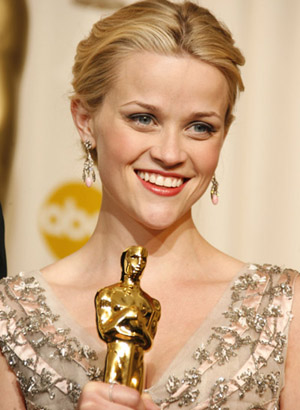 “I was thinking about why I make movies, and I know why. Life is hard. It's nice to go escape and have a good time at the movies. If I can give people a movie about hope, love and the future, then I've done my job.”
Witherspoon's first role was in a made-for-TV movie called Wildflower, directed by Diane Keaton and starring Beau Bridges, William McNamara, and Patricia Arquette. That same year, at age 15, Witherspoon attended an open casting call for The Man in the Moon, intending to audition as a bit player. She was instead cast in the lead role, immediately capturing the attention of critics. She has since built up an impressive filmography, playing both comedic and dramatic roles. Following the success of The Man in the Moon, Witherspoon acted in many both lead and supporting roles. In 1993, Witherspoon had a minor role in Jack the Bear. That same year, she portrayed the leading character "Nonnie Parker" in the Disney/Amblin film A Far Off Place. The following year, Witherspoon acted in another leading role as "Wendy Pfister" in the 1994 film S.F.W.. In 1996, Witherspoon starred alongside Kiefer Sutherland and Brooke Shields as Vanessa Lutz in the thriller Freeway. Consequently, Witherspoon won Best Actress at the Cognac Festival du Film Policier.
1998 was a successful year for Witherspoon as she made three films: Twilight, Overnight Delivery, and Pleasantville. In the thriller Twilight, Witherspoon played "Mel Ames", making her first and only nude appearance. Meanwhile, her role as "Jennifer" in Pleasantville garnered her the Young Hollywood Award for the "Best Female Breakthrough Performance".
In 1999, Witherspoon's career continued as she starred as "Lissa" in the drama thriller Best Laid Plans. Meanwhile, she also portrayed "Annette Hargrove" in Cruel Intentions, where she acted alongside her future husband Ryan Phillippe and Sarah Michelle Gellar. Also in 1999, Witherspoon portrayed Tracy Flick in Election. Although the film received good reviews (and her performance earned her a Golden Globe nomination) Witherspoon noted in an interview that she struggled to find work after completing the film. Her highly praised performance received a ranking in 2006, at #45 on the list of 100 Greatest Film Performances of All Time by Premiere Magazine.
In 2000, Witherspoon received a supporting role in American Psycho. Witherspoon had small parts as Jill Green, Rachel Green's sister, in season six of "Friends", as well as Debbie Grunds in two episodes of King of the Hill.
After struggling to find work for a period of time, in 2001 Witherspoon starred as "Elle Woods", a fashion merchandising major who decided to become a law student to follow her ex-boyfriend to Harvard, in the film Legally Blonde, resulting in her breakthrough as a leading actress. Critics began referring to Witherspoon as "the new Meg Ryan". The box-office hit helped Witherspoon achieve fame. Meanwhile, critical reviews were generally positive, with Roger Ebert commenting that "Witherspoon effortlessly animated this material with sunshine and quick wit". As a result, Witherspoon garnered her second Golden Globe Best Actress nomination for her role. In 2003, Witherspoon followed up the success of Legally Blonde by starring in its sequel Legally Blonde 2, where her character became an environmental lawyer. Reportedly, Witherspoon received a $15 million paycheck for the sequel, making her one of Hollywood's highest paid actresses.
Witherspoon also starred as Becky Sharp in the 2004 film Vanity Fair, an adaptation of the classic novel by William Makepeace Thackeray. In early 2005, Witherspoon acted as "Elizabeth Masterson" in the romantic comedy Just Like Heaven.
In 2005, Witherspoon garnered much critical praise and awards for her turn as June Carter Cash in Walk the Line. Carter Cash, who died in 2003, had personally approved of Witherspoon to play her in the 2005 biopic. However, Witherspoon never had the chance to meet Carter Cash, as Witherspoon was filming Vanity Fair when Carter Cash died. For this role, Witherspoon won several critical awards across the globe, including the Golden Globe Award for Best Actress – Motion Picture Musical or Comedy, NYFCC, the FFCC, the SFFCC Award for Best Actress, the Screen Actor's Guild (SAG) for best actress in a lead role, the British Academy's BAFTA for best actress in a lead role, the "Favorite Leading Lady" at the 32nd Annual People's Choice Awards, and the Academy Award for Best Actress.
Recently, Witherspoon has been featured as one of Time Magazine's 100 Most Influential People.
Witherspoon's first post-Oscar role came in the modern-day fairy tale, "Penelope", in which Witherspoon plays the supporting role of Annie, the eccentric best friend of Christina Ricci's pig-nosed character. Witherspoon was back in front of the cameras again in November 2006 as shooting began for the political thriller Rendition, in which Witherspoon stars as Isabella El-Ibrahim, alongside Meryl Streep, Alan Arkin, Peter Sarsgaard, and Jake Gyllenhaal. The film is set to be released on October 12, 2007. It will be Witherspoon's first appearance in theatres in two years, since the 2005 release of Walk the Line.

“Hello, I’m Johnny Cash…”
The story of country legend Johnny Cash (Joaquin Phoenix) is told through his ongoing romance with fellow singer June Carter (Reese Witherspoon) and how they get through tough times, from Cash's pill popping addiction to Carter's own marital troubles until finally agreeing to marry Cash.
The focus on Johnny and June is what makes this movie so compelling. It serves as a filter: every detail about Johnny's career doesn't have be shown, we don't have to follow his life until he dies, and so forth. Instead, we can focus on the topic of Johnny and June, and the movie has a story with a structure and a happy ending. It also serves to make this movie more intimate than most biopics: we see Johnny's personal life, not only in short clips, but as a continuing theme throughout. It makes him more human. Stellar performances from both lead actors, particularly Reese Witherspoon, who portrays June's compelling personality very well. The chemistry between the two lead actors is great.
The story of country legend Johnny Cash (Joaquin Phoenix) is told through his ongoing romance with fellow singer June Carter (Reese Witherspoon) and how they get through tough times, from Cash's pill popping addiction to Carter's own marital troubles until finally agreeing to marry Cash.
The focus on Johnny and June is what makes this movie so compelling. It serves as a filter: every detail about Johnny's career doesn't have be shown, we don't have to follow his life until he dies, and so forth. Instead, we can focus on the topic of Johnny and June, and the movie has a story with a structure and a happy ending. It also serves to make this movie more intimate than most biopics: we see Johnny's personal life, not only in short clips, but as a continuing theme throughout. It makes him more human. Stellar performances from both lead actors, particularly Reese Witherspoon, who portrays June's compelling personality very well. The chemistry between the two lead actors is great.
The childhood scenes also worked. In most biopics, these are very short and seem like gratuitous foreshadowing of the star's later career (see the otherwise brilliant Man on the Moon, for example). Here that was avoided by focusing on the brother's tragic death. That and the father's attitude served to explain Cash's problems later in life, and they weren't overdone. The death was touching, but not too dramatized; it seemed fairly realistic. We got to see just enough of Jack and the family dynamics to understand how devastating his death would be for the others.
Of course, the thing with biopics is that if you've seen enough of the genre you'll presume you'll know how the story will unfold up until the credits and then you can figure out the theme of life-affirmation. But that's hardly fair with the point of the movie. The film is about the character of Cash and how his humanity has failed to cope with everything that's happened in his story. Mangold and his co-writer Gill Dennis brilliantly stayed faithful to the story of the man they were paying their respects to.
"Walk the Line" is set in the post-World War II era, with culture in general and music in particular experiencing a great transition. It's underlined with a cinematography that borders on retrospective. There's one gorgeous shot during one of Cash and his band's performance which I think was done somewhat in high contrast, and it added a touch of sophistication and subtlety to the scene. It's this great use of technique that gives the film its emotional impact.
Of course, no review of the film is ever complete without saying something about the performances of the leads. Honestly, I think this is Phoenix's best performance to date. His authentic portrayal of the legendary singer is complemented with great crooning and such a delicate tenderness. Witherspoon's performance gives soul to the film, and her understated voice is a joy to listen to. She proves how talented actor she is and that she's more than the roles she usually plays. Because you’re mine, I walk the line… 9/10
Of course, the thing with biopics is that if you've seen enough of the genre you'll presume you'll know how the story will unfold up until the credits and then you can figure out the theme of life-affirmation. But that's hardly fair with the point of the movie. The film is about the character of Cash and how his humanity has failed to cope with everything that's happened in his story. Mangold and his co-writer Gill Dennis brilliantly stayed faithful to the story of the man they were paying their respects to.
"Walk the Line" is set in the post-World War II era, with culture in general and music in particular experiencing a great transition. It's underlined with a cinematography that borders on retrospective. There's one gorgeous shot during one of Cash and his band's performance which I think was done somewhat in high contrast, and it added a touch of sophistication and subtlety to the scene. It's this great use of technique that gives the film its emotional impact.
Of course, no review of the film is ever complete without saying something about the performances of the leads. Honestly, I think this is Phoenix's best performance to date. His authentic portrayal of the legendary singer is complemented with great crooning and such a delicate tenderness. Witherspoon's performance gives soul to the film, and her understated voice is a joy to listen to. She proves how talented actor she is and that she's more than the roles she usually plays. Because you’re mine, I walk the line… 9/10
Mensagens antigas Página inicial
Subscribe to:
Mensagens (Atom)