


Mostrar mensagens com a etiqueta 2005. Mostrar todas as mensagens
Mostrar mensagens com a etiqueta 2005. Mostrar todas as mensagens
 “I have given Jerusalem my whole life. First, I thought we were fighting for God. Then I realized we were fighting for wealth and land. I was ashamed...”
In 1935, Cecil B. DeMille made his famous epic "The Crusades" on one of the backlots of Hollywood. What a change in the Ridley Scott film "Kingdom of Heaven" of 2005 with the technical wizardry of a new era!
In "Kingdom of Heaven", wars and battles are fuelled by an assortment of motivations including land, money, political consideration, natural desire for violence, lust for fame, love of the common people, among others. Even more importantly, this "idea" thing does not prevent leaders from practicing tolerance, reaching compromises and even recognizing equality with alien faiths, as the movie tries to show us.
Recognizing that this movie is a mix of historical fact and dramatized fiction, let me focus on one rather unusual aspect of the hero Balian (Orlando Bloom), a blacksmith inheriting knighthood and an estate from a father appearing out of the blues. As Balian takes over the barren desert estate after the untimely death of the recently-discovered father, he does something that the father apparently has failed to do in all these years – dig into the earth to find a reliable source of water and proceed to make the estate productive. Later, the resilient defence of Jerusalem owes just as much to Balian's knowledge of practical laws of mechanics as to his military skills. In the end, he turns away from the inherited knighthood and goes back to be a blacksmith, taking with him a queen. Triumph of the working class...
Depiction of the arch adversary Saladin follows very much the line taken in the novels of Sir Walter Scott, particularly "The Talisman", as someone mysterious (to the extent of being almost omnipresent - in the novel) but wise and benevolent, a breed of political leader that is sadly in short supply today. The hero Balian, as mentioned, has little interest in divinity and every interest in the welfare of the people. These two leaders, put in today's context, could qualify "Kingdom of Heaven" for a fairy tale.
It's difficult to refrain from comparing the attack of Jerusalem with the attack of Minas Tirith, and this very comparison can be construed as an unreserved compliment on Kingdom of Heaven. Another comparison that can be made is the depiction of a mighty army, done so unimaginatively in two similar movies last year. In Kingdom of Heaven, we see first a solitary figure on horseback at a distant mountain gap. "Saladin's army of 200 thousand is here" says Balian. "There's only one person", comes the reply from a follower. "No, they're all here" Balian quietly responses, at which point the angle of the camera starts to rise, first revealing the patch behind the mountain gap, filled with soldiers. Then, as the horizon of our vision continues to extend, layers of mountains and vales continue to appear, together with Saladin's mighty army deployed in an apparently haphazard, but ultimately strategic fashion. This must be seen to appreciate.
Of the cast, I must first mention Edward Norton. As the leper king of Jerusalem, he appears all the time behind a mask which covers his entire face, showing only his eyes with disfigured corners. But it's the voice that is so mesmerizing. Ever since Fight Club, Norton's voice has such a timbre that soft as he sounds, there are lurking behind tantalizing hints of subtlety, intrigue, compassion, power, and twenty other different and conflicting emotions all at once.
Bloom grows into his role, starting rather expressionless (which may not be totally unreasonable considering that the character has just lost a wife and a child) but gradually gaining in confidence. Liam Neeson and Jeremy Irons, playing father and mentor respectively, do not exactly have the most challenging parts in their careers. Eva Green retains the girlish defiance in The Dreamer, but adds to it the maturity and allure required for the role of Sibylla (as portrayed by the script, but not necessarily as recorded in history). And there is good old Brendan Gleeson, in the customary role of big bully fighter which he has perfected in Gangs of New York and Troy. It is clear no one owned Jerusalem in the Middle Ages, and no one owns it now, Palestinian protests notwithstanding. For a history lesson with modern relevances, see this epic… 8/10
 “If I go back to the beginning, I could start it over again. I could go line by line; try and find a shorter way. I could try to make it... better.”
"Proof", the excellent play by David Auburn, was one of the best things in the New York stage in recent memory. Part of the attraction was the intelligent subject matter, math science, and how it connected the four characters one got to meet. The casting was an ideal one, Mary Louise Parker, Larry Briggman, Johanna Day and Ben Shenkman, playing Cahterine, Robert, Claire and Hal, respectively.
Mr. Auburn and Rebecca Miller, a movie director, herself, took the task of adapting "Proof" for the screen. The result, directed by John Madden, opens the play in cinematic terms, no small undertaking in presenting the movie to a wider audience who might not be interested in science, and much less in the advanced math that plays an important role in the proceedings.
Catherine, the 27 year old, at the center of the film, is a woman who has stayed behind to take care of her aging father, a man much esteemed in academic circles, who is suffering from, perhaps, a neurological illness that is killing him slowly. Catherine has, in a way, sacrificed her life in order to see that Robert spends his last days at home instead of at an institution.
The death of the father brings Claire home. This woman, who lives in New York, wants to get rid of everything connected with her father. She even has made plans for Catherine to move from Chicago to be near each other in New York, where things are much better. To complicate things, Harold, the nerdy math student, finds a hidden notebook that might contain a discovery that will revolutionize math. The only problem is the proof might not have been the dead man's own creation.
"Proof" works as a film because of Mr. Madden's direction. We are kept involved in what is going on because we have been won by Catherine, the wounded woman trying to live her life without having to tend to a sick man. Catherine love for math, in a way, makes her realize her place is in the same institution where her father made mathematical discoveries as she will be following his steps.
Gwyneth Paltrow makes an excellent Catherine, a role she had played on the London stage. Paltrow is a welcome presence in the movie because of the intelligence she projects when working with a good director like John Madden. Hope Davis, another excellent actress, plays Claire, the materialistic sister who has arrived and who wants to transform the frumpy Catherine and mold her to her own taste.
Davis has accustomed us to expect a valuable contribution to any film in which she plays. As Claire, she clearly understand who this character she is portraying really is.
Anthony Hopkins has only a few good moments on the screen. But it's Jake Gyllenhaal who deserves special compliment for taking on a role with nothing to hang on to, not even a stereotype, and turning it into a real person with passion, warmth and weakness. Finally, the script is just great as the characters talk just the way people talk, rather than deliver smart-Alex punchlines every five minutes. Maybe for some movies, that's alright. But "Proof" demands and deserves a lot more… 9/10
 “I'm sorry, I would sign, but I don't know the language.”
Meredith Morton is not the kind of woman you would call relaxed in social settings. She gets the case of the dry-throats which can result in her trying to clear it, and any attempt to alleviate her awkwardness results in her digging an even bigger hole for herself. And to top it all, she is the fiancée of Everett Stone, and he is about to do the criminal: introduce her to his family.
The Stones are the kind of family anyone would want to be a part of. Liberal minded almost to idealistic extremes, nothing is sacred with them, not the sexual escapades of youngest daughter Amy by one Brad Stevenson which mother Sybil casually makes a reference to (as if this were the latest recipe for apple crumb cake), not brother Ben's fondness for pot and nudity, and certainly not Thad's gayness and interracial lover Patrick and their intentions to adopt.
So why the hostility towards Meredith? Because, as Amy points out and they all come to witness, she's just wrong in more ways than one and Everett, whom they all love, is about to make a grave mistake in marrying her. Meredith lacks the warmth and spontaneity that makes for a complete human being and is a complete control freak who is as incapable of letting loose as they are incapable of being stuffed shirts. Matters get complicated when Meredith calls on her sister Julie and she reveals to be as different from Meredith as day is to night: she's the real deal. And something barely mentioned among the Stones, simmering below the surface has Sybil vehemently opposed to even the thought of Meredith becoming a part of her family.
The Family Stone certainly has moments of hilarity and is being marketed as a romantic comedy, but it really has a little too much emotional gravitas to be considered as such.
Maybe a drama/comedy should fit it better. It's a very poignant film that manages to touch sensitive issues such as terminal disease and gay parenting without ever hammering it in. If the time frame weren't so fixed where the story lines must be solved come Christmas it is possible that it were a shade more believable, but in the tradition of Christmas movies, it's all about the magic and wonder and situations finding closure.Despite a sizable cast, there isn't a role that feels underwritten. Sarah Jessica Parker, in her first starring role since Sex and the City, plays against her girlish type and becomes Meredith Morton - a woman too severe for her own good, too shrill for a family so lax.
Diane Keaton also plays somewhat against her intellectual type and shows what a mother's anger can do when a nasty comment is made. Keaton's interaction with Craig T. Nelson is so heartfelt one could think they have been married in real life for over thirty years. Rachel MacAdams has a field day playing a character whose messiness and blunt nature clashes in every aspect with Meredith's uptightness.
Claire Danes has a role reminiscent of Donna Reed - natural, girlish, wholesome - again a total opposite to Parker, and necessary to make Parker stand out as a sore thumb.
Dermot Mulroney and Luke Wilson also find the right notes in their characters: one wanting to make something of himself and believing that marrying an anal woman will grant him that, the other a sensitive man hiding under an apparent facade of neo-hippiness.
The Family Stone is a genuine, heartfelt movie and despite its political correctness it manages to be nicely subversive while also reviving Christmas films from the 40s, such as Meet Me in St. Louis (“Have Yourself a Merry Little Christmas) and The Man Who Came to Dinner… 9/10
 “The man who said "I'd rather be lucky than good" saw deeply into life. People are afraid to face how great a part of life is dependent on luck. It's scary to think so much is out of one's control. There are moments in a match when the ball hits the top of the net, and for a split second, it can either go forward or fall back. With a little luck, it goes forward, and you win. Or maybe it doesn't, and you lose.”
In "Match Point," Woody Allen, caught in one of his more "serious" moods, takes a simple tale about marital infidelity and turns it into something complex and fascinating. Although he leaves a trail of clues implying that this is to be another of his homages to Fyodor Dostoevsky, the film really turns out to be Allen's own version of Theodore Dreiser's "An American Tragedy" (albeit set in England, perhaps to throw us off the scent). The parallels between the two works are not perfect, of course - in fact they often seem to be intentionally inverted - but they are close enough to make us wonder if Allen did, indeed, do it all on purpose.
Jonathan Rhys-Meyers plays Chris Wilton, a down-on-his-luck social climber who marries into wealth but longs for the passion he finds with another woman. Chris is a professional tennis player who decides to leave the circuit when he realizes he hasn't the skill to compete with the real pros. Taking a job as an instructor at a posh, highly exclusive tennis club, Chris finds himself wining and dining with the rich and famous after one of his pupils, Tom Hewett, takes a liking to him and introduces Chris to his snooty but accepting family. Chris begins to date Tom's warmhearted sister, Chloe, but he is really smitten by an aspiring American actress, Nola, who just happens to be Tom's fiancé. Chris makes the mistake of marrying Chloe before Tom and Nola call off their engagement and go their separate ways. The fact that Nola is free but he is not doesn't deter Chris from pursing an affair with the woman who provides all the passion and excitement his loving but boring wife cannot. But Chris soon discovers that carrying on an affair can result in a life filled with secrecy, lies, guilt and self-loathing. And when the going gets to be just a bit too much for our hero to handle…well, there's always that "final solution" lurking in the wings, as many an earlier adulterer has discovered to his everlasting regret.
"Match Point" starts off very slowly and seems at first as if it will be just another tale of adultery and unrequited love. Yet, Allen really knows how to draw us into Chris' predicament, so that, by about halfway into the film, we feel as enmeshed in his seemingly irreconcilable dilemma as he himself is. Torn between the wealth and position he has as Chloe's husband and the love he feels for the relatively impoverished Nola, Chris is frozen into a state of paralyzing indecisiveness, his every waking moment a tormenting hell of fear and gathering dread as he keeps waiting in breathless anticipation for that other shoe to drop. It isn't until the "other woman" becomes more of a burden than his clinging wife that Chris can finally launch into action. This turnabout in the screenplay might strike many in the audience as arbitrary and implausible and there is certainly a case to be made for that. But if you can go with the flow, you will be delighted by all the little ironies Allen throws at us in the final stages of the story, which help to underline the filmmaker's thesis that, for all the efforts we make to control our lives, The Fickle Finger of Fate - or in this case a tennis ball precariously balancing on the top of a net trying to figure out which way to fall - always has the final word.
Allen has written dialogue that is incisive, intelligent and literate, and the performances he's drawn from the likes of Rhys-Meyers, Goode, Emily Mortimer, Scarlett Johansson and Penelope Wilton are superb down to the tiniest detail. Allen keeps his camera tightly focused on his characters, rarely pulling away from them much beyond a middle distance, keeping us firmly locked in the near-claustrophobic drama. Here is a movie that demands patience at the beginning but that really sneaks up on you the longer you watch it… 9/10

“A story: A man fires a rifle for many years, and he goes to war. And afterward he turns the rifle in at the armory, and he believes he's finished with the rifle. But no matter what else he might do with his hands, love a woman, build a house, change his son's diaper; his hands remember the rifle.”
The first thing that may surprise audiences is that this is not necessarily an anti-war piece. Mendes and screenwriter William Broyles, Jr. have been careful not to make this film narrow in view. Instead, by focusing on the psychological turmoil of one soldier, Anthony Swofford (Jake Gyllenhaal), Jarhead is able to speak specifically about this man's experience and how it relates to those around him.
Mendes drenches the screen with sights and sounds that literally envelope us in the horrors of warfare. These explosions of vision and noise are counterbalanced, however, with scenes of great sadness and warmth. One scene that comes quickly to mind is a boot camp drill where the young soldiers are crawling under barbed wire--the sound design is such that we hear every character screaming or grunting as the gunshots zoom overhead. But then, the scene changes. An event occurs that allows Mendes to silence all of the violence and machismo of war. Amongst the hysteria of the scene, one of the soldiers freaks out and a gunshot is discharged. Mendes lets the camera witness this as if it hadn't expected it to occur. The characters are in shock, and so is the audience. It's just one of many powerful moments where Mendes changes from loud, visceral warfare to quiet, poignant moments.
Not that there's much warfare here. In fact, the lack of warfare becomes a theme for this film. Peter Sarsgaard, in a great performance, reaches his breaking point during the final third of the film, and it's a riveting moment where the lack of warfare has finally made him explode. His performance is very strong throughout, but it is not until the second half of the film when he finally gets the chance to break loose.
Jamie Foxx surprised me here. His character is so well-conceived, and works wonderfully as the counterpoint to the Gyllenhaal character. Foxx plays his scenes confidently, but also with touches of gravitas that, even in Ray, we haven't seen before. The scene that we get a glimpse of at the end of the trailer is wonderful in its fullness, and helps Mendes' film give us a well-rounded opinion of Swofford's opinions on the war. Foxx is by turns hilarious and profound.
And then there was Jake Gyllenhaal. Wow. This is an incredible performance. Watch for a dozen scenes where he literally explodes off the screen, but how he also juggles the quieter moments with great aplomb. What makes Swofford an intriguing character is that he doesn't always get our sympathy; or, for that matter, want our sympathy. He is scarred by war and his family and the life he left behind, and he is just looking for a way to get out of the sand and the sexual dysfunction of war and the lack of gunfire. Gyllenhaal captivates our attention from his very first glimpse, and his voice-over performance laces the film with irony and melancholy. He is a great physical presence in the film as well. I could cite more than a few dynamic scenes that he performs masterfully in, but I'll just mention one. Swofford points a rifle at a fellow soldier after a failed night watch, and then turns the rifle on himself, asking the fellow soldier to discard a round into his mouth. It's an indescribably painful scene to watch, but it's also an example of Gyllenhaal's brave and honest portrayal of this bruised man.
Some people have begun to write about this film as lacking structure or story, and in saying that I'm afraid they may have missed the point. This is a story about ambiguity of self, about dislocation, about ambivalence to war and love, about sexual frustration. In these terms, I think Mendes & Co. have found the perfect way to cinematically allow us to experience the same sort of blank complexity that Swofford must have felt.
As Swof's friend Troy says at one point, "Fuck politics. We're here. All the rest is bullshit". Which is all the movie is about, really. This is what happened. Take it or leave it. 9/10
The first thing that may surprise audiences is that this is not necessarily an anti-war piece. Mendes and screenwriter William Broyles, Jr. have been careful not to make this film narrow in view. Instead, by focusing on the psychological turmoil of one soldier, Anthony Swofford (Jake Gyllenhaal), Jarhead is able to speak specifically about this man's experience and how it relates to those around him.
Mendes drenches the screen with sights and sounds that literally envelope us in the horrors of warfare. These explosions of vision and noise are counterbalanced, however, with scenes of great sadness and warmth. One scene that comes quickly to mind is a boot camp drill where the young soldiers are crawling under barbed wire--the sound design is such that we hear every character screaming or grunting as the gunshots zoom overhead. But then, the scene changes. An event occurs that allows Mendes to silence all of the violence and machismo of war. Amongst the hysteria of the scene, one of the soldiers freaks out and a gunshot is discharged. Mendes lets the camera witness this as if it hadn't expected it to occur. The characters are in shock, and so is the audience. It's just one of many powerful moments where Mendes changes from loud, visceral warfare to quiet, poignant moments.
Not that there's much warfare here. In fact, the lack of warfare becomes a theme for this film. Peter Sarsgaard, in a great performance, reaches his breaking point during the final third of the film, and it's a riveting moment where the lack of warfare has finally made him explode. His performance is very strong throughout, but it is not until the second half of the film when he finally gets the chance to break loose.
Jamie Foxx surprised me here. His character is so well-conceived, and works wonderfully as the counterpoint to the Gyllenhaal character. Foxx plays his scenes confidently, but also with touches of gravitas that, even in Ray, we haven't seen before. The scene that we get a glimpse of at the end of the trailer is wonderful in its fullness, and helps Mendes' film give us a well-rounded opinion of Swofford's opinions on the war. Foxx is by turns hilarious and profound.
And then there was Jake Gyllenhaal. Wow. This is an incredible performance. Watch for a dozen scenes where he literally explodes off the screen, but how he also juggles the quieter moments with great aplomb. What makes Swofford an intriguing character is that he doesn't always get our sympathy; or, for that matter, want our sympathy. He is scarred by war and his family and the life he left behind, and he is just looking for a way to get out of the sand and the sexual dysfunction of war and the lack of gunfire. Gyllenhaal captivates our attention from his very first glimpse, and his voice-over performance laces the film with irony and melancholy. He is a great physical presence in the film as well. I could cite more than a few dynamic scenes that he performs masterfully in, but I'll just mention one. Swofford points a rifle at a fellow soldier after a failed night watch, and then turns the rifle on himself, asking the fellow soldier to discard a round into his mouth. It's an indescribably painful scene to watch, but it's also an example of Gyllenhaal's brave and honest portrayal of this bruised man.
Some people have begun to write about this film as lacking structure or story, and in saying that I'm afraid they may have missed the point. This is a story about ambiguity of self, about dislocation, about ambivalence to war and love, about sexual frustration. In these terms, I think Mendes & Co. have found the perfect way to cinematically allow us to experience the same sort of blank complexity that Swofford must have felt.
As Swof's friend Troy says at one point, "Fuck politics. We're here. All the rest is bullshit". Which is all the movie is about, really. This is what happened. Take it or leave it. 9/10

“Hello, I’m Johnny Cash…”
The story of country legend Johnny Cash (Joaquin Phoenix) is told through his ongoing romance with fellow singer June Carter (Reese Witherspoon) and how they get through tough times, from Cash's pill popping addiction to Carter's own marital troubles until finally agreeing to marry Cash.
The focus on Johnny and June is what makes this movie so compelling. It serves as a filter: every detail about Johnny's career doesn't have be shown, we don't have to follow his life until he dies, and so forth. Instead, we can focus on the topic of Johnny and June, and the movie has a story with a structure and a happy ending. It also serves to make this movie more intimate than most biopics: we see Johnny's personal life, not only in short clips, but as a continuing theme throughout. It makes him more human. Stellar performances from both lead actors, particularly Reese Witherspoon, who portrays June's compelling personality very well. The chemistry between the two lead actors is great.
The story of country legend Johnny Cash (Joaquin Phoenix) is told through his ongoing romance with fellow singer June Carter (Reese Witherspoon) and how they get through tough times, from Cash's pill popping addiction to Carter's own marital troubles until finally agreeing to marry Cash.
The focus on Johnny and June is what makes this movie so compelling. It serves as a filter: every detail about Johnny's career doesn't have be shown, we don't have to follow his life until he dies, and so forth. Instead, we can focus on the topic of Johnny and June, and the movie has a story with a structure and a happy ending. It also serves to make this movie more intimate than most biopics: we see Johnny's personal life, not only in short clips, but as a continuing theme throughout. It makes him more human. Stellar performances from both lead actors, particularly Reese Witherspoon, who portrays June's compelling personality very well. The chemistry between the two lead actors is great.
The childhood scenes also worked. In most biopics, these are very short and seem like gratuitous foreshadowing of the star's later career (see the otherwise brilliant Man on the Moon, for example). Here that was avoided by focusing on the brother's tragic death. That and the father's attitude served to explain Cash's problems later in life, and they weren't overdone. The death was touching, but not too dramatized; it seemed fairly realistic. We got to see just enough of Jack and the family dynamics to understand how devastating his death would be for the others.
Of course, the thing with biopics is that if you've seen enough of the genre you'll presume you'll know how the story will unfold up until the credits and then you can figure out the theme of life-affirmation. But that's hardly fair with the point of the movie. The film is about the character of Cash and how his humanity has failed to cope with everything that's happened in his story. Mangold and his co-writer Gill Dennis brilliantly stayed faithful to the story of the man they were paying their respects to.
"Walk the Line" is set in the post-World War II era, with culture in general and music in particular experiencing a great transition. It's underlined with a cinematography that borders on retrospective. There's one gorgeous shot during one of Cash and his band's performance which I think was done somewhat in high contrast, and it added a touch of sophistication and subtlety to the scene. It's this great use of technique that gives the film its emotional impact.
Of course, no review of the film is ever complete without saying something about the performances of the leads. Honestly, I think this is Phoenix's best performance to date. His authentic portrayal of the legendary singer is complemented with great crooning and such a delicate tenderness. Witherspoon's performance gives soul to the film, and her understated voice is a joy to listen to. She proves how talented actor she is and that she's more than the roles she usually plays. Because you’re mine, I walk the line… 9/10
Of course, the thing with biopics is that if you've seen enough of the genre you'll presume you'll know how the story will unfold up until the credits and then you can figure out the theme of life-affirmation. But that's hardly fair with the point of the movie. The film is about the character of Cash and how his humanity has failed to cope with everything that's happened in his story. Mangold and his co-writer Gill Dennis brilliantly stayed faithful to the story of the man they were paying their respects to.
"Walk the Line" is set in the post-World War II era, with culture in general and music in particular experiencing a great transition. It's underlined with a cinematography that borders on retrospective. There's one gorgeous shot during one of Cash and his band's performance which I think was done somewhat in high contrast, and it added a touch of sophistication and subtlety to the scene. It's this great use of technique that gives the film its emotional impact.
Of course, no review of the film is ever complete without saying something about the performances of the leads. Honestly, I think this is Phoenix's best performance to date. His authentic portrayal of the legendary singer is complemented with great crooning and such a delicate tenderness. Witherspoon's performance gives soul to the film, and her understated voice is a joy to listen to. She proves how talented actor she is and that she's more than the roles she usually plays. Because you’re mine, I walk the line… 9/10
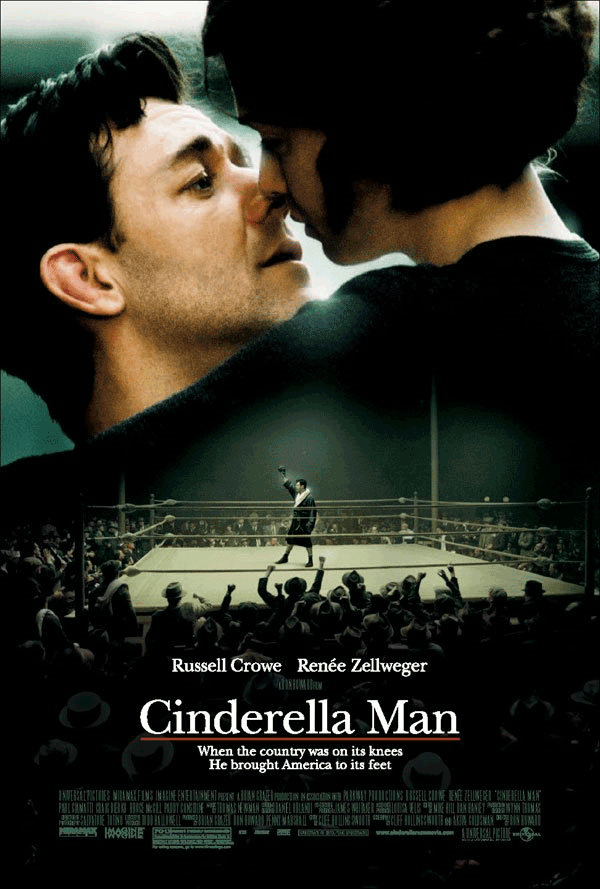
“You think you're telling me something? Like, what, boxing is dangerous, something like that? You don't think working triple shifts and at night on a scaffold isn't just as likely to get a man killed? What about all those guys who died last week living in cardboard shacks to save on rent money just to feed their family, 'cause guys like you have not quite figured out a way yet to make money off of watching that guy die? But in my profession, and it is my profession, I'm a little more fortunate.”
"Cinderella Man" deserves to be placed alongside other great biographical films dealing with the lives and times of great boxers. Such films include "Raging Bull," "The Joe Louis Story," "Ali," "The Hurricane," and "Ring of Fire: The Emile Griffith Story."
These films share in common not just a documentary-like approach to boxing or a superficial biopic. They also portray the human side of a modern gladiator and the culture that produced him. In the case of "Cinderella Man," we are given a detailed and heart-rending portrait of the Great Depression in American. The story of the gentleman pugilist James J. Braddock is the backdrop to the larger drama of Americans' struggle in the 1930s.
Russell Crowe provides a brilliant interpretation of Braddock, capturing the decency of a man whose career as a boxer would appear to have peaked at just the wrong time prior to the Crash of 1929. After that momentous event, Braddock's boxing went into decline just like the lives of millions of Americans. The scenes of Braddock and his family living in squalid conditions and with uncertainty about such basics as heat and electricity were carefully developed in the film. Renée Zellweger was outstanding as Mae, the caring but feisty wife of Braddock. Paul Giamatti was also excellent as Braddock's handler-manager, Joe Gould. Joe tries to keep up appearances by sporting fancy clothes. But in one revealing scene in the film when we see the interior of Joe's ostensibly swanky apartment, there is no fancy furniture other than a dowdy table and some flimsy deck chairs. Everyone is reeling from the Depression. In the depiction of the massive unemployment, the "Hoovervilles" of the homeless residing in Central Park, and the desperate need for Americans for an optimistic icon like Braddock to raise their spirits, the film truly captured the tragedy of the Great American Depression.
The film's director Ron Howard emphasized close-ups throughout the film with uneven results. In many of the boxing sequences, the close-ups and rapid editing made it difficult tell the fighters apart. The close-ups continued even into the domestic scenes and the outdoor sequences depicting Braddock working as a longshoreman. The film's dark cinematography conveyed the bleakness of the Depression years, but it worked against bringing out the buoyant spirit of Braddock himself and the optimism that he instilled in others.
Indeed, the characters and the story were the strong points of "Cinderella Man." Much credit should go to Cliff Hollingsworth for a screenplay that included thoughtful dialogue, humor, and multi-dimensional characters. Daniel Orlandi also merits praise for the brilliant costumes that helped to recreate the period of the early 1930s.
"Cinderella Man" deserves to be placed alongside other great biographical films dealing with the lives and times of great boxers. Such films include "Raging Bull," "The Joe Louis Story," "Ali," "The Hurricane," and "Ring of Fire: The Emile Griffith Story."
These films share in common not just a documentary-like approach to boxing or a superficial biopic. They also portray the human side of a modern gladiator and the culture that produced him. In the case of "Cinderella Man," we are given a detailed and heart-rending portrait of the Great Depression in American. The story of the gentleman pugilist James J. Braddock is the backdrop to the larger drama of Americans' struggle in the 1930s.
Russell Crowe provides a brilliant interpretation of Braddock, capturing the decency of a man whose career as a boxer would appear to have peaked at just the wrong time prior to the Crash of 1929. After that momentous event, Braddock's boxing went into decline just like the lives of millions of Americans. The scenes of Braddock and his family living in squalid conditions and with uncertainty about such basics as heat and electricity were carefully developed in the film. Renée Zellweger was outstanding as Mae, the caring but feisty wife of Braddock. Paul Giamatti was also excellent as Braddock's handler-manager, Joe Gould. Joe tries to keep up appearances by sporting fancy clothes. But in one revealing scene in the film when we see the interior of Joe's ostensibly swanky apartment, there is no fancy furniture other than a dowdy table and some flimsy deck chairs. Everyone is reeling from the Depression. In the depiction of the massive unemployment, the "Hoovervilles" of the homeless residing in Central Park, and the desperate need for Americans for an optimistic icon like Braddock to raise their spirits, the film truly captured the tragedy of the Great American Depression.
The film's director Ron Howard emphasized close-ups throughout the film with uneven results. In many of the boxing sequences, the close-ups and rapid editing made it difficult tell the fighters apart. The close-ups continued even into the domestic scenes and the outdoor sequences depicting Braddock working as a longshoreman. The film's dark cinematography conveyed the bleakness of the Depression years, but it worked against bringing out the buoyant spirit of Braddock himself and the optimism that he instilled in others.
Indeed, the characters and the story were the strong points of "Cinderella Man." Much credit should go to Cliff Hollingsworth for a screenplay that included thoughtful dialogue, humor, and multi-dimensional characters. Daniel Orlandi also merits praise for the brilliant costumes that helped to recreate the period of the early 1930s.
But the heart of this film experience is Russell Crowe's screen portrayal of Braddock. It was the colorful sportswriter and raconteur Damon Runyan who coined the nickname of "Cinderella Man" for Braddock. However, the real James J. Braddock was more than lucky. It was his strength of character in and out of the ring that captivated America. One of the most moving scenes of the film was a heated argument between Braddock and his wife Mae where Braddock insists that even in the most difficult of times, he would refuse to be separated from his children. As a boxer, he was fearless. But he demonstrated even more courage in fighting for family values—a lesson from which we can learn a great deal today in reflecting on this sensitive film. 9/10
Mensagens antigas Página inicial
Subscribe to:
Mensagens (Atom)