


Mostrar mensagens com a etiqueta Joaquin Phoenix. Mostrar todas as mensagens
Mostrar mensagens com a etiqueta Joaquin Phoenix. Mostrar todas as mensagens
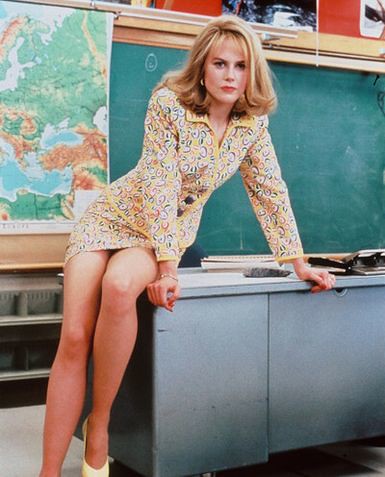 “You're not anybody in America unless you're on TV. On TV is where we learn about who we really are. Because what's the point of doing anything worthwhile if nobody's watching? And if people are watching, it makes you a better person.”
Gus Van Sant is part of the fixture in American independent cinema and although "To Die For" was a piece of work that came from the studios, he films the story of this female go-getter ready for anything to accede glory and fame in a very personal way.
It's built on an alternation of present moments in which various characters who crossed Nicole Kidman's path talk about her and flashes-back that relate the turn of events.
Characters including her parents, her former young lover and friends express their thoughts about her without succeeding in understanding her. There, appears the first quality of Van Sant's work: the somewhat elusive personality of her main female character who especially manipulated her close relatives to go up the social ladder and to achieve her ends.
Manipulation is very present throughout the work with the conspicuous presence of TV and camera. And you have to see the contrast between the dynamic Suzanne Maretto (Nicole Kidman) and her rather listless husband Larry acted by Matt Dillon and especially the teenagers who hang around us like Jimmy Emmett (a young and good Joaquin Phoenix) or Lydia Mertz (Alison Folland). There, appears Van Sant's signature.
"To Die For" includes some of the filmmaker's obsessions revolving around an American youth who is adrift and lacks of marks for their future and security. What Jimmy and timid, hung-up Lydia need is true love, something that Suzanne can't really give them. And her plan to report on an American high school is only a means to establish a little more her galloping ambition. Van Sant will resume his set of themes about a ramshackle American youth and will hone it with his masterful "Elephant" (2003).
The choice of the scenery (Moretto's house) and the brightness of the cinematography, Nicole Kidman's make-up fuel the somewhat quirky side of the venture and Van Sant doesn't deprive himself of gently laughing at her female heroine. I dig the moments when she goes to the office held by Wayne Knight to ask for a job and ends up hosting the weather forecast on a little local area. A task she painstakingly fulfills. Nicole Kidman holds her role at arms' length and has a tremendous screen presence. It's just a shame that Van Sant doesn't emphasis enough on the madness that seizes Suzanne after the murder when she is interviewed by the journalists.
But see it anyway for Kidman and the manner Van Sant tells this story of ambition, manipulation and hypocrisy. And David Cronenberg has a surprising cameo at a well-appropriated moment in a vital step of the heroine's fate… 8/10
 “My name is Gladiator.”
Germania, 150 AD, the setting of Gladiator's opening scene. Far from the blazing sun and dazzlingly beauty of ancient Rome, Ridley Scott shoots the opening sequence in a subdued light. The Roman legions are nonetheless impeccably turned out as they face the comparatively disorganised rabble that inhabits this miserable environment. Caesar's soldiers seem somewhat misplaced here. However, Russell Crowe is at home in this environment of knee-deep mud and merciless snow. He commands the screen with all the virtues of his motto: ‘Strength and Honour'.
The plot, with its hero-to-zero-to-hero nature, runs through Gladiator's every vein. As General Maximus, Russell Crowe is welcomed by Marcus Aurelius Caesar (Richard Harris) to take the Roman throne as Emperor of a new Republic. All does not run smoothly however as mislead heir to the throne Commodus (Phoenix) takes over Rome with ill-gotten domination, having dispatched his own Father. Maximus is cast out to find his family murdered and his Spanish farm burnt to the ground. Taken in as a slave by Proximo (Reed), Maximus becomes a Gladiator and starts his journey to the Coliseum and revenge against Commodus.
Scott's cast is powerful and he is not left wanting as powerful performances are delivered by all. Due to his untimely mid-production death, Oliver Reed is created in some scenes by the grace of computer graphics, which are as convincing as they come; sometimes making it difficult to differentiate between Reed himself and his computerised counterpart.
It is, however, the supporting actors who create many of Gladiator's best dialogue-based scenes. In an accomplished demonstration of her acting ability as Lucilla, Connie Nielsen saves the occasional scene as Joaquim Phoenix shows us that he can ‘do evil', but is less convincing when it comes to the more emotional qualities of his role.
As a vehicle for the plot, Scott's beautifully created and highly symbolic (there is an image of fire in nearly every shot of the film) dialogue scenes are of a certain merit with digitally created backgrounds that encompass the meticulous nature of the Roman Empire. However, dialogue alone does not an epic movie make, and it is in the film's spectacular action sequences that Gladiator come into its own. Shot on location in Malta, Scott's first arena was built by an army of locals and commanded some 5000 extras (a large majority of whom were of a cardboard variety). All of this pales in comparison as we arrive in a digitally created Rome which makes some scenes in Ben Hur some somewhat small scale. The Coliseum is immense, both inside and out, and the computerised provides the electric atmosphere in which Crowe and his feline companions (four sizeable, and real, Bengal tigers) perform.
The battle sequences are perfectly choreographed and shot as iconic masks and typically Roman chariots are abundant in their power and imagery. As swords clash and heads roll, Ridley Scott is triumphant in the application of special effects technology and his directorial prowess.It is also emotionally intriguing, something some Scott films lack. Its soul-searching music (kudos to Hans Zimmer) and its ambitious, gorgeous view of the after-life are beautiful. Its truly gritty-edge give it a dirty, gruesome magnificence. It is the tale of earthly combatants, most notable in the final, gut-wrenching duel; where the warriors drop their swords and duke it out with what nature gave them… 10/10

“Hello, I’m Johnny Cash…”
The story of country legend Johnny Cash (Joaquin Phoenix) is told through his ongoing romance with fellow singer June Carter (Reese Witherspoon) and how they get through tough times, from Cash's pill popping addiction to Carter's own marital troubles until finally agreeing to marry Cash.
The focus on Johnny and June is what makes this movie so compelling. It serves as a filter: every detail about Johnny's career doesn't have be shown, we don't have to follow his life until he dies, and so forth. Instead, we can focus on the topic of Johnny and June, and the movie has a story with a structure and a happy ending. It also serves to make this movie more intimate than most biopics: we see Johnny's personal life, not only in short clips, but as a continuing theme throughout. It makes him more human. Stellar performances from both lead actors, particularly Reese Witherspoon, who portrays June's compelling personality very well. The chemistry between the two lead actors is great.
The story of country legend Johnny Cash (Joaquin Phoenix) is told through his ongoing romance with fellow singer June Carter (Reese Witherspoon) and how they get through tough times, from Cash's pill popping addiction to Carter's own marital troubles until finally agreeing to marry Cash.
The focus on Johnny and June is what makes this movie so compelling. It serves as a filter: every detail about Johnny's career doesn't have be shown, we don't have to follow his life until he dies, and so forth. Instead, we can focus on the topic of Johnny and June, and the movie has a story with a structure and a happy ending. It also serves to make this movie more intimate than most biopics: we see Johnny's personal life, not only in short clips, but as a continuing theme throughout. It makes him more human. Stellar performances from both lead actors, particularly Reese Witherspoon, who portrays June's compelling personality very well. The chemistry between the two lead actors is great.
The childhood scenes also worked. In most biopics, these are very short and seem like gratuitous foreshadowing of the star's later career (see the otherwise brilliant Man on the Moon, for example). Here that was avoided by focusing on the brother's tragic death. That and the father's attitude served to explain Cash's problems later in life, and they weren't overdone. The death was touching, but not too dramatized; it seemed fairly realistic. We got to see just enough of Jack and the family dynamics to understand how devastating his death would be for the others.
Of course, the thing with biopics is that if you've seen enough of the genre you'll presume you'll know how the story will unfold up until the credits and then you can figure out the theme of life-affirmation. But that's hardly fair with the point of the movie. The film is about the character of Cash and how his humanity has failed to cope with everything that's happened in his story. Mangold and his co-writer Gill Dennis brilliantly stayed faithful to the story of the man they were paying their respects to.
"Walk the Line" is set in the post-World War II era, with culture in general and music in particular experiencing a great transition. It's underlined with a cinematography that borders on retrospective. There's one gorgeous shot during one of Cash and his band's performance which I think was done somewhat in high contrast, and it added a touch of sophistication and subtlety to the scene. It's this great use of technique that gives the film its emotional impact.
Of course, no review of the film is ever complete without saying something about the performances of the leads. Honestly, I think this is Phoenix's best performance to date. His authentic portrayal of the legendary singer is complemented with great crooning and such a delicate tenderness. Witherspoon's performance gives soul to the film, and her understated voice is a joy to listen to. She proves how talented actor she is and that she's more than the roles she usually plays. Because you’re mine, I walk the line… 9/10
Of course, the thing with biopics is that if you've seen enough of the genre you'll presume you'll know how the story will unfold up until the credits and then you can figure out the theme of life-affirmation. But that's hardly fair with the point of the movie. The film is about the character of Cash and how his humanity has failed to cope with everything that's happened in his story. Mangold and his co-writer Gill Dennis brilliantly stayed faithful to the story of the man they were paying their respects to.
"Walk the Line" is set in the post-World War II era, with culture in general and music in particular experiencing a great transition. It's underlined with a cinematography that borders on retrospective. There's one gorgeous shot during one of Cash and his band's performance which I think was done somewhat in high contrast, and it added a touch of sophistication and subtlety to the scene. It's this great use of technique that gives the film its emotional impact.
Of course, no review of the film is ever complete without saying something about the performances of the leads. Honestly, I think this is Phoenix's best performance to date. His authentic portrayal of the legendary singer is complemented with great crooning and such a delicate tenderness. Witherspoon's performance gives soul to the film, and her understated voice is a joy to listen to. She proves how talented actor she is and that she's more than the roles she usually plays. Because you’re mine, I walk the line… 9/10
Mensagens antigas Página inicial
Subscribe to:
Mensagens (Atom)