


Mostrar mensagens com a etiqueta Nicole Kidman. Mostrar todas as mensagens
Mostrar mensagens com a etiqueta Nicole Kidman. Mostrar todas as mensagens
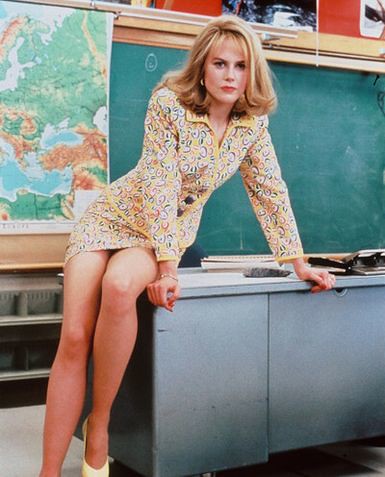 “You're not anybody in America unless you're on TV. On TV is where we learn about who we really are. Because what's the point of doing anything worthwhile if nobody's watching? And if people are watching, it makes you a better person.”
Gus Van Sant is part of the fixture in American independent cinema and although "To Die For" was a piece of work that came from the studios, he films the story of this female go-getter ready for anything to accede glory and fame in a very personal way.
It's built on an alternation of present moments in which various characters who crossed Nicole Kidman's path talk about her and flashes-back that relate the turn of events.
Characters including her parents, her former young lover and friends express their thoughts about her without succeeding in understanding her. There, appears the first quality of Van Sant's work: the somewhat elusive personality of her main female character who especially manipulated her close relatives to go up the social ladder and to achieve her ends.
Manipulation is very present throughout the work with the conspicuous presence of TV and camera. And you have to see the contrast between the dynamic Suzanne Maretto (Nicole Kidman) and her rather listless husband Larry acted by Matt Dillon and especially the teenagers who hang around us like Jimmy Emmett (a young and good Joaquin Phoenix) or Lydia Mertz (Alison Folland). There, appears Van Sant's signature.
"To Die For" includes some of the filmmaker's obsessions revolving around an American youth who is adrift and lacks of marks for their future and security. What Jimmy and timid, hung-up Lydia need is true love, something that Suzanne can't really give them. And her plan to report on an American high school is only a means to establish a little more her galloping ambition. Van Sant will resume his set of themes about a ramshackle American youth and will hone it with his masterful "Elephant" (2003).
The choice of the scenery (Moretto's house) and the brightness of the cinematography, Nicole Kidman's make-up fuel the somewhat quirky side of the venture and Van Sant doesn't deprive himself of gently laughing at her female heroine. I dig the moments when she goes to the office held by Wayne Knight to ask for a job and ends up hosting the weather forecast on a little local area. A task she painstakingly fulfills. Nicole Kidman holds her role at arms' length and has a tremendous screen presence. It's just a shame that Van Sant doesn't emphasis enough on the madness that seizes Suzanne after the murder when she is interviewed by the journalists.
But see it anyway for Kidman and the manner Van Sant tells this story of ambition, manipulation and hypocrisy. And David Cronenberg has a surprising cameo at a well-appropriated moment in a vital step of the heroine's fate… 8/10
 “Kapéla, we're on opposite sides of the river.”
Very interesting idea, captivating performances, professional direction, gripping character revelations, exceptionally interesting dynamics between the main characters, truly moving moments that never go cheap, essential ideas woven into the dialogue...
Why, then, did I feel somewhat cheated?
Let's not dwell on the fact that, for me, such dramatic historical truths ('every dictator begins as a savior') are betrayed when treated upon the thriller recipe. I could live with that, if it means that they reach a larger audience this way. Let's accept that there would be such a country where the main adviser of a black president is white, when at some point colour became politics. Let's just say that these are the paradoxes of dictatorship, although they could have been described much more interestingly and convincingly than they were.
The main source of disappointment for me was the script. I felt it went past tight, past thrilling, past complicated and it settled somewhere between too intelligent for its own good and completely flat.
First, the final twists were clear from the very beginning. The moment when Nils Lud appeared on the screen, it was clear he was the chief bad guy. His motivation was conspicuously stated by Kuman-Kuman in a very early scene: a near-assassination would launder all the president's sins. Nothing surprising or at least interesting here. The other twist was just as predictable, at least for this viewer. I cannot describe exactly what pointed me to expect it, but I was sure since very early on that Silvia would try to kill the president herself, on the spur of the moment. She was talking of diplomacy just a little too emphatically, perhaps. In any case, I could only yawn during what was supposed to be the climax scene where Sean Penn's character tries to convince Silvia to put the gun down. It was a pity.
Perhaps to make up for such predictable developments, there were a lot of confusing details thrown in with the sole purpose to sidetrack the viewer from the correct expectations, except there were so many and so confusing that I can only see them as plot holes. I can just about swallow that Silvia was in contact with the friend with whom she has no emotional involvement, but never with her brother and former lover. These things happen. The "you" in "I'm worried about you" can be understood as plural. Why, however, would Phillipe say that he arranged the seeing of the dead bodies during which Simon and the former lover where killed, when we have seen that the former lover had told Phillipe "No, he said just the two of us"? No real consistency here, as far as I understand, except trying to create confusion for later cheap 'thrilling' purposes.
Then there is the issue of the complot itself. I can only understand - please somebody correct me if I am wrong - that Sylvia overheard Jamal and Gamba. Then Gamba killed Jamal because he wanted to scare Silvia, but went himself to kill her days later, when it was almost certain that the flat was under surveillance - why? Why didn't he just kill her first thing, when they found out whom she was? Because he 'knew' she would be on the same bus as Kuman-Kuman? And why didn't he off Kuman-Kuman earlier on, if he was working for the president and it was so easy to do it, why now when he would have been a good suspect for the mock assassination? Of course, because now we are watching, but still, does it make any sense to anybody? To me it doesn't. I can only assume that Jamal knew about the plot because he had to smuggle in some pieces of the gun, but why did he speak with Gamba there, inside the UN, why was Gamba there at all? Why would a pawn like Jamal know the reason why he had to smuggle the gun in? Why didn't Marcus do it himself? Why did Gamba need to speak to Marcus at all? And finally, where did Marcus learn the language he was supposed to be translating, because nobody in that country looks like he does? Of course, we can imagine answers to all these questions, but I would have preferred all this to be addressed in the movie instead.
One more thing I didn't like was the drowning of the assassin thing. In itself it was a beautiful enough metaphor, but the way Senn Pean's character changed his tackle from the first scene when it was mentioned to the 'put the gun down' scene was - well - a bit risible, wasn't it?
There were things I liked in the plot, however. To end the examples on a positive note, I must say that it was, for me, extraordinarily beautiful how 'a human voice, even a whisper' is louder than, and can be recognised among, the racket of guns and screams. If only for that part, whether a quote or written specifically for the film, Interpreter was a good movie.Ultimately, all my critics only come to show how difficult it is to write a good thriller. And how sometimes trying to write both a political thriller and a character-driven movie can fail on both accounts…7/10
 “Even from a very early age I knew I didn't want to miss out on anything life had to offer just because it might be considered dangerous.”
Kidman's first appearance in film came in 1983 when, as a fifteen year-old, she appeared in the Pat Wilson music video for the song Bop Girl. By the end of the year she had secured a supporting role in the television series Five Mile Creek and four film roles, including BMX Bandits and Bush Christmas. During the 1980s, she appeared in several Australian movies and TV series, notably including the soap opera A Country Practice, the mini-series Vietnam (1986), Emerald City (1988), and Bangkok Hilton (1989).In 1989, Kidman starred in the thriller Dead Calm as Rae Ingram, the wife of naval officer John Ingram (Sam Neill), held captive on a Pacific Ocean yacht trip by the psychotic Hughie Warriner (Billy Zane). The thriller film received generally positive reviews; the staff of Variety.com commented: "Throughout the film, Kidman is excellent. She gives the character of Rae real tenacity and energy." Meanwhile, critic Roger Ebert noted the excellent chemistry between the leads, stating, "...Kidman and Zane do generate real, palpable hatred in their scenes together." In 1990, she appeared opposite Tom Cruise in Days of Thunder, a stock car racing movie. After this, Kidman starred with Cruise in Ron Howard's Far and Away (1992). In 1995, Kidman featured in the ensemble cast of Batman Forever. On November 20, 1993 she hosted Saturday Night Live.
Her second film in 1995, To Die For was a satirical comedy that earned her praise from critics. She won a Golden Globe Award, and five other best actress awards for her portrayal of the murderous newscaster Suzanne Stone Maretto. Kidman and Cruise portrayed a married couple in Eyes Wide Shut in 1999, Stanley Kubrick's final film.In 2002, Kidman received an Academy Award nomination for her performance in the 2001 film Moulin Rouge!, in which she played the courtesan Satine opposite Ewan McGregor. Consequently, Kidman received her second Golden Globe Award for Best Actress in a Motion Picture Musical or Comedy. The same year, she had a well-received starring role in the horror film The Others. While in Australia filming Moulin Rouge!, Kidman injured her knee; as a result, Jodie Foster had to replace her in the film Panic Room. Instead she was the voice on the phone of the mistress of Jodie Foster's character's husband.
The following year, Kidman won critical praise for her portrayal of Virginia Woolf in The Hours, in which the prosthetics applied to her made her almost unrecognizable. She won the Academy Award for Best Actress for this role, along with a Golden Globe Award, a BAFTA, and numerous critics awards. Kidman became the first Australian actress to win an Academy Award. During her Academy Award acceptance speech, after tearing, Kidman made a statement about the importance of art, even during times of war: "Why do you come to the Academy Awards when the world is in such turmoil? Because art is important. And because you believe in what you do and you want to honor that, and it is a tradition that needs to be upheld."In the same year, Kidman took a hand at film production in the film In the Cut. In 2003, Kidman starred in three very different films. Dogville, by Danish director Lars von Trier, an experimental film set on a bare soundstage. Secondly, she co-starred alongside Anthony Hopkins in the film adaptation of Philip Roth's novel The Human Stain. Many critics felt that both Kidman and Hopkins were miscast. Cold Mountain, a love story of two Southerners separated by the Civil War, was her final release that year, and garnered her a Golden Globe Award nomination.In 2004, Kidman appeared in the critically panned remake of The Stepford Wives alongside Glenn Close, Faith Hill and Bette Midler. In September of the same year, Birth, in which the 37-year-old actress' character has an encounter with a 10-year-old boy (played by Cameron Bright) who attempts to convince her that he is a reincarnation of her dead husband, was met with a mixed reception primarily due to a scene where the boy strips and joins Kidman in the bathtub. Despite this, the film was nominated for the Golden Lion Award at the Venice Film Festival, and Kidman was nominated for another Golden Globe Award. Kidman's two movies in 2005 were The Interpreter, directed by Sydney Pollack, and Bewitched, co-starring Will Ferrell, based on the 1960s TV sitcom of the same name; the latter fared abysmally with critics and at the box office.In conjunction with her success in the film industry, Kidman became the face of the Chanel No. 5 perfume brand. She starred in a campaign of television and print ads with Rodrigo Santoro, directed by Moulin Rouge! director Baz Luhrmann to promote the fragrance during the holiday season in 2004, 2005, and 2006. The three-minute commercial produced for Chanel No. 5 perfume made Kidman the record holder for the most money paid per minute to an actor after she reportedly earned $US3.71 million.During this time, Kidman was also listed as the 45th Most Powerful Celebrity on the 2005 Forbes Celebrity 100 List. She made a reported US$14.5 million in 2004-2005. On People magazine's list of 2005's highest paid actresses, Kidman was second behind Julia Roberts with a US$16 million to US$17 million per-film price tag. She has since passed Roberts as the highest paid actress, due in no small part to Roberts's recent devotion to parenting and broadway theatre acting rather than film work.Kidman has at least five movies in production over the next two years. She has completed filming the Diane Arbus bio-pic Fur, director Oliver Hirschbiegel's science fiction movie The Invasion and Noah Baumbach's comedy-drama Margot at the Wedding. She has also provided her voice for the animated movie Happy Feet. She is currently working on the film adaptation of the first part of the His Dark Materials trilogy in which she plays the villainous Mrs. Coulter. She is also set to star in director Wong Kar-wai's next film, The Lady from Shanghai and Baz Luhrmann's Australian period film titled Australia, which is set in the remote Northern Territory during the Japanese attack on Darwin during World War II. Kidman will play an English woman feeling overwhelmed by the continent, opposite Hugh Jackman.On 25 June 2007, Nintendo announced that Kidman is to be the new face of Nintendo's advertising campaign for the Nintendo DS game More Brain Training in its European market.It is reported that Kidman will star and produce in an upcoming romantic comedy film called Monte Carlo. She plays one member of a trio of school teachers on holiday who cut short their no-frills sojourn in Paris and head to Monte Carlo, where they pose as wealthy vacationers.
 “I remember one morning getting up at dawn, there was such a sense of possibility. You know, that feeling? And I remember thinking to myself: So, this is the beginning of happiness. This is where it starts. And of course there will always be more. It never occurred to me it wasn't the beginning. It was happiness. It was the moment. Right then.”
"The Hours" more than lives up to its critical praise. If nothing else it is a must see for the originality of the technique. The film (and the book by Michael Cunningham) is structured around the process of linking up three stories set at different points in time. Each story concerns a woman trying to define herself, to identify what she needs, and to find a way to get it.
The 1920's story concerns Virginia Woolf's (Nicole Kidman) efforts to write her first successful novel, "Mrs. Dallaway"; which is the story of one day in the life of a woman named Clarissa Dallaway. The story set in the early 1950's concerns Laura Brown (Julianne Moore), a woman who is reading "Mrs. Dallaway". Finally the contemporary story concerns Clarissa Vaughn (Meryl Streep) who is essentially living Mrs. Dallaway's life in modern NYC. All three performances are extraordinary in their own unique ways and there are wonderful performances from all members of the supporting cast. It is as if each member of the ensemble brought out the best in each other.
Each story begins with the husband/lover of each woman leading the camera to the woman. All three women are found in bed and this begins a match cut process that will repeat itself throughout the film as the director and editor work to connect and unify the three separate stories. Woolf writes: "Mrs. Dallaway said she would buy the flowers herself" just as Laura Brown reads that sentence and Clarissa speaks that sentence.
Kidman's Woolf is an amazing character. She is a psychological mess, making life difficult for those around her and full of torment and despair. Yet she has a subtle charm that helps you to understand why people found her fascinating.
This is an ambitious character study film with many characters. By necessity, both films rely more on behavioral language than dialogue in revealing the personality of its characters. Note Laura Brown's neatness obsession as she readies her house and herself prior to leaving for the hotel.
Woolf began the book "Mrs. Dallaway" with the intention of basing it on a society woman she knew who unexpectedly committed suicide. Brown describes the book to her neighbor as: "Oh, it's about this woman who's incredibly - well, she's a hostess and she's incredibly confident and she's going to give a party. And, maybe because she's confident, everyone thinks she's fine... but she isn't".
At its core this is a movie about art but it is a broad definition of art, writing a book - baking a cake - giving a party. Each woman/artist is driven and frustrated by a need for unattainable perfection. There is a touch of irony to each situation. For example, Laura Brown is where she is because her husband has pulled her into the great American dream without realizing that it was the worse thing he could do to her. Although all three women love their children/child/niece, those relationships do not give them what they need.
There is a visitor and a kiss in each story central to the self-definition process each woman is going through. Virginia kisses her sister Vanessa (Miranda Richardson), desperately trying to force a better connection with her. Vanessa understands this, she is not shocked by the kiss but by the implication that her sister needs this so desperately.
Sophie Wyburd who plays Virginia's young niece was obviously cast for her haunting voice and her ability to display such a focused intensity. Each woman has a child picking up on their needs, which the adults around them do not seem to be aware of.
Watch the scene where Laura's husband is urging her to come to bed. Moore's voice does not betray the revulsion or the internal struggle which only viewers can see on her face. In fact at this point each woman's partner is urging her to go to bed but each must first a make choice. Then watch for the great match cut, Virginia announces that she has decided that the poet will die in her novel and they cut to little Richard lying in his bed. Moore's expression finally tells us that she has decided to leave her family. Streep's kiss signifies her recognition of the preciousness of what she still has in her life and her choice to embrace it and move forward.
Ultimately this film is about the increasing difficulty we have as we get older in making choices. This is because as we discover who we are, we also experience loss and accumulate grief over the course of our lives, making us ever more aware of the cost of our choices. Clarissa looks back on a short moment that she thought was the beginning of happiness and realizes that it was her only moment of actual happiness… 10/10
Mensagens antigas Página inicial
Subscribe to:
Mensagens (Atom)