


Mostrar mensagens com a etiqueta Russel Crowe. Mostrar todas as mensagens
Mostrar mensagens com a etiqueta Russel Crowe. Mostrar todas as mensagens
 “My name is Gladiator.”
Germania, 150 AD, the setting of Gladiator's opening scene. Far from the blazing sun and dazzlingly beauty of ancient Rome, Ridley Scott shoots the opening sequence in a subdued light. The Roman legions are nonetheless impeccably turned out as they face the comparatively disorganised rabble that inhabits this miserable environment. Caesar's soldiers seem somewhat misplaced here. However, Russell Crowe is at home in this environment of knee-deep mud and merciless snow. He commands the screen with all the virtues of his motto: ‘Strength and Honour'.
The plot, with its hero-to-zero-to-hero nature, runs through Gladiator's every vein. As General Maximus, Russell Crowe is welcomed by Marcus Aurelius Caesar (Richard Harris) to take the Roman throne as Emperor of a new Republic. All does not run smoothly however as mislead heir to the throne Commodus (Phoenix) takes over Rome with ill-gotten domination, having dispatched his own Father. Maximus is cast out to find his family murdered and his Spanish farm burnt to the ground. Taken in as a slave by Proximo (Reed), Maximus becomes a Gladiator and starts his journey to the Coliseum and revenge against Commodus.
Scott's cast is powerful and he is not left wanting as powerful performances are delivered by all. Due to his untimely mid-production death, Oliver Reed is created in some scenes by the grace of computer graphics, which are as convincing as they come; sometimes making it difficult to differentiate between Reed himself and his computerised counterpart.
It is, however, the supporting actors who create many of Gladiator's best dialogue-based scenes. In an accomplished demonstration of her acting ability as Lucilla, Connie Nielsen saves the occasional scene as Joaquim Phoenix shows us that he can ‘do evil', but is less convincing when it comes to the more emotional qualities of his role.
As a vehicle for the plot, Scott's beautifully created and highly symbolic (there is an image of fire in nearly every shot of the film) dialogue scenes are of a certain merit with digitally created backgrounds that encompass the meticulous nature of the Roman Empire. However, dialogue alone does not an epic movie make, and it is in the film's spectacular action sequences that Gladiator come into its own. Shot on location in Malta, Scott's first arena was built by an army of locals and commanded some 5000 extras (a large majority of whom were of a cardboard variety). All of this pales in comparison as we arrive in a digitally created Rome which makes some scenes in Ben Hur some somewhat small scale. The Coliseum is immense, both inside and out, and the computerised provides the electric atmosphere in which Crowe and his feline companions (four sizeable, and real, Bengal tigers) perform.
The battle sequences are perfectly choreographed and shot as iconic masks and typically Roman chariots are abundant in their power and imagery. As swords clash and heads roll, Ridley Scott is triumphant in the application of special effects technology and his directorial prowess.It is also emotionally intriguing, something some Scott films lack. Its soul-searching music (kudos to Hans Zimmer) and its ambitious, gorgeous view of the after-life are beautiful. Its truly gritty-edge give it a dirty, gruesome magnificence. It is the tale of earthly combatants, most notable in the final, gut-wrenching duel; where the warriors drop their swords and duke it out with what nature gave them… 10/10
“You think you're telling me something? Like, what, boxing is dangerous, something like that? You don't think working triple shifts and at night on a scaffold isn't just as likely to get a man killed? What about all those guys who died last week living in cardboard shacks to save on rent money just to feed their family, 'cause guys like you have not quite figured out a way yet to make money off of watching that guy die? But in my profession, and it is my profession, I'm a little more fortunate.”
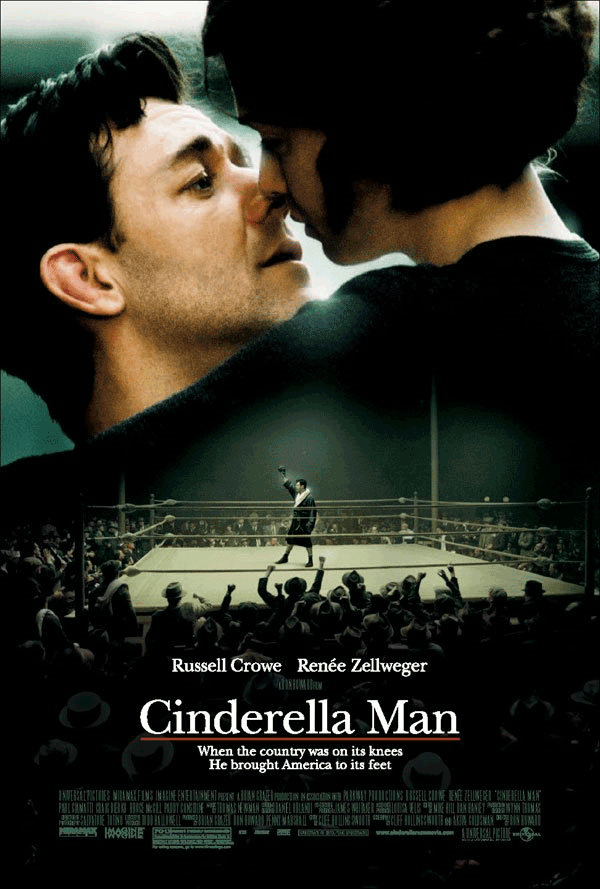
"Cinderella Man" deserves to be placed alongside other great biographical films dealing with the lives and times of great boxers. Such films include "Raging Bull," "The Joe Louis Story," "Ali," "The Hurricane," and "Ring of Fire: The Emile Griffith Story."
These films share in common not just a documentary-like approach to boxing or a superficial biopic. They also portray the human side of a modern gladiator and the culture that produced him. In the case of "Cinderella Man," we are given a detailed and heart-rending portrait of the Great Depression in American. The story of the gentleman pugilist James J. Braddock is the backdrop to the larger drama of Americans' struggle in the 1930s.
Russell Crowe provides a brilliant interpretation of Braddock, capturing the decency of a man whose career as a boxer would appear to have peaked at just the wrong time prior to the Crash of 1929. After that momentous event, Braddock's boxing went into decline just like the lives of millions of Americans. The scenes of Braddock and his family living in squalid conditions and with uncertainty about such basics as heat and electricity were carefully developed in the film. Renée Zellweger was outstanding as Mae, the caring but feisty wife of Braddock. Paul Giamatti was also excellent as Braddock's handler-manager, Joe Gould. Joe tries to keep up appearances by sporting fancy clothes. But in one revealing scene in the film when we see the interior of Joe's ostensibly swanky apartment, there is no fancy furniture other than a dowdy table and some flimsy deck chairs. Everyone is reeling from the Depression. In the depiction of the massive unemployment, the "Hoovervilles" of the homeless residing in Central Park, and the desperate need for Americans for an optimistic icon like Braddock to raise their spirits, the film truly captured the tragedy of the Great American Depression.
The film's director Ron Howard emphasized close-ups throughout the film with uneven results. In many of the boxing sequences, the close-ups and rapid editing made it difficult tell the fighters apart. The close-ups continued even into the domestic scenes and the outdoor sequences depicting Braddock working as a longshoreman. The film's dark cinematography conveyed the bleakness of the Depression years, but it worked against bringing out the buoyant spirit of Braddock himself and the optimism that he instilled in others.
Indeed, the characters and the story were the strong points of "Cinderella Man." Much credit should go to Cliff Hollingsworth for a screenplay that included thoughtful dialogue, humor, and multi-dimensional characters. Daniel Orlandi also merits praise for the brilliant costumes that helped to recreate the period of the early 1930s.
"Cinderella Man" deserves to be placed alongside other great biographical films dealing with the lives and times of great boxers. Such films include "Raging Bull," "The Joe Louis Story," "Ali," "The Hurricane," and "Ring of Fire: The Emile Griffith Story."
These films share in common not just a documentary-like approach to boxing or a superficial biopic. They also portray the human side of a modern gladiator and the culture that produced him. In the case of "Cinderella Man," we are given a detailed and heart-rending portrait of the Great Depression in American. The story of the gentleman pugilist James J. Braddock is the backdrop to the larger drama of Americans' struggle in the 1930s.
Russell Crowe provides a brilliant interpretation of Braddock, capturing the decency of a man whose career as a boxer would appear to have peaked at just the wrong time prior to the Crash of 1929. After that momentous event, Braddock's boxing went into decline just like the lives of millions of Americans. The scenes of Braddock and his family living in squalid conditions and with uncertainty about such basics as heat and electricity were carefully developed in the film. Renée Zellweger was outstanding as Mae, the caring but feisty wife of Braddock. Paul Giamatti was also excellent as Braddock's handler-manager, Joe Gould. Joe tries to keep up appearances by sporting fancy clothes. But in one revealing scene in the film when we see the interior of Joe's ostensibly swanky apartment, there is no fancy furniture other than a dowdy table and some flimsy deck chairs. Everyone is reeling from the Depression. In the depiction of the massive unemployment, the "Hoovervilles" of the homeless residing in Central Park, and the desperate need for Americans for an optimistic icon like Braddock to raise their spirits, the film truly captured the tragedy of the Great American Depression.
The film's director Ron Howard emphasized close-ups throughout the film with uneven results. In many of the boxing sequences, the close-ups and rapid editing made it difficult tell the fighters apart. The close-ups continued even into the domestic scenes and the outdoor sequences depicting Braddock working as a longshoreman. The film's dark cinematography conveyed the bleakness of the Depression years, but it worked against bringing out the buoyant spirit of Braddock himself and the optimism that he instilled in others.
Indeed, the characters and the story were the strong points of "Cinderella Man." Much credit should go to Cliff Hollingsworth for a screenplay that included thoughtful dialogue, humor, and multi-dimensional characters. Daniel Orlandi also merits praise for the brilliant costumes that helped to recreate the period of the early 1930s.
But the heart of this film experience is Russell Crowe's screen portrayal of Braddock. It was the colorful sportswriter and raconteur Damon Runyan who coined the nickname of "Cinderella Man" for Braddock. However, the real James J. Braddock was more than lucky. It was his strength of character in and out of the ring that captivated America. One of the most moving scenes of the film was a heated argument between Braddock and his wife Mae where Braddock insists that even in the most difficult of times, he would refuse to be separated from his children. As a boxer, he was fearless. But he demonstrated even more courage in fighting for family values—a lesson from which we can learn a great deal today in reflecting on this sensitive film. 9/10

"I've acted with all types, I've directed all types. What you want to understand as a director, is what actors have to offer. They'll get at it however they get at it. If you can understand that, you can get your work done."
Ronald William Howard is an American actor, film director, and producer, known for his roles on sitcoms, movies and television. Howard first earned recognition for playing Winthrop Paroo, the child with the lisp in the film version of The Music Man with Robert Preston and Shirley Jones. After The Music Man, he appeared in the role of Opie Taylor in the television series The Andy Griffith Show. There he portrayed the son of the local sheriff in the fictional town of Mayberry, North Carolina. The credits referred to him as "Ronny Howard." He also appeared in "The Courtship of Eddie's Father" with Glenn Ford
Howard is also well known for his role as Richie Cunningham in television's Happy Days on which, beginning in 1974, he played the likable "buttoned down" boy, in contrast to Henry Winkler's Fonz. He attained film success with his role as Steve Bollander in George Lucas' teen movie American Graffiti. In 1977, while still starring on Happy Days, he directed his first film, a low-budget comedy/action film called Grand Theft Auto. After leaving Happy Days in 1980, he directed several TV movies. His big theatrical directing break came in 1982 when he directed the bigger budget film Night Shift featuring soon-to-be well-known actors such as Michael Keaton and Shelley Long, and reuniting Howard with his Happy Days co-star Henry Winkler.
He has since directed a number of high-visibility films, the most acclaimed of which include Curious George, Splash, Cocoon, Apollo 13 (nominated for several Academy Awards), A Beautiful Mind, for which he won the Oscar for Best Director, and Cinderella Man. His latest film, The Da Vinci Code, has been a box office hit earning more than $700 million at the box office. Howard is the co-chairman, with Brian Grazer, of Imagine Entertainment, a major film and television production company, which has produced notable projects like Friday Night Lights, 8 Mile, Inside Deep Throat, and the television series 24 and Felicity.
Through his company Imagine Television, Howard continues to have a presence in television, most recently as the executive producer and uncredited narrator of the critically acclaimed FOX sitcom Arrested Development. The show, despite having won six Emmy awards and near-unanimous praise from critics, did not enjoy high ratings and was limited by Fox Television in 2006. A series finale took place in February, but Howard, on-screen for the first time in the show, suggested a movie version may be in the works.
Howard is also well known for his role as Richie Cunningham in television's Happy Days on which, beginning in 1974, he played the likable "buttoned down" boy, in contrast to Henry Winkler's Fonz. He attained film success with his role as Steve Bollander in George Lucas' teen movie American Graffiti. In 1977, while still starring on Happy Days, he directed his first film, a low-budget comedy/action film called Grand Theft Auto. After leaving Happy Days in 1980, he directed several TV movies. His big theatrical directing break came in 1982 when he directed the bigger budget film Night Shift featuring soon-to-be well-known actors such as Michael Keaton and Shelley Long, and reuniting Howard with his Happy Days co-star Henry Winkler.
He has since directed a number of high-visibility films, the most acclaimed of which include Curious George, Splash, Cocoon, Apollo 13 (nominated for several Academy Awards), A Beautiful Mind, for which he won the Oscar for Best Director, and Cinderella Man. His latest film, The Da Vinci Code, has been a box office hit earning more than $700 million at the box office. Howard is the co-chairman, with Brian Grazer, of Imagine Entertainment, a major film and television production company, which has produced notable projects like Friday Night Lights, 8 Mile, Inside Deep Throat, and the television series 24 and Felicity.
Through his company Imagine Television, Howard continues to have a presence in television, most recently as the executive producer and uncredited narrator of the critically acclaimed FOX sitcom Arrested Development. The show, despite having won six Emmy awards and near-unanimous praise from critics, did not enjoy high ratings and was limited by Fox Television in 2006. A series finale took place in February, but Howard, on-screen for the first time in the show, suggested a movie version may be in the works.
.jpg)
“She never gets old! Marcee can't be real; she never gets old!”
"A Beautiful Mind", based on the novel by Sylvia Nasar, is the story of John Forbes Nash Jr., the genius mathematician, whose life suddenly takes a turn for the worse when he is diagnosed with paranoid schizophrenia. After fierce battles with his inner self, he overcomes this and returns to win the Nobel Prize in 1994 for his brakethrough game theory in economics that he had been working on during his years in Princeton University in the 1950s.
"A Beautiful Mind", based on the novel by Sylvia Nasar, is the story of John Forbes Nash Jr., the genius mathematician, whose life suddenly takes a turn for the worse when he is diagnosed with paranoid schizophrenia. After fierce battles with his inner self, he overcomes this and returns to win the Nobel Prize in 1994 for his brakethrough game theory in economics that he had been working on during his years in Princeton University in the 1950s.
John Nash, portrayed very well by the versatile and brilliant Russell Crowe, is a partly shy, yet ironic and sometimes even arrogant, gifted young student studying in Princeton University in the late 1940s. He dedicates his time to numbers and equations, set on to solving every problem at hand, rather than mingling with co-students on the football field or in the pub.
We see him impolite and rude, too smart to have to attend class, lacking social skills, insulting the great ideas of his colleagues, calling their work derivative, and declaring, "To find a truly original idea is the only way to distinguish myself."
We see him impolite and rude, too smart to have to attend class, lacking social skills, insulting the great ideas of his colleagues, calling their work derivative, and declaring, "To find a truly original idea is the only way to distinguish myself."
Nash is obsessed with patterns... He spends his days writing perplexing formulas on his dormitory window in search of a breakthrough idea... He gets it one night, while out with his fellow scholars at a local bar where a stunning blond grabs their attention... He recreates the design of a classmate's tie reflecting light through glass... He follows the movements of pigeons as they compete for food... He stares obsessively at too many numbers, and reveals his natural ability helping the Pentagon crack the mathematical codes the Soviets are using...
Nash is later on introduced to Sylvia (played by Jennifer Connely), a physics student attending his classes. She helps Nash to open up and eventually discover love.Enter William Parcher (Ed Harris), a shadowy and mysterious agent working for the Department of Defense. Parcher, after realizing Nash's ability to see mathematical and geometrical patterns everywhere, approaches Nash with a mission that involves national security.
Now, amidst his work and relationship, Nash is suddenly thrown into a whirlwind of emotions and disbeliefs as he is diagnosed with paranoid schizophrenia. And this is the part where "A Beautiful Mind" truly shines: in portraying the disorder from Nash's own point of view. In a powerful and emotional way, it shows the viewer how difficult an illness like this can be to not only face, but overcome, something that people today may not always realize.
A Beautiful Mind will be considered one of the best biopics ever. It is dramatic, descriptive, detailed, reflective, enthusiastic, heroic and in all, a beautiful film. 10/10
A Beautiful Mind will be considered one of the best biopics ever. It is dramatic, descriptive, detailed, reflective, enthusiastic, heroic and in all, a beautiful film. 10/10
Mensagens antigas Página inicial
Subscribe to:
Mensagens (Atom)